Quick Summary
3D product content helps footwear and bag brands increase engagement, boost conversions, and reduce returns. Brands using immersive 3D see up to 80% more time on product pages and 29% fewer returns, making it a powerful competitive advantage for e-commerce.
From Flat To Immersive: How 3D Content Creation Is Redefining E-commerce
Online shoppers can’t pick up a shoe, flex the leather, feel the sole, or turn a bag over to inspect it. For years, brands tried to close that gap with better lighting, more angles, and higher-resolution photography, yet static 2D images still fall short.
Leading brands now replace flat visuals with interactive, photorealistic 3D experiences. Shoppers can rotate products in real-time, zoom into stitching and texture, and even place items in their own space with AR.
This guide shows you how 3D content creation works for e-commerce. You’ll see what 3D content is, and why adoption accelerates. You’ll also know how top brands deploy it across channels, and how to build a business case that scales beyond a small pilot.
Why Listen to Us

Fibbl powers 31+ million consumer interactions with 3D product experiences for footwear and bag brands, working with companies like Samsonite, Gant, Tumi, and Elten. Our platform industrializes the entire 3D pipeline, from proprietary capture hardware to automated asset creation and cross-channel distribution.
This gives us real-world expertise in helping e-commerce brands scale 3D content across large catalogs, and create photorealistic product visuals. We also help brands power AR/virtual try-on experiences, and improve engagement, conversions, and return rates.
What Is 3D Content for E-commerce, and Why Is Adoption Accelerating?
3D content for e-commerce turns physical products into digitized assets that you can render, rotate, and place in augmented reality. You can also generate images and videos from it, all from a single source file. Unlike traditional photography, a 3D asset doesn’t freeze a single moment. It acts as a living digital twin of the product.
This difference matters deeply for footwear and bag brands. A sneaker includes mesh uppers, rubber outsoles, metallic eyelets, and foam midsoles. While a leather handbag has material depth, stitching detail, and hardware reflections. 3D content creation captures that complexity and keeps it consistent across web, mobile, and AR environments.
Why 3D Content Has Taken Off In Online Shopping Experiences
3D content adoption is surging. In 2024 alone, monthly consumer interactions with Fibbl’s 3D platform grew from 160,000 in January to more than 2.3 million by January 2025. Brands no longer run small tests. They scale 3D content across active product ranges.
Several forces drive this shift. Shoppers now expect richer, more immersive online experiences. Also, AR-capable devices have become standard. At the same time, platforms like Shopify, Salesforce Commerce Cloud, and WooCommerce make 3D embedding much easier.
Brands that move early into 3D e-commerce build a content infrastructure that compounds in value. One 3D asset generates unlimited images, videos, AR experiences, and B2B sales tools from a single capture.
5 Types of 3D E-commerce Content And When To Use Them
3D content comes in several formats, each supporting a different step in the path from discovery to purchase. These are the five main types and how they perform in practice:
1. Interactive 3D Product Viewers

Interactive 3D viewers let shoppers rotate a product 360 degrees, zoom into materials, and inspect every angle directly on the product page. On the storefront, this format replaces or supplements the static image carousel. Shoppers click or drag to spin the product in real-time.
You can use it for any high-consideration product where material, construction, or design detail drives the purchase decision. For footwear, this means nearly every SKU. Using Fibbl’s interactive 3D viewer, brands can display photorealistic product models that highlight textures like leather, mesh, and rubber.
In fact, brands using Fibbl report up to an 80% increase in time spent on product pages. This is along with stronger click-through rates from product listing pages to product detail pages. The Fibbl viewer integrates easily with major browsers and more than 200 digital platforms. This allows brands to deploy interactive 3D across e-commerce, marketing, and other channels without ongoing maintenance.
2. Augmented Reality and Virtual Try-On

Augmented reality (AR) places a photorealistic 3D model into the shopper’s real environment through their phone camera. For footwear, Virtual Try-On (VTO) goes further by overlaying shoes directly onto the shopper’s feet, so they can judge style and fit before they buy.
You can use AR and VTO when fit confidence or real-world scale creates friction. Footwear brands rely on it for styles where comfort and silhouette matter, while bag brands use it when size and proportion on the body become critical. While shoppers can see how a backpack sits on their frame or how a tote looks next to their outfit. This clarity reduces returns and raises purchase confidence.
Fibbl’s AR and VTO experiences focus specifically on footwear materials and construction. So shiny patent leather, technical mesh, and other challenging materials appear as they do in real life.
3. 3D-to-Video Content
Once you turn a product into a 3D asset, you can animate it into a video without reshooting the physical item. You can generate spin videos, close-up loops, and lifestyle-style renders directly from the 3D file.
Employ 3D-to-video for dynamic product ads, social content, and email campaigns, any channel where motion outperforms stills, which, in 2026, describes most of them. With 3D product models, you produce video content faster and more cost-efficiently than with traditional production methods. Moreover, you can skip studio bookings and never reshoot when brand guidelines, backgrounds, or crops change.
4. 3D-Generated Packshots and Lifestyle Imagery

A single 3D asset can generate an unlimited number of product images. You control every angle, background, lighting condition, and file format. This includes high-fidelity packshots for e-commerce and lifestyle-adjacent renders for campaigns.
You can use 3D-generated imagery to replace or supplement traditional photography, especially when you launch new seasons or refresh your visual identity. Instead of reshooting entire collections, you can render updated visuals on demand.
Fibbl’s platform lets you generate packshots and creative imagery from the same 3D asset that powers your viewers and AR. So, you can keep consistency across your entire digital ecosystem.
5. B2B and Digital Showroom Experiences
3D assets also power B2B experiences. You share them directly with retail partners, distributors, and buyers through digital showroom tools. So, they can explore products interactively online without waiting for physical samples.
Use digital showrooms for pre-season sell-in, trade shows, and remote B2B cycles. They’re especially helpful when you manage large seasonal collections. Instead of shipping full sample sets, you can present the complete range in 3D.
This approach accelerates sell-in, and reduces sample production and logistics costs. It also helps partners experience more than just a curated subset of products.
How 3D Content for E-commerce Is Produced

Producing and deploying 3D content at scale follows four main stages.
What happens at each stage determines whether you roll out across your full catalog or stall in an expensive pilot:
Modeling and Capture
You create 3D product assets in two primary ways:
- Manual 3D modeling.
- 3D scanning.
In manual modeling, an artist builds each product in software. This method can deliver high-quality results but moves slowly and doesn’t scale. A skilled 3D artist might complete three or four products per week. But for a brand that launches 200 styles per season, that pace doesn’t work.
However, 3D scanning captures the physical product using hardware that records geometry, material properties, and color simultaneously. Different materials, such as shiny leather, matte rubber, and porous mesh, require different capture settings. On the other hand, generic scanners often produce inconsistent results across a product range.
Fibbl built its proprietary capture hardware, the Fibbl ARC, specifically for footwear and bag materials. It can scan every product with material-optimized settings to deliver sub-millimeter accuracy and true-to-life color at scale.
Reconstruction and Processing
Next, you convert raw scan data into a usable 3D asset with clean geometry, proper UV maps, and accurate materials. For brands digitizing hundreds or thousands of SKUs, this pipeline must run in a repeatable and largely automated way.
Fibbl’s reconstruction pipeline processes everything automatically, from shiny leather boots to technical mesh sneakers. So, you can receive production-ready assets without manual intervention for each product.
Embedding and Visualization
A 3D asset only creates value when it loads cleanly on a product page. Embedding 3D content requires you to handle file formats that perform across all browsers and devices. Many brands struggle here when they try to repurpose 3D assets created for other workflows like DPC or game development pipelines. That’s because those formats don’t always render correctly on the web.
But Fibbl’s platform connects directly to e-commerce environments through a single, lightweight integration and handles all format optimization automatically. You don’t need to reformat content files for each use case or platform.
Distribution
Once you embed 3D assets on product pages, you still need them to flow across marketing, social, B2B, and AR channels. So, you must share your content across channels without recreating or manually adapting it. Fibbl’s distribution platform pushes the same master asset to all digital channels and devices from one integration and scales as new platforms emerge. Creation gives you a starting point. Distribution determines whether you capture the full value of your 3D content.
Real-World Brands Using 3D e-commerce Content
Several global brands already run full-scale 3D and AR deployments, not just proofs-of-concept.
- IKEA lets shoppers place furniture virtually in their homes before buying, using AR to drive confidence in size and fit.
- Samsonite and American Tourister showcase luggage and bags with interactive 3D viewers and AR placement on their e-commerce sites.
- Apple uses 3D and AR on product pages so shoppers can preview devices like the iPhone and Apple Watch in their physical space. The experience runs seamlessly inside the standard shopping flow, not as an add-on.
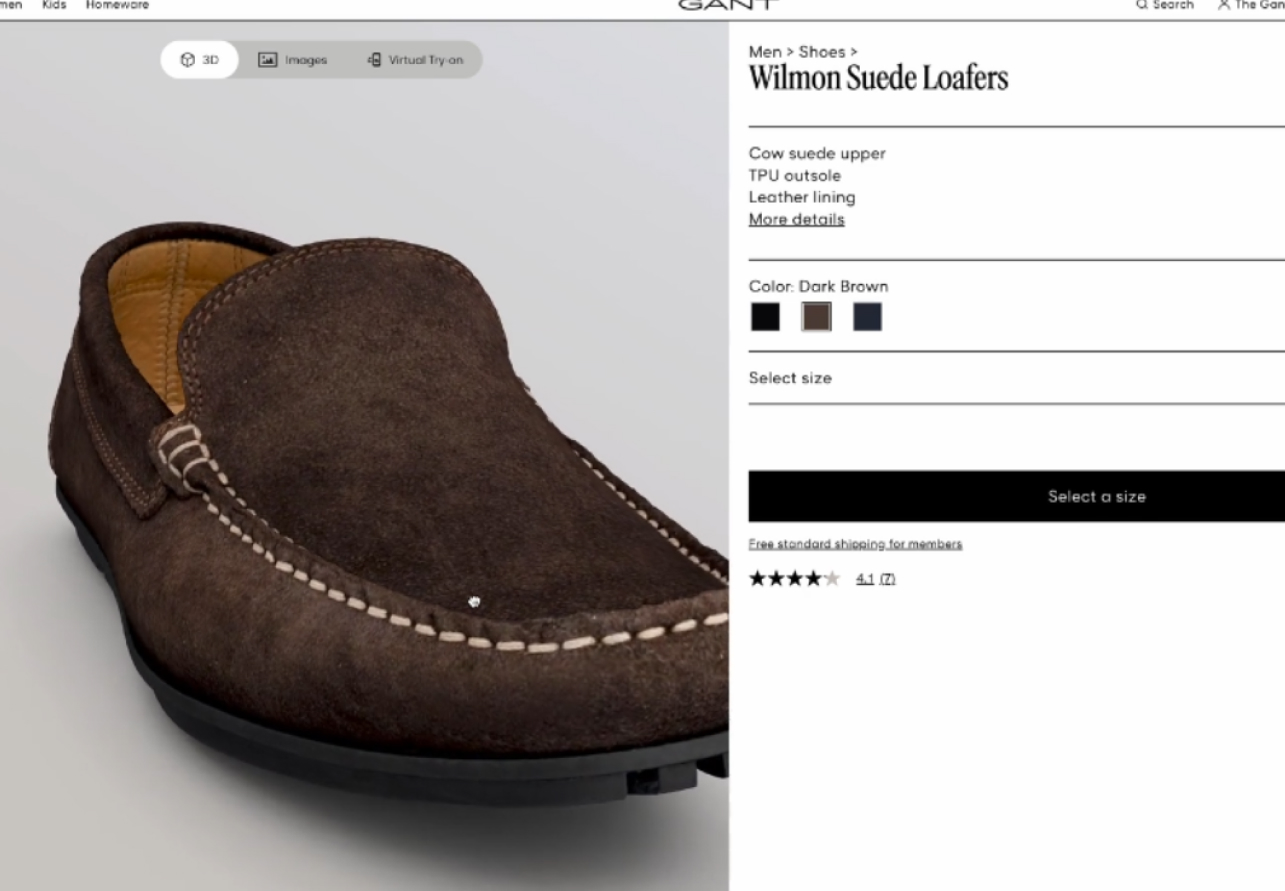
- Gant lets shoppers rotate and zoom footwear from any angle with 3D viewers and uses 3D-generated video content in paid advertising.
- Tumi offers premium bags and luggage with immersive 3D experiences, allowing shoppers to explore materials and design details at a level traditional photography can’t match.
These brands run 3D content live, indexed, and serving real shoppers across browsers, devices, and markets, well beyond experimental pilots.
Traditional E-commerce Content Creation vs 3D Content Creation
The decision to invest in 3D content creation ultimately comes down to a business case. Here’s how traditional photography and 3D content compare across the levers that matter most:
Cost
Traditional product photography eats budget through studio time, photographer fees, and endless retouching. It also requires coordination across multiple vendors, increasing administrative overhead and hidden internal costs. For a footwear brand launching 200 styles per season, the cost compounds quickly.
If you include multiple colorways, angles, on-model shots, and channel-specific crops, the costs go even higher. But with 3D content creation, you capture each product once. Every new image, video, background variation, or angle then comes from the existing asset at near-zero marginal cost. Over time, the cost per asset declines as the same 3D file continues generating value across departments and campaigns.
Time to Launch
Traditional photoshoots depend on physical samples, studio availability, and post-production timelines. The workflow is sequential. Delays in one stage cascade into the next. If a sample arrives late, the entire shoot slips. But if a colorway changes, it may require re-editing or re-shooting. Marketing calendars are often held hostage by production bottlenecks.
With 3D, once you capture the product, you can generate assets for all channels in parallel. You can produce e-commerce packshots, paid social videos, retailer-ready imagery, and product detail page content simultaneously from the same master asset. Besides, you can even create marketing assets before physical products enter full production. This accelerates go-to-market timelines and gives teams more flexibility in campaign planning.
Scalability
Traditional workflows break down under large catalogs. Shooting 2,000 SKUs with multiple angles, on-model shots, and lifestyle variants becomes logistically and economically prohibitive. Studio capacity, model bookings, and editing bandwidth create hard ceilings on output. As SKU counts rise, complexity increases exponentially rather than linearly.
Whereas an industrialized 3D pipeline scales linearly. Once the capture and reconstruction system is in place, adding products becomes a repeatable, standardized process rather than a creative reinvention each time. As an example, Fibbl can digitize entire seasonal collections of hundreds or thousands of products within compressed timeframes, season after season.
Consistency
Photography introduces variation in lighting, angle, and color rendering between shoots. Even with detailed guidelines, subtle differences accumulate across seasons and studios. Different photographers and post-production teams interpret brand standards slightly differently.
But 3D assets maintain mathematical consistency. You render every product under identical lighting and from identical angles, so your grid looks intentional and cohesive rather than stitched together from many sessions.
Content Reuse

A photograph produces a single image tied to one angle, lighting setup, and context. Repurposing it usually means cropping, re-editing, or compromising quality. But a 3D asset, by contrast, produces unlimited outputs from a single source file:
- Packshots.
- Lifestyle renders.
- Video.
- AR.
- AI-generated scenes.
- B2B showroom content.
- Social media content.
For brands managing content across e-commerce, marketing, and retail partners, the ROI grows with every new use case.
How to Implement 3D Content in Your e-commerce Store
Getting 3D content live on your storefront often proves simpler than teams expect. Focus on these areas as you plan your rollout:
Platform Compatibility
Most major e-commerce platforms, such as Shopify, Salesforce, and Magento, support 3D content through standard web technologies like WebGL and model-viewer.
But Fibbl’s integration works across more than 200 platforms with no ongoing system maintenance and deploys across all browsers and devices out of the box.
File Formats
The most common web-optimized 3D format, glTF/GLB, balances visual quality and load speed. Assets built for other workflows like DPC pipelines, game engines, and film often use formats that web browsers handle poorly without heavy optimization.
But a dedicated 3D e-commerce platform handles format conversion and optimization automatically. You don’t need to ask your dev team to manually convert and compress files per channel.
Performance
Slow-loading 3D experiences kill engagement before they start. You need optimization at every step: texture compression, level-of-detail management, and progressive loading. Fibbl’s pipeline builds for performance from the ground up, delivering lightweight assets that load fast and render at high quality on both high-end and mid-range devices.
Workflow Integration
The biggest implementation risk for footwear and bag brands comes from treating 3D as a separate, isolated workflow. Ideally, you can connect 3D assets directly to your PIM or DAM, and sync them with product catalog updates. Then, you can distribute them to all channels through a single integration instead of manual uploads. Fibbl’s platform follows this model. One connection distributes 3D assets simultaneously across e-commerce, marketing, and B2B channels.
Managing 3D Assets at Scale
Once you manage 2,000 SKUs across multiple seasons, you need infrastructure, not folders. Version control, channel-specific variants, seasonal updates, and retailer distribution all demand a system built for volume. This is where most in-house or piecemeal solutions break down and where an industrialized platform quickly pays for itself.
ROI of 3D Content: Success Stories from Real Brands
The business case for 3D content no longer sits in the hypothetical column. Brands that scale 3D across their catalogs see measurable gains.
Zach Footwear: 29% Reduction in Returns
Zach Footwear integrated Fibbl’s 3D product visualization and cut return rates by 29.4%. When customers accurately visualize material texture, true color, construction detail, and silhouette from multiple angles, they make better purchase decisions. Fewer surprises on delivery translate directly into fewer returns and meaningful margin recovery. In a category where returns often hit 20–30% on fashion styles, that shift materially changes e-commerce economics.
Gant: Conversion Lift and Ad Performance

Gant rolled out 3D-first product experiences across its footwear range and recorded a 6.3% uplift in conversion rate. Incremental gains at this level, across a full catalog, map directly to revenue. Gant also reused Fibbl’s 3D models to generate video content for dynamic product ads faster and more cost-effectively than traditional production.
Samsonite: Global Scale, Tier-One Standards

Samsonite partnered with Fibbl to bring immersive 3D and AR experiences to its bag and luggage lineup. Luggage poses a particular challenge for 3D, with telescoping handles, multi-zone zippers, spinner wheels, and diverse shell textures that all demand fidelity. The partnership proves that 3D content creation can hit the quality bar and operational requirements of global tier-one brands. Not just smaller DTC players with limited SKU counts.
Platform-Wide: 80% Uplift in Product Page Engagement
Across Fibbl’s customer base, brands that integrate 3D product experiences see up to an 80% increase in time spent on product pages. For e-commerce teams, time-on-page acts as a leading indicator of purchase intent. A shopper who spends significantly more time with a product usually builds the confidence they need to buy. At catalog scale, that engagement drives the conversion gains and return reductions that make the 3D business case self-evident.
5 Common e-commerce Content Challenges and How to Avoid Them
Most 3D initiatives stall for predictable, avoidable reasons. When you understand these patterns early, you can choose approaches and partners that sidestep them.
1. 3D Quality Is Inconsistent Across Materials
Footwear and bags include materials that challenge scanners: high-gloss patent leather, chrome hardware, semi-transparent mesh, and more.
Generic scanning hardware, and even many purpose-built scanners, often produce artifacts, color drift, and geometry errors on these materials. They create assets that look fine on simple products and unconvincing on technically complex ones.
But Fibbl built proprietary material-specific scanning technology because off-the-shelf equipment couldn’t meet the quality bar for footwear at production scale.
2. Proof-of-Concept Works, Full Catalog Doesn’t
Another common failure pattern appears when a five-product proof-of-concept works but a 500-product rollout fails. Pipelines that handle a carefully managed small batch buckle under the volume, material variety, and timeline pressure of full seasonal catalogs.
Many brands have already run through this frustrating cycle. They buy a 3D scanner, digitize a handful of products, and then meet hard limits. The root cause usually lies in the absence of an industrialized production pipeline. So, before you commit to a 3D vendor, ask for proof of delivery at production scale.
3. Assets Don’t Work Across Channels
A 3D asset built for one purpose is rigid. For example, a mobile AR experience often doesn’t convert easily for web viewers, marketing creatives, or B2B tools. File formats, polygon counts, texture resolutions, and material specifications all shift by use case.
Brands that discover this late end up paying twice: once to create and again to adapt. You avoid this by using a platform that creates assets for multi-channel distribution from day one. One source file then powers every downstream use case without per-channel conversion.
4. Internal Resistance and Organizational Readiness
The move to 3D content creation affects multiple teams:
- e-commerce.
- Marketing.
- IT.
- Creative production.
- B2B sales.
Each team already runs its own workflows and works with existing vendors. Each brings valid questions about how 3D fits into their current processes. Brands that succeed do so because they treat 3D not as a marketing experiment but as a strategic infrastructure.
They secure executive sponsorship, plan cross-functionally, and roll out in phases that prove ROI team by team. Many start with a single category or season, then scale once they show internal success and commercial results.
5. In-House Build vs Platform Decision
Large brands often attempt to build custom scanning setups and proprietary viewers. Most underestimate the engineering depth and time-to-market impact. In many cases, brands that pursue in-house development eventually return to specialist platforms. They discover that the material science, reconstruction engineering, and distribution logistics run deeper than expected.
The key question is simple:
Is 3D content infrastructure a core competency for a footwear or bag brand, or should the brand source that infrastructure from a specialist?
What to Look for in a 3D Partner
The 3D e-commerce vendor landscape includes a range of options. There are general-purpose 3D scanning hardware, manual 3D modeling studios, virtual try-on platforms, and integrated 3D creation and distribution platforms. Not every option fits the scale, material complexity, or channel mix of footwear and bag brands. Therefore, ask these questions before you commit:
- Can they handle gloss, metal, mesh, and textured rubber at consistent quality?
Difficult materials expose weak pipelines quickly. Ask for raw catalog samples, not just polished hero assets, to confirm that they can reproduce accuracy and color fidelity across real-world SKU variation. - Have they delivered full seasonal catalogs with hundreds or thousands of SKUs?
A five-product pilot doesn’t prove operational readiness. You need documented evidence of repeated production under seasonal deadlines, including turnaround times and quality controls at volume. - Do they solve creation as well as distribution?
Creation without distribution creates bottlenecks and hidden costs. The same master asset should power web, AR, marketing, and B2B without per-channel reformatting or duplicated workflows. - What is the real engineering lift and maintenance burden?
Demo performance rarely matches the reality of live e-commerce integration. Clarify implementation timelines, required internal resources, and ongoing upkeep. Look for integrations that behave as production-ready components, not custom projects. - Can they digitize every new collection reliably and economically?
3D content isn’t a one-off project. It becomes part of your content infrastructure. Economics, quality, and turnaround time must stay stable season after season without creeping costs or quality degradation.
Choosing a 3D vendor means making an infrastructure decision that touches e-commerce, marketing, and B2B performance. The right partner proves they can handle your materials, your scale, and your distribution complexity from day one.
Start Building Your 3D Content Strategy for E-commerce Today
Immersive 3D content is reshaping the competitive landscape for footwear and bag brands. Those that can scale it effectively convert more, reduce returns, and build a content engine that compounds in value with every season and across every channel. The real challenge isn’t adopting 3D, but it’s scaling it across an entire catalog without sacrificing quality, speed, or cost efficiency. That’s where Fibbl stands prominent. With proprietary capture hardware, an automated reconstruction pipeline, and cross-channel distribution, Fibbl enables brands to create photorealistic 3D assets. Then, they can deploy these assets across e-commerce, marketing, and B2B platforms from a single workflow. Book a personalized demo to see how your catalog performs in production-ready, scalable 3D.