- −50%
- Time and cost
- Packshots, one season
- +6.3%
- Conversion uplift
- 274 products, 400,000 users
- +30.27%
- Click-through uplift
- 392 videos from 196 SKUs
GANT, the premium lifestyle brand known for timeless American sportswear, has always held a high bar for quality — not just in products, but in presentation. As consumer behavior shifted and e-commerce matured, GANT faced a key challenge: how to translate the tactile richness of its footwear into compelling digital experiences.
The answer came in the form of immersive 3D. Together with Fibbl, GANT began a multi-phase journey to move from static images to fully interactive product experiences — not just as an experiment, but as a new standard.
What started as a way to streamline content production quickly evolved into a performance driver and strategic advantage. Today, GANT uses 3D across markets, channels, and teams — demonstrating how immersive product visuals can elevate both storytelling and sales. This is the story of how GANT unlocked the full value of 3D to delight customers and drive results.
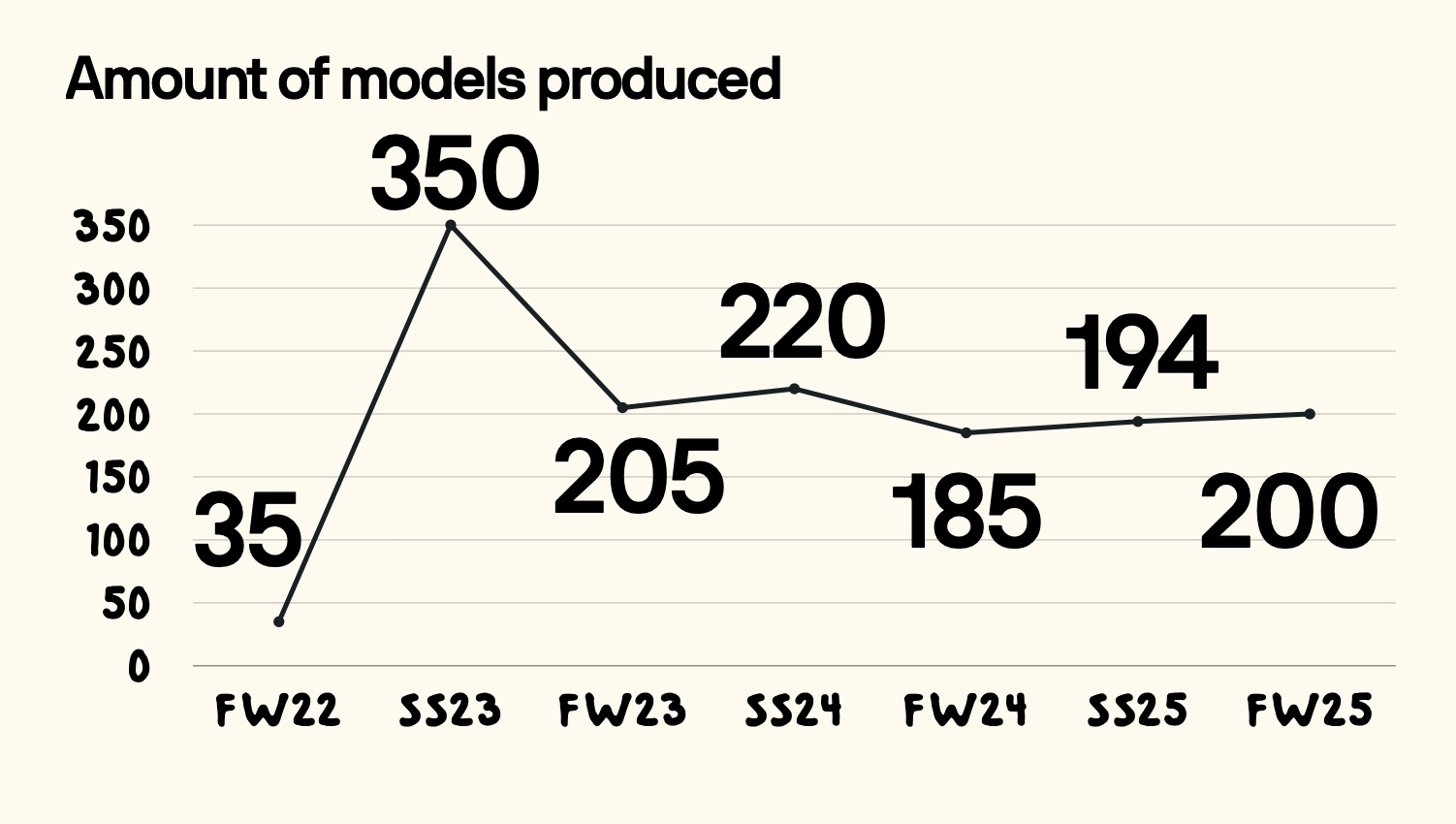
A three-year journey across three verticals.
From first steps to full rollout
Testing before scaling and standardizing
From the very beginning, GANT approached 3D not as a flashy feature, but as a potential strategic capability. And like all sound strategies, theirs began with testing. At each phase of their journey — from content creation to PDP performance to paid media — GANT committed to pilot projects before committing to scale.
- For e-commerce experience, they started out with a simple experiment on PDP where 3D and Virtual Try-on (VTO) was implemented via a button approach – to then implement 3D-First and lead with the 3D as hero content across 13 markets.
- For product imagery , they started with one season’s footwear collection to test whether 3D-generated packshots could surpass traditional photography — and they ended up halving both cost and production time.
- In paid media, they ran a controlled test of 3D-rendered videos vs. static images in Meta Dynamic Product Ads across three markets, using a clean experimental setup — and saw significant gains in CTR and ROAS.
This mindset of “test before scale” has now led GANT to roll out 3D experiences across 13 markets, with a unified pipeline powering imagery, product pages, Virtual Try-On, and paid media — all from the same 3D asset and pipeline.

A cross-functional foundation
Each test — whether in e-commerce, content production, or paid media — contributed to building a scalable foundation for the entire organization.
What began as a set of independent experiments has now become an integrated system that powers GANT’s digital presence across channels and markets. 3D is no longer a feature or campaign tool — it’s a shared resource that supports how GANT creates, sells, and communicates footwear globally.

“An argument for not making traditional product images anymore is the significant cost and time involved. If something can’t be fixed in post- production, it must be reshot. That is very expensive and time-consuming.”
Gustaf Jernberg
Production Lead
Replacing traditional photography
Improving quality while cutting time & cost in half
When GANT understood the possibilities opened up by creating a 3D model of a product – one of their goals was to modernize their visual content workflow. Traditional product photography – especially for shoes – was time-consuming, costly , and often inconsistent. Fibbl’s 3D solution allowed GANT to generate high-quality packshots directly from 3D models, minimizing the time their retouch team spend in post-production and eliminating reshoots. 3D was no longer a novelty. It became a core part of how GANT created, managed, and distributed product visuals.

Highlights from the case study
-50% time
GANT saved 50% in time by using Fibbl’s product images, needing only 1 day to approve the images, compared to 2 days using traditional photography.
-50% cost
GANT saved 50% of their expenses by not having to create product images themselves.
Improved quality
- Improved time to market
- Higher quality images
- Consistency between 2D and 3D for better customer experience
Road to 3D-First
Validating conversion impact — and making 3D the default
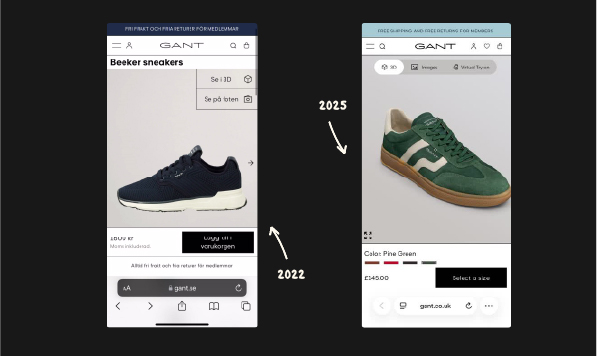
When GANT first introduced 3D on their product detail pages, it wasn’t front and center. Instead, they started small – with a button-based implementation, giving users the option to launch the 3D viewer and explore products in more detail.
Early data showed promise: even with a subtle UX/UI, some users were actively choosing the 3D option. The usage rate hovered around 3% – a modest signal, but enough to justify iteration. With small UX tweaks to visibility and interaction design, usage began to climb.
Encouraged by the trend, GANT decided to go further – not just adjusting placement, but testing a new assumption entirely: What if 3D wasn’t optional, but the default?
Putting data behind the decision
They launched a large-scale A/B test across 13 markets, covering 274 products and over 400,000 users. The test compared two variants.
- Variant A: 3D-first — the immersive viewer loads before static images
- Variant B: image-first — traditional imagery loads first, with 3D available via button
*To validate the integrity of the test, a 10% control group was also included.
The results were conclusive. The 3D-first experience drove a 6.3% increase in conversion, with 95% statistical significance. Even in the image-first group, 16% of users still chose to interact with 3D, reinforcing what GANT had suspected all along: immersive product experiences weren’t a gimmick — they were a driver of real product understanding and buyer confidence. Users who engaged with Virtual Try-On converted at even higher rates, pointing to the growing role of personalized, interactive shopping tools in fashion and footwear.
“These insights led GANT to standardize 3D-first as the default experience across their entire footwear catalog in all markets — making 3D the first thing every shopper sees. Fibbl’s technology helps address one of the biggest challenges we face in digital commerce: the difficulty of experiencing products—touching, feeling, and trying them on—through a screen”
André Lago
Global E-commerce Director
From performance to storytelling
After proving the commercial value of 3D in both production of packshots and experiences on the e-commerce, GANT extended its use of 3D models to unlock faster , more flexible brand storytelling. GANT used its existing 3D models to generate thumb-stopping and premium CGI content at a fraction of the usual effort and expense. What began as a solution for e-commerce performance evolved into a creative enabler – helping GANT tell its brand story with the same precision and quality it brings to its products.

Leveraging 3D models for better low funnel ad performance
Once GANT had proven the value of 3D on-site, the team turned their attention to paid social — using the same assets to generate motion-based product videos for Meta’s Dynamic Product Ads (DP A). Using Fibbl’s platform, 392 videos were created from 196 SKUs — all rendered in GANT’s own visual style, with 1:1 formats optimized for their DP A template. The team then ran a controlled A/B test across Sweden, Germany , and the UK to compare static images vs. product videos — using the exact same products and targeting setup.

With no other changes to audience or copy, the performance boost came down to one factor: motion. The videos stood out in feed, captured attention faster, and made it easier for users to understand the product at a glance.
+30.27%
Higher CTR
+13.79%
Higher ROAS

The uplift in click-through rate demonstrates how effective video is at capturing users’ attention. Video is a powerful format on social media, and Dynamic Product Ads are one of our most important commercial channels. Combining the two felt like a natural next step.
André Lago
Global E-commerce Director