I have been meeting with hundreds of footwear brands over the last couple of years. From global giants to start-up brands that just got off the ground.
And almost every single one of them has the same problem.
They are spending enormous amounts of money on content workflows built for a world that no longer exists. Physical samples are shipped across the globe. Photo studios are booked months in advance. Lifestyle photoshoots at the mercy of weather and logistical constraints. Content managers are buried in file management. And still, their product pages underperform.
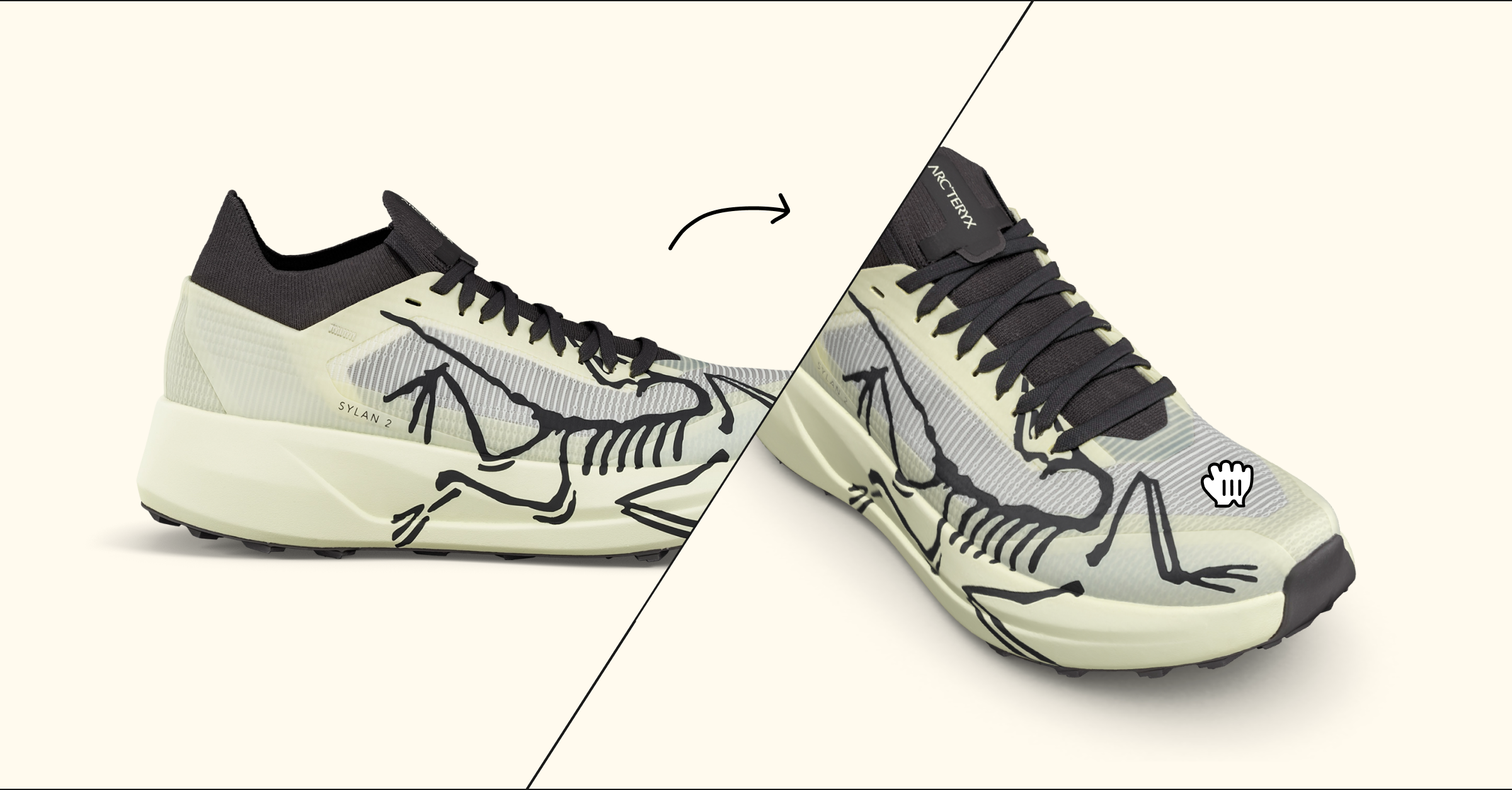
We have helped both small and large footwear brands transition their entire product range from old 2D content workflows to more efficient 3D & AI content pipelines that unlock new ways to display products and build entirely new customer journeys.
The same principles apply for both small and large brands. But the efficiency wins for larger brands are, of course, much bigger – and when successful transformations happen at scale, the numbers become hard to ignore.
In this article, I will lay out exactly how footwear brands build the business case to make the switch from 2D to 3D. Not in theory. In actual numbers.
Meet our fictitious brand
To make this concrete, I built a business case around a fictitious mid-sized footwear brand. A brand most of you will recognise – because it could be almost any brand in the mid-segment.
Here are the assumptions:
- Two collections per year – FW & SS – with 300 SKUs each, totalling 600 shoes to produce content for annually
- €50M in annual turnover, split 50/50 between B2B/Wholesale and DTC e-commerce
- All content outsourced – packshots and lifestyle imagery for both B2B sales material and e-commerce
- A global sales network supplied with physical samples every sell-in season
- Two full-time employees dedicated to managing content workflows
Let’s look at what this costs them today.
The true cost of doing things the old way
Content production: €136,000 per year
The brand outsources packshots for all 600 SKUs at €60 per SKU – that’s €36,000 per year just for standard e-commerce imagery. On top of that, they spend €100,000 annually on lifestyle imagery for campaigns, B2B sales materials, and channel marketing.
Total content spend: €136,000 per year.
That buys them static images. Images that cannot be reused across seasons. That needs to be re-shot for every new colorway. That look slightly different depending on which studio shot them, which photographer lit them, which retoucher touched them up. The “visual drift” problem that every brand with a real catalog knows all too well.
Physical sales samples: €400,000 per year
The brand produces 10,000 physical sales samples per year to supply their global sales network during the sell-in process. At €40 per pair – covering production, logistics, storage, and handling – that is €400,000 per year spent on physical objects that exist for one selling season and are then largely discarded.
And that €40 is the visible cost. The true cost, when you factor in warehousing, returns logistics, coordination, and write-offs at season end, is almost certainly higher.
People: €130,000 per year
Two full-time employees spend the majority of their time managing the content workflow. Briefing studios. Chasing deliveries. Organising files. Distributing assets to markets, retailers, and agencies. Checking consistency. Doing it all again next season.
At a fully-loaded cost of €65,000 per FTE, that is €130,000 per year of human talent absorbed by a workflow problem.
Total annual cost of the old way: €666,000
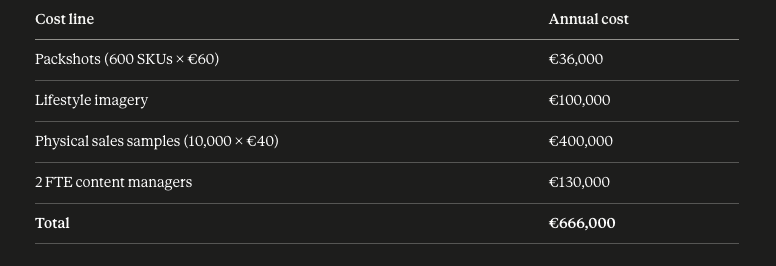
€666,000 every year. To produce content & sales samples that are already outdated the moment the next collection drops.
What is happening on the e-commerce side
Because the cost story is only half of it.
The brand’s DTC e-commerce generates €25,000,000 in annual revenue. With an average order value of €150, that means 166,667 units sold per year. And with a conversion rate of 2.2%, they need 7,575,758 product page sessions every year to generate those sales.
2.2% is right in line with the industry average for footwear. It sounds small, but it reflects a structural problem: shoppers cannot see enough. Static images taken from a handful of fixed angles cannot show the volume of the sole, the texture of the upper, the way the silhouette sits. Uncertainty breeds hesitation. Hesitation kills conversion.
What if that 2.2% could move?
The 3D transformation: what changes, and what it’s worth
Conversion rate uplift: +€1,575,000 per year
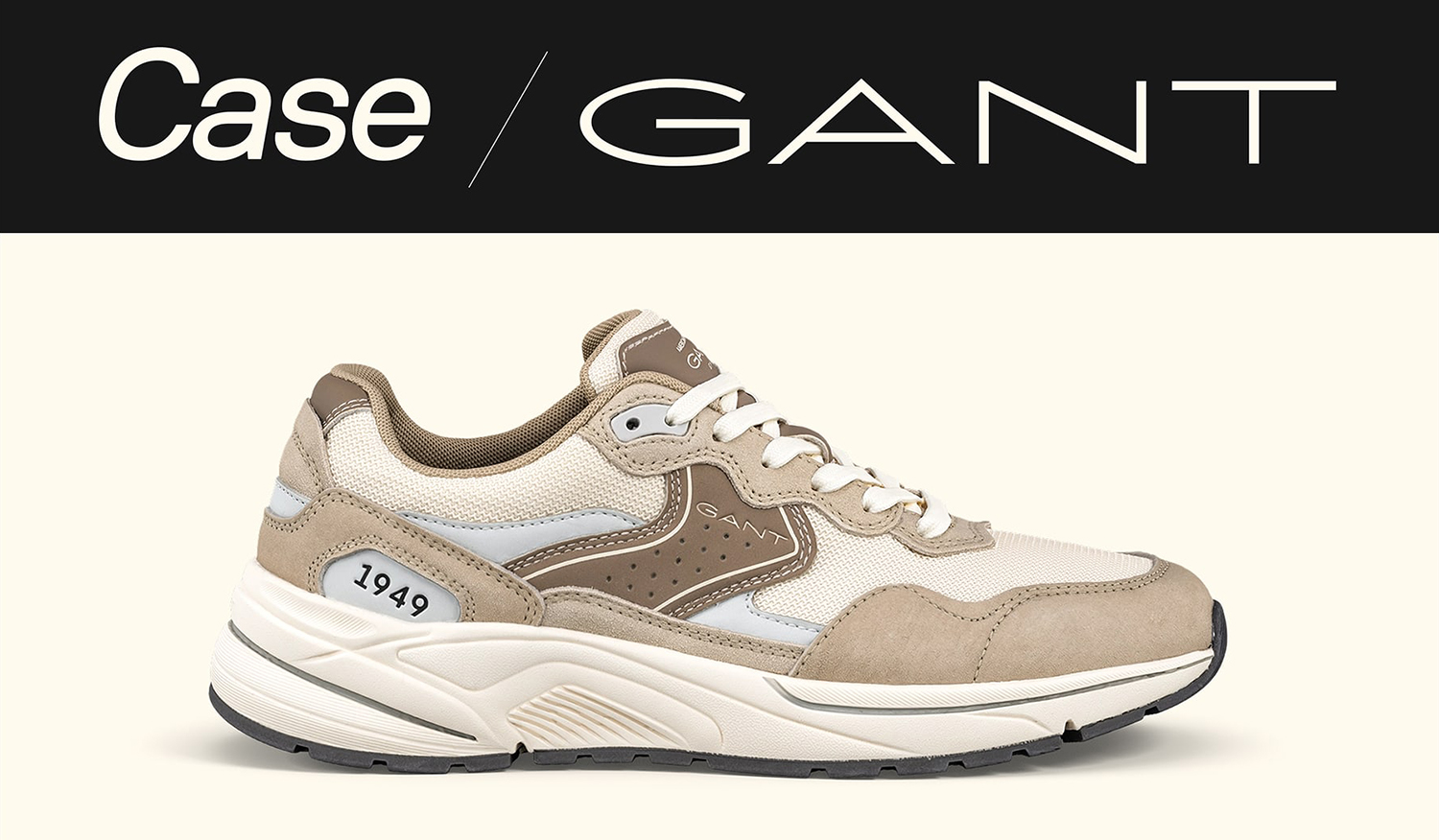
GANT – one of the brands we have worked with – achieved a 6.3% uplift in conversion rate after implementing 3D product visualization across their e-commerce. That is not a projection. That is a measured result across 13 markets.
Applied to our fictitious brand:
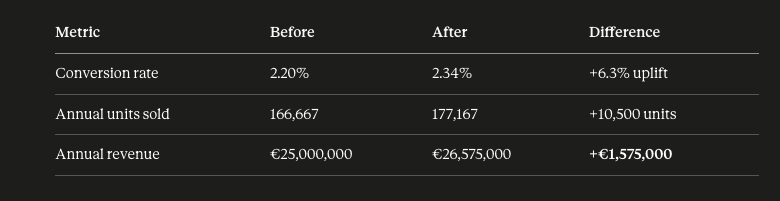
Same traffic. Same marketing budget. Same product. The only variable is what the shopper sees on the product page.
GANT also saw +30.27% CTR and +13.79% ROAS on Meta Dynamic Product Ads using 3D assets – which means the revenue uplift from 3D compounds beyond the product page and into paid media performance. The €1,575,000 figure is likely conservative.
In this scenario, I haven’t included any reduction in online product returns, which is another key metric where 3D can have a significant impact.
Sample reduction: save €200,000 per year
With 3D digital twins of every SKU in the collection, the brand can replace physical samples with digital showrooms for their B2B sell-in process. Buyers can explore every product in full 3D – rotating, zooming, inspecting materials – without a physical pair in the room.
A 50% reduction in physical samples – from 10,000 to 5,000 pairs – saves €200,000 per year in sample production and logistics costs. As digital adoption matures across their retailer network, that number can move further.
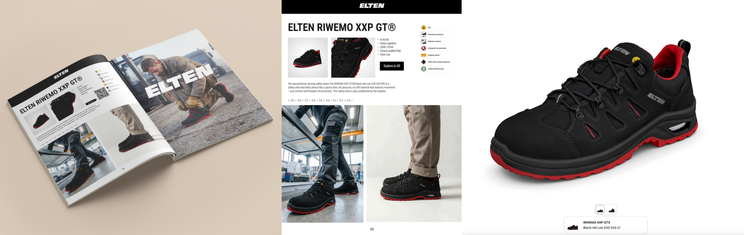
AI-generated lifestyle imagery: save €50,000 per year
With a 3D digital twin of every product already in the system, AI-generated imagery becomes a practical reality. The brand can replace 50% of their traditional lifestyle shoot budget with AI-generated scenes – product in context, seasonal backdrops, campaign-ready visuals – all produced from the existing 3D asset without a studio, a location, or a photographer.
That saves €50,000 per year on lifestyle production alone, while actually increasing the volume and variety of content they can produce.

One person redeployed: save €65,000 per year
When content is produced from a centralised 3D pipeline – consistent, structured, and ready to distribute – the workload that previously required two people can be handled by one. The second FTE is freed up to move to another department where their skills can create real value, rather than being absorbed by a logistics problem.
That is €65,000 per year of talent put to better use.
Packshots replaced: save €36,000 per year
The 3D pipeline generates packshots directly – 18 camera angles, multiple lighting presets, white background or custom – from the same digital twin. The €36,000 annual spend on outsourced packshot photography disappears entirely.
The full picture: cost of 3D vs. return on 3D
The total annual cost of 3D scanning + 3D & AI content generation platform: €88,000
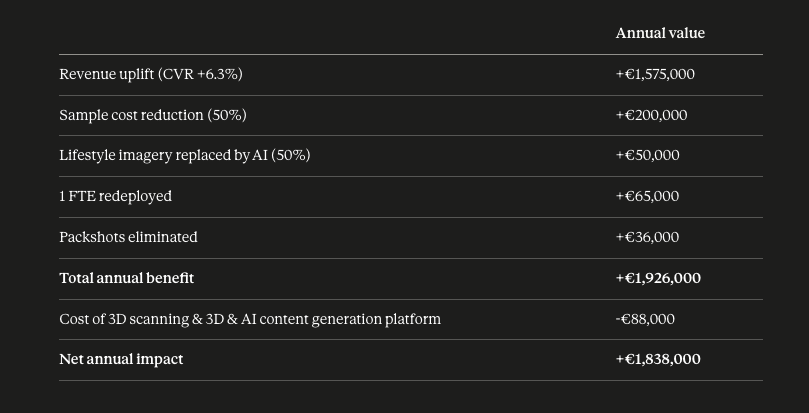
Return on investment: 21x. For every €1 spent on the 3D & AI platform, the brand gets €21 back – through a combination of cost savings and revenue growth.
This is not a technology decision
That is the thing I want to leave you with.
When footwear brands frame this as a technology question – “should we invest in 3D?” – they are asking the wrong question. The right question is: what is the cost of not doing it?
€666,000 per year on a content workflow that produces static images and disposable samples. A 2.2% conversion rate on 7.5 million product page sessions. Lifestyle shoots that need to be re-booked every season. Two talented people spending their days managing file transfers – when one of them could be doing something that actually moves the business forward.
The numbers speak for themselves.
The brands that move first have an early adopter edge while their competitors. They build leaner, more scalable content operations. They show up better in paid media. And they give their buyers – both wholesale and DTC – a product experience that static images simply cannot match.
The question is not whether 3D makes sense. The question is how much longer it makes sense to wait.
At Fibbl, we help footwear and bag brands build and deploy their entire 3D content pipeline – from scanning to e-commerce integration, AR, virtual try-on, AI imagery, and B2B digital product experiences. If you want to build a business case for your brand specifically, send me a message or book a call with me here.
Johan Bertilsson Co-founder, Fibbl – Building the content infrastructure for the next generation of footwear brands.