3D Scanner vs. Photogrammetry for E-commerce Product Content
Most 3D journeys in footwear start the same way. A proof of concept works beautifully on ten products. Then the brand tries to scale it to a full seasonal catalog or invests in its own scanning setup.
The result is that quality falls apart on reflective leather, fine mesh, or intricate stitching. While the assets exist, they do not look right. Unusable assets also do not make it to the product page, and the root of this problem is capture. Not the viewer, platform, or integration. The method used to convert a physical product into a 3D digital asset determines everything downstream. Get that right, and the pipeline works across packshots, AR, virtual try-on, dynamic ads, and B2B showrooms.
3D scanning and photogrammetry are the two main approaches to solving it. They are not equivalent, as accuracy and material handling differ. At the scale a real seasonal footwear collection demands, how they perform could not be more different.
This article explains both 3D scanning and photogrammetry. It compares them directly, and lays out what a production-grade capture pipeline actually needs to deliver for footwear and bag brands.
What Is a 3D Scanner and How Brands Use It for E-commerce Product Content?
A 3D scanner captures the physical geometry and surface properties of a product. It uses controlled light and sensor technology to do this. Unlike a camera, it does not record a flat 2D image, but builds a precise three-dimensional model by measuring the actual object.
For e-commerce product content, that distinction matters more than most brands realize. A 3D scanner does not interpret how a product looks. It measures what the product actually is. For instance, the exact curve of a sole, the texture of a suede upper, or the way light behaves on a patent leather finish. The output is a digital twin, i.e., a mathematically accurate representation of the physical product.
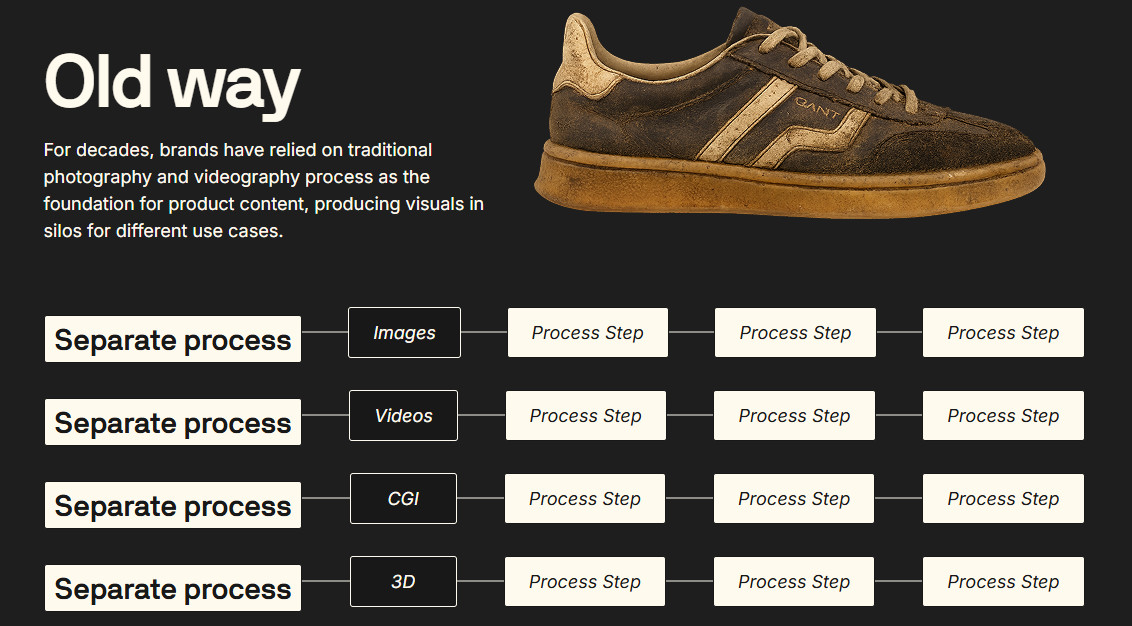
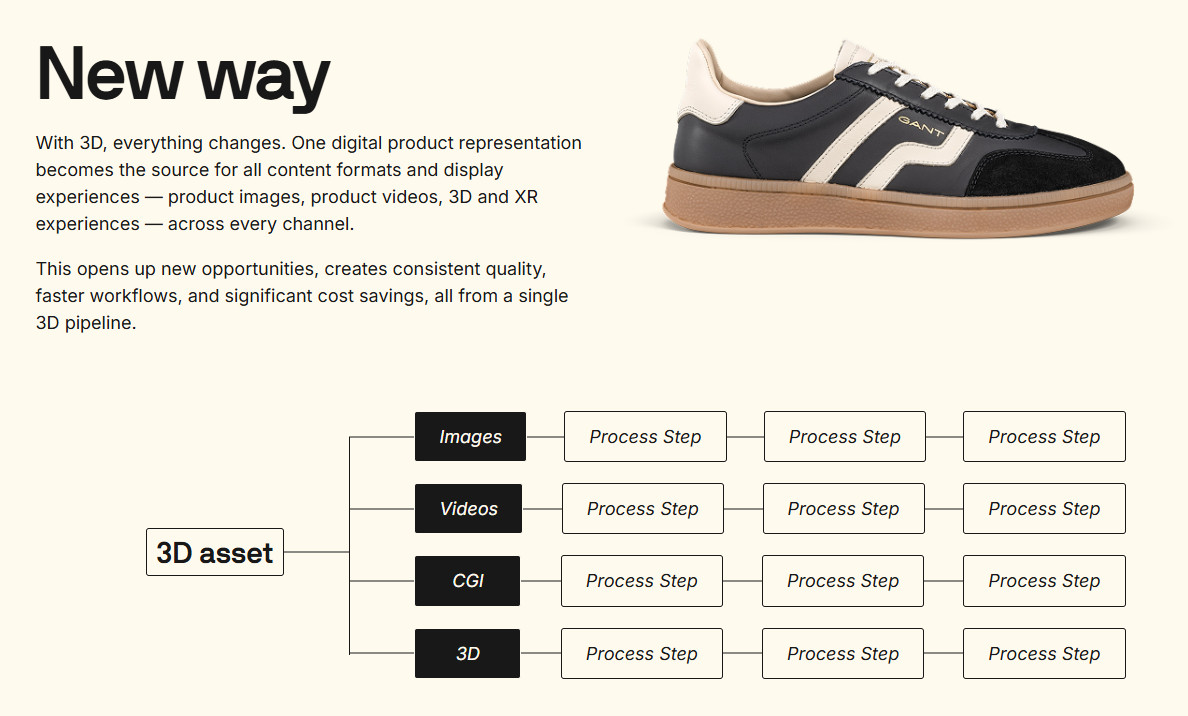
That accuracy is what makes the asset so useful once it exists. The same digital twin generates packshots at any angle. It powers an interactive 3D viewer on a product page, and feeds virtual try-on, renders motion videos, and produces AI lifestyle imagery. So, there are no reshoots, and rebuilding assets per channel.
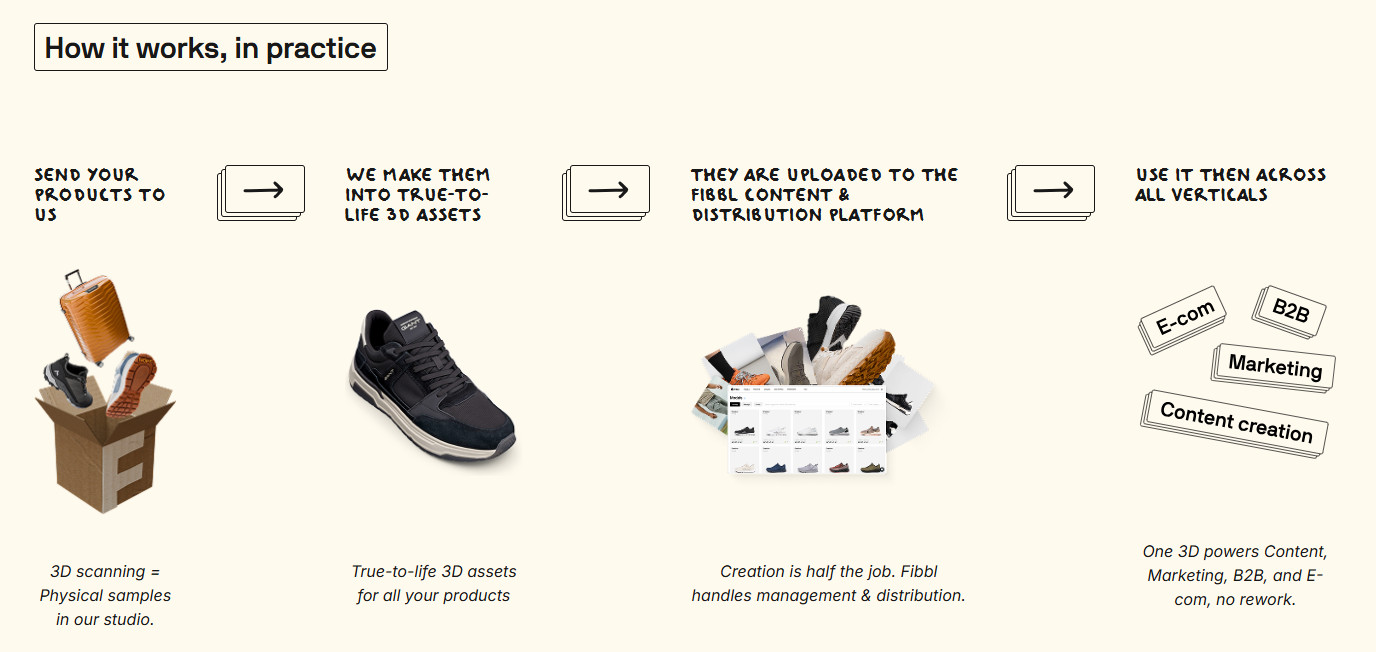
For brands managing large seasonal catalogs, professional 3D scanning is almost always a managed service. Not an in-house operation. Physical samples go to a specialist scanning studio. Production-ready assets come back that are deployable across every digital channel from a single integration. That is exactly how Fibbl’s pipeline works.
What Is Photogrammetry for E-commerce Product Content?
Photogrammetry creates 3D models from overlapping 2D photographs. Dozens or hundreds of images are taken from different angles. Software identifies common reference points across them. It then reconstructs the object as a three-dimensional mesh.
Photogrammetry is a widely used technique and, at first glance, an accessible one. The barrier to entry is relatively low, i.e., a camera, a controlled lighting setup, and photogrammetry software are enough to get started. For certain applications, particularly architectural scanning, heritage preservation, and large-object capture, it produces strong results.
In e-commerce product content, however, photogrammetry has real limitations that become harder to ignore as catalog size and quality expectations grow. The reconstruction depends entirely on the source photographs. Lighting variation between shots, reflective surfaces and fine details like stitching or mesh weaves introduce errors. A 3D artist then has to clean all of that up manually. The asset is not usable until they do.
For a brand digitizing ten or twenty hero products a season, that cleanup overhead is manageable. But for a brand with hundreds or thousands of SKUs across multiple colorways, it becomes a significant bottleneck. The process looks simple at a small scale, but it breaks down at volume.
How E-commerce Brands Use 3D Assets
To understand why capture quality matters, start here. A single 3D asset is expected to do a lot. For footwear and bag brands, a production-grade digital twin is not a one-time content piece. It is the source file for everything. Every output built from it inherits the quality captured at the start, or the lack of it.
On the product page, 3D viewers let shoppers rotate, zoom, and inspect freely, and a virtual try-on shows how a shoe looks on their own foot. While AR lets them place a bag in their own space. None of this is novelty anymore.
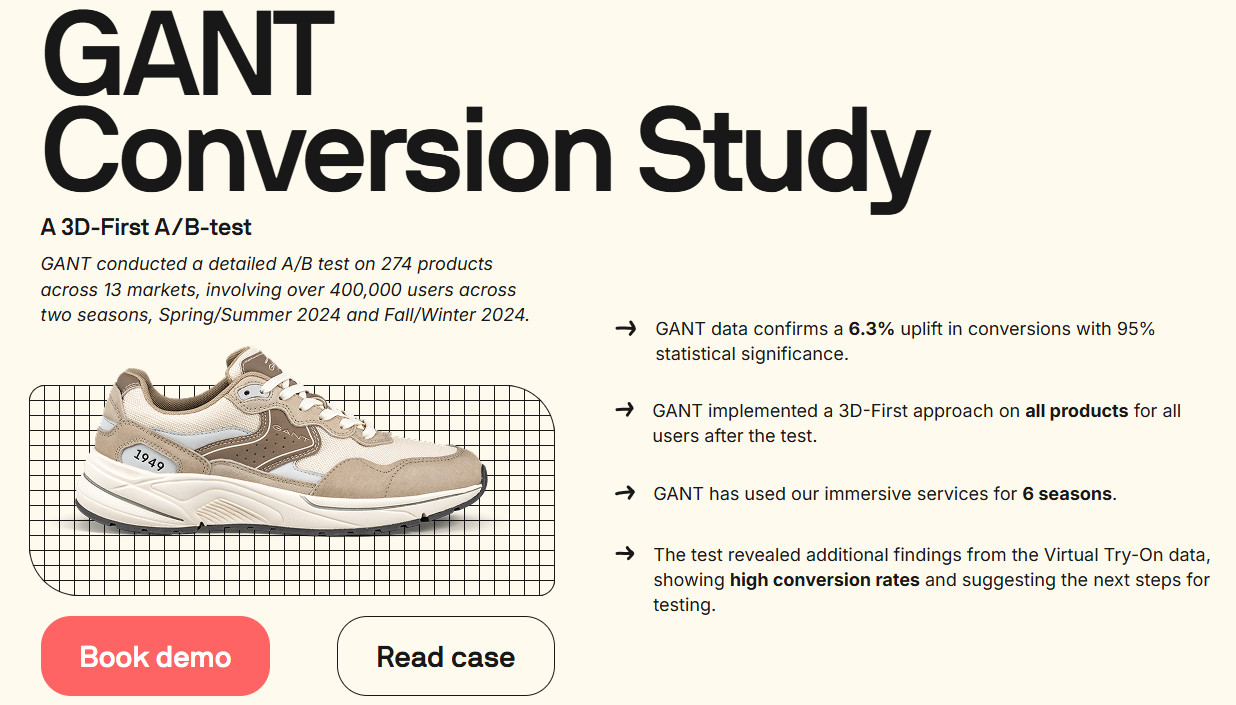
GANT tested 3D-first product pages across 13 markets and 400,000 users. Conversion increased 6.3%. Whereas Zach Footwear introduced 3D on their product pages, and returns dropped 29.4%. Product misrepresentation disappeared almost entirely as a return reason.
In marketing and advertising, a single asset can generate product videos, CGI lifestyle visuals, and on-foot shots from any angle. It also allows changes in background and lighting conditions without needing reshoots.
GANT produced 392 video assets from 196 SKUs for Meta Dynamic Product Ads using existing 3D models. The result was a 30.27% higher click-through rate and 13.79% higher ROAS compared to static images.
In B2B and wholesale, physical samples are replaced by immersive digital product experiences shared with retail partners. One capture creates a single asset that cuts costs, speeds up sales, and works across every channel.
3D Scanner vs. Photogrammetry: Key Differences
Both methods produce 3D assets. But the quality, consistency, and usability of those assets differ significantly. Here is a direct comparison across the criteria that matter most for e-commerce product content:
Criteria | 3D Scanning | Photogrammetry |
Accuracy | Sub-millimetre geometric precision | Dependent on image quality and overlap |
Material handling | Optimized per material type | Struggles with complex surfaces |
Color fidelity | True-to-life color capture | Prone to color inconsistency across shots |
Reflective surfaces | Handles with material-specific settings | Frequently fails or requires heavy correction |
Speed per SKU | Fast with an industrialised pipeline | Slower due to image capture and processing |
Scalability | Built for high-volume production | Difficult to maintain quality at scale |
Consistency | Repeatable results across every scan | Varies with lighting, setup, and operator |
Manual cleanup | Minimal with a mature pipeline | Often significant, adds time and cost |
Output quality | Production-ready across all formats | Variable, depends heavily on input quality |
Ecommerce readiness | Immediate deployment across channels | Requires additional processing and QA |
Here’s more context for the criteria we’ve shared in the table for your understanding:
- Reflective surfaces are where photogrammetry most visibly struggles. Camera-based reconstruction relies on consistent light behavior across images. Reflective or semi-reflective materials, such as patent leather, metallic hardware, or glossy synthetic uppers, disrupt this process by reflecting light unpredictably. The resulting mesh is often distorted or incomplete.
- Consistency is the hidden cost. With photogrammetry, results vary with every session. Lighting shifts, camera positioning,and operator technique, all of it introduces variation. At low volumes, that variation is manageable. Across hundreds of SKUs and multiple colorways, it becomes a quality control problem.
- Manual cleanup compounds this. Every hour a 3D artist spends correcting a mesh is an hour not spent on the next product. For brands with large catalogs and tight seasonal timelines, that overhead adds up fast.
Professional 3D scanning addresses all three through purpose-built hardware, controlled capture environments, and material-specific settings calibrated for each product type.
Fibbl’s pipeline, for example, is built per product category, with separate optimized settings for sneakers, boots, leather bags, and luggage. The result is repeatable, production-ready quality across every SKU. You can see how that works in practice here.
Why Footwear and Bags Are Difficult to Capture
Not all products are equally hard to digitize. A flat, matte surface with simple geometry is straightforward. Footwear and bags are the opposite. They sit among the most technically demanding categories to capture in 3D. Understanding why explains the reasons the capture method matters so much here:
Reflective and semi-reflective materials
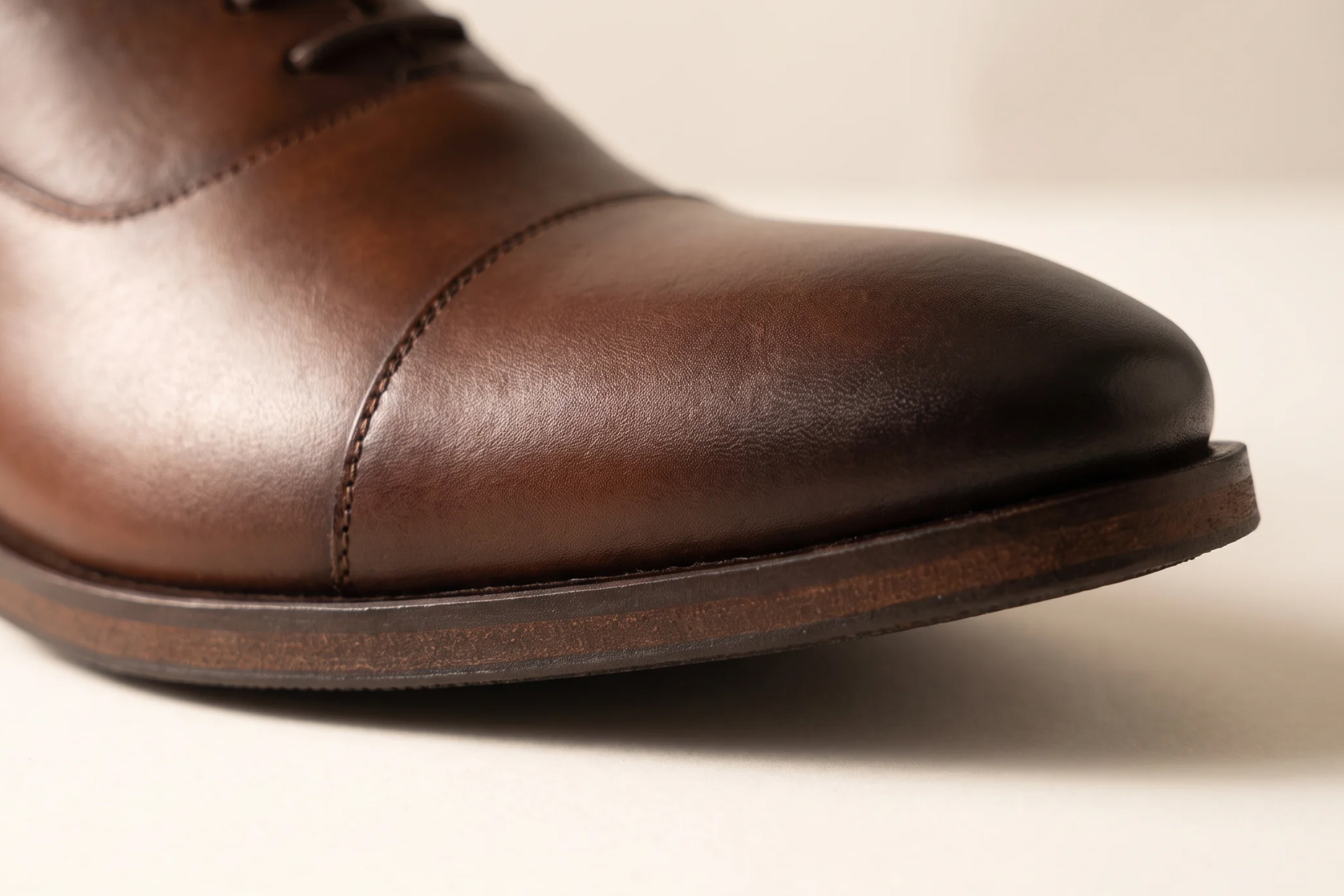
Leather is the obvious starting point. Patent leather reflects light almost like a mirror. Whereas standard smooth leather has a sheen that shifts with every angle. Photogrammetry depends on a consistent surface appearance across images.
When that surface changes with every shot, the mesh comes back wrong. Gaps, distortions, and artifacts, all require manual correction before the asset is usable. Buckles, zippers, and eyelets do the same thing, on a smaller scale, but in locations where precision matters most.
Mesh, knit, and textile uppers
Athletic footwear is built around engineered mesh, knit constructions, and layered textiles. These have fine, repeating surface structures that are easy to see with the eye. Though notoriously hard to reconstruct from photographs. Photogrammetry either smooths them out entirely or produces noisy, inconsistent geometry. Neither version works for close-up inspection or virtual try-on.
Suede and nubuck
Suede and nubuck absorb light rather than reflect it. That sounds easier. Although, it is not. The challenge is capturing the directional texture that defines how suede looks. Standard setups miss it. The result looks flat and unconvincing, which defeats the point of 3D visualization entirely.
Curved and compound geometry
Shoes are not flat. A single sneaker has compound curves across the sole, toe box, heel counter, and upper. While bags have gussets, handles, structured panels, and recessed zippers. Getting all of that geometry right requires a system built for exactly that complexity.
Colorways and consistency
Most footwear styles ship in multiple colorways. Each one gets captured individually. Results need to look consistent across the whole range. A system that drifts between sessions creates a quality control problem. One that grows with every SKU added to the catalog.
Fibbl builds a dedicated pipeline per product type. Capture settings are tuned specifically for the materials and geometry of each category, from sneakers and boots to structured bags and soft luggage. That decision at the capture stage changes the quality of every piece of content generated afterward. See the full product type breakdown here.
Which Method Scales Better for E-commerce
Scalability is where the real difference between these two methods becomes impossible to ignore. A footwear brand launching a seasonal collection is not dealing with ten products. It is dealing with hundreds of styles, each in multiple colorways, across tight production timelines, with campaign deadlines that do not move.
The capture method that works in a controlled pilot with a handful of hero products needs to perform at that volume as well. However, most do not.
The photogrammetry bottleneck
Photogrammetry is a largely manual process. Each product requires a full photography session, careful lighting setup, image processing, mesh reconstruction, and cleanup by a 3D artist. Even with experienced operators, that pipeline produces a limited number of finished assets per day. When quality issues arise, and with complex footwear materials, they frequently do, assets go back for correction. That adds days, sometimes weeks, to production timelines.
Brands that have tried to scale photogrammetry in-house consistently hit the same wall. A team of 3D artists producing three to four finished assets per week cannot keep pace with a catalog of 200 styles per season. The math does not work.
What an industrialized scanning pipeline changes
Professional 3D scanning, when built around an industrialized production pipeline, operates differently. Capture is fast, controlled, and repeatable. Material-specific settings also mean fewer errors entering the pipeline in the first place. Automated reconstruction reduces the manual cleanup burden significantly. The result is a system that can process large volumes of SKUs within seasonal timelines without sacrificing quality.
This is the operational reality that separates a genuine 3D content strategy from a proof of concept. Fibbl was built specifically to solve this problem. It is the only platform purpose-built to scale 3D asset creation to thousands of footwear and bag SKUs season after season. Brands like GANT have standardized 3D-first across their entire footwear catalog across 13 markets as a direct result. Read about GANT’s full 3D journey here.
Why Capture Quality Impacts Final Content Quality
There is an assumption underlying many 3D investment decisions, that the viewer, the platform, or the integration determines the quality of the final customer experience. It is an understandable assumption. Those are the parts customers interact with directly. But the actual determinant of content quality is the asset itself, and it is only as good as the capture that created it.
Packshots and product imagery
When a brand generates packshots from a 3D model, the output inherits everything from the underlying asset. Accurate geometry means clean silhouettes and correct proportions, and accurate material representation means colors and textures look true to life.
A model with reconstructed errors, smoothed-out textures, or inaccurate surface properties produces packshots that look slightly off. Not obviously wrong, but not quite right either. In a category where customers make purchase decisions based entirely on digital visuals, even a slight deviation is enough to hurt conversion.
AI-generated imagery
AI image generation is now standard for lifestyle shots and campaign visuals. The quality traces directly back to the 3D model it was generated from. A geometrically inaccurate base model produces distorted, unrealistic AI imagery. Regardless of how sophisticated the generation model is. The output is only ever as good as what went in.
Augmented Reality and Virtual Try-On
AR and virtual try-on are unforgiving formats. When a product is overlaid onto a real environment or placed on a real foot, any inaccuracy in geometry or material becomes immediately visible.
It can be a sole that curves slightly wrong, a texture that does not respond to light correctly, and an upper that looks flat instead of structured. These are not details customers consciously analyze. But they register, and they erode the confidence that AR and virtual try-on are supposed to build.
This is why Fibbl’s pipeline is engineered around sub-millimeter accuracy and true-to-life material reproduction from the capture stage. Every downstream output, packshot, AI image, AR, virtual try-on, and dynamic video is built on that foundation.
See the full range of outputs here.
When Photogrammetry Still Makes Sense
We focused on the limitations of photogrammetry in the context of large-scale footwear and bag e-commerce. But intellectual honesty requires acknowledging where it still makes sense, like:
Smaller brands with low SKU counts
A brand launching 15 to 20 styles a season, with relatively simple materials and no immediate plans to scale, may find photogrammetry a practical starting point. The upfront investment is lower, and the workflow is accessible. At that volume, the manual cleanup overhead is manageable.
Experimentation and proof of concept
For brands that are early in their 3D evaluation and want to test the concept internally, photogrammetry offers a low-barrier entry point. It allows them to experiment before committing to a full production pipeline. Photogrammetry is a reasonable way to build an internal understanding of 3D workflows before making larger decisions.
Non-reflective, geometrically simple products
Photogrammetry performs best on matte, diffuse surfaces with simple geometry. If a brand’s catalog fits that profile, the quality gap narrows considerably. In a nutshell, photogrammetry works. It has real applications and legitimate use cases. For footwear and bag brands managing full seasonal catalogs and complex materials, it is rarely the right foundation. Not for a production-grade content strategy.
What E-commerce Brands Should Look for in a 3D Capture Provider?
Choosing a 3D capture provider is not just a technology decision. It is an operational one. The right partner does not just deliver good-looking assets on a test batch. They deliver consistent, production-ready quality across your entire catalog, season after season, without becoming a bottleneck in your content workflow. Here is what actually matters when evaluating a provider:
Scalability
Can they handle your full SKU count within your seasonal timelines? Ask specifically about throughput, not just quality. A provider that produces exceptional results on twenty products but cannot scale to two hundred is not a production partner. It is a vendor for hero content.
Category expertise
3D capture for footwear and bags is not the same as 3D capture for furniture or electronics. The materials, the geometry, and the downstream use cases are different. Look for a provider whose pipeline is built specifically for your product category, with demonstrated results across the full range of materials your catalog includes.
Output formats and channel readiness
Production-ready assets should be immediately deployable across e-commerce, marketing, and B2B channels without additional processing. Ask what formats are included in delivery, and whether the assets are optimized for web performance out of the box.
End-to-end capability
The most operationally efficient setup is one where capture, processing, and distribution are handled within a single integrated system. Providers that only solve part of the workflow, either capture without distribution or distribution without capture, create integration gaps. Those gaps typically end up requiring additional work from your internal team.
Proven results in your category
Case studies matter. Not generic 3D case studies, but evidence of measurable outcomes for footwear and bag brands specifically, like conversion lift, return rate reduction, and content production savings. These are the metrics that justify the investment internally and indicate a provider that understands how 3D performs in your specific context.
Fibbl was built to meet every one of these criteria for footwear and bag brands specifically. See how it works or get a free product scan to see the quality firsthand.
Conclusion
The opportunity for 3D in footwear e-commerce is real, with proven gains in conversion, returns, and content cost savings. But everything depends on capture, not the platform or viewer. 3D scanning and photogrammetry are not the same.
Scanning delivers consistent, high-accuracy results even for complex materials like leather, mesh, and suede. While photogrammetry is cheaper to start with, it struggles to scale and often breaks on reflective or detailed surfaces.
For footwear and bags, this matters because these products are complex, seasonal, and produced in large volumes. Poor capture leads to unusable or inconsistent assets downstream. The brands seeing real results chose the right capture pipeline from the start.
Fibbl supports this with industrial 3D scanning built specifically for footwear and bags, and an end-to-end workflow from capture to distribution. It also offers a free product scan so brands can test quality before committing.
Get your free product scan here or book a demo to check out what a full pipeline looks like for your catalog.