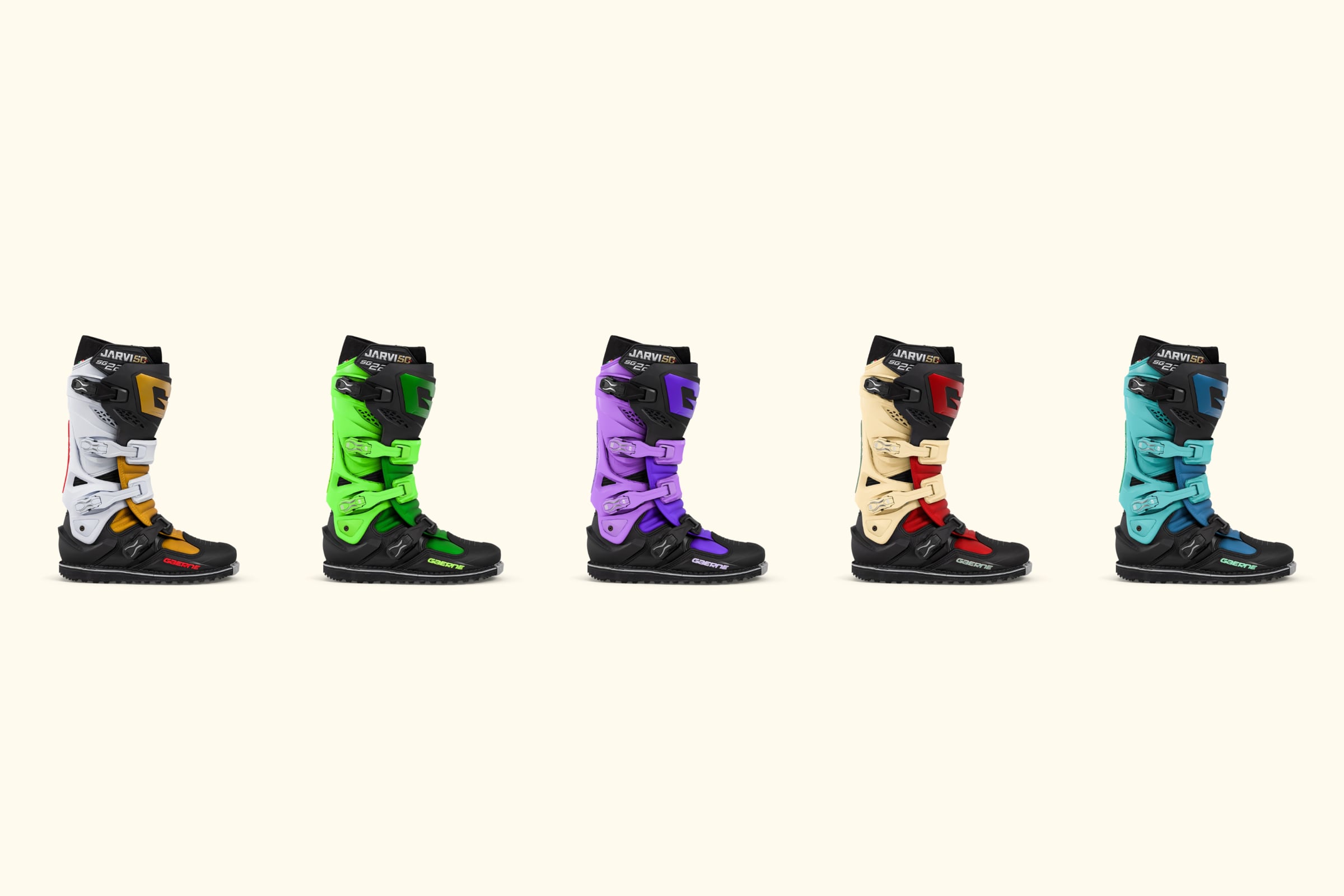
Quick Summary
The footwear market has reached a critical saturation point, making it increasingly difficult for individual brands to stand out. To maintain a foothold, companies are aggressively adopting digital solutions to sharpen their competitive edge and improve how they connect with customers.
Rising Competition in the Footwear Space
The footwear market has never been more crowded or competitive. In fact, the AI-based shoe market size is expected to grow to $747.87 billion in 2030 at a CAGR of 17.5%. This shows how brands are firing on all cylinders to digitize faster, sell smarter, and retain customers more effectively.
Unsurprisingly, the window for differentiation is shrinking. 25 leading names in fashion and footwear, including Nike, Gucci, and ASOS, are now using AI to transform user retail experiences. This article shows what e-commerce challenges footwear brands are facing and how AI is being adopted widely to counter that.
Why Listen to Us
Fibbl has worked with over 60 footwear and bag brands, handling more than 50 million user interactions and digitizing over 18,000 shoes into 3D assets. This gives us strong real-world data on how immersive product content impacts sales and returns.
Unlike general platforms, Fibbl focuses specifically on footwear and bags, so our insights are based on real category performance rather than broad retail trends.
E-commerce Challenges Footwear Brands Are Facing
E-commerce growth is exposing cracks in how footwear brands operate. Returns, rising marketing expectations, escalating costs, and 3D content demand from customers are all converging into a margin problem. This is turning once-viable workflows into inefficient, expensive bottlenecks in a digital-first market. But first, let’s address the elephant in the room: Returns:
Returns
IAMBIC founder Maeve Wang, while talking to Forbes, said, “The fashion [industry] overproduces by up to 40% each season,” with footwear “among the most returned online categories, with fit as a leading reason.” Robbie Thompson, founder and CEO of Zach Footwear, went as far as to say, “Fighting returns is a nightmare.”
According to Statista, footwear is one of the most returned product categories in e-commerce, and fit uncertainty is the leading reason. According to their data, shoes see high return rates due to size and fitting mismatches. Shoppers simply cannot tell how a shoe truly looks, fits, or feels from a flat, static image.
According to Statista Consumer Insights data, 17% of U.S. respondents say they’ve returned shoes purchased online in the past 12 months alone, highlighting a persistent gap between expectation and reality.
Customer Expectations
Today’s footwear shopper expects more than a product page with a static image. They want to rotate, inspect, zoom, and try the product in AR before pressing ‘add to cart.’ With 44% of European consumers already using virtual try-on (VTO), online behavior has shifted toward immersive, interactive experiences.
Cost Pressure
Traditional product photography is slow, expensive, and difficult to scale. For brands managing thousands, or perhaps even hundreds, of SKUs per season, the math just doesn’t add up. For a mid-sized footwear brand, a single photoshoot can easily exceed $5,000 to $15,000.
When scaled across multiple product lines and seasonal launches, traditional photography quickly becomes a major budget constraint. On top of that, every reshoot due to a brand guideline update, or even just a regular seasonal inventory refresh, can cost 25–50% of the original shoot budget, every time.
Content Demand
The volume of content required to remain competitive across e-commerce, social media, and B2B digital showrooms is growing every season. A single product requires packshots, lifestyle images, and video ads, each produced separately under traditional workflows. That fragmentation not only raises costs, but also reduces efficiency.
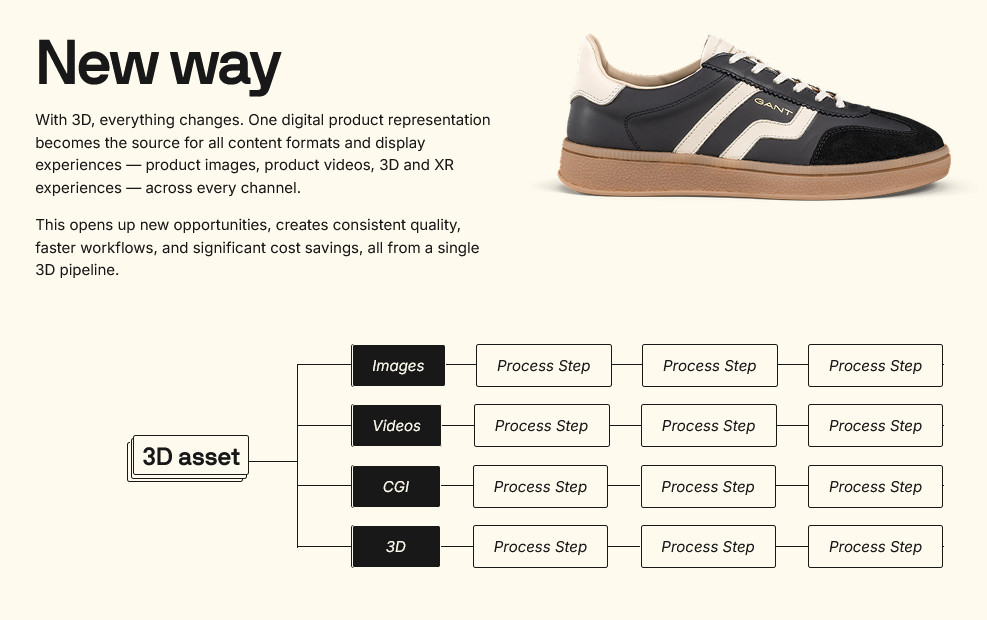
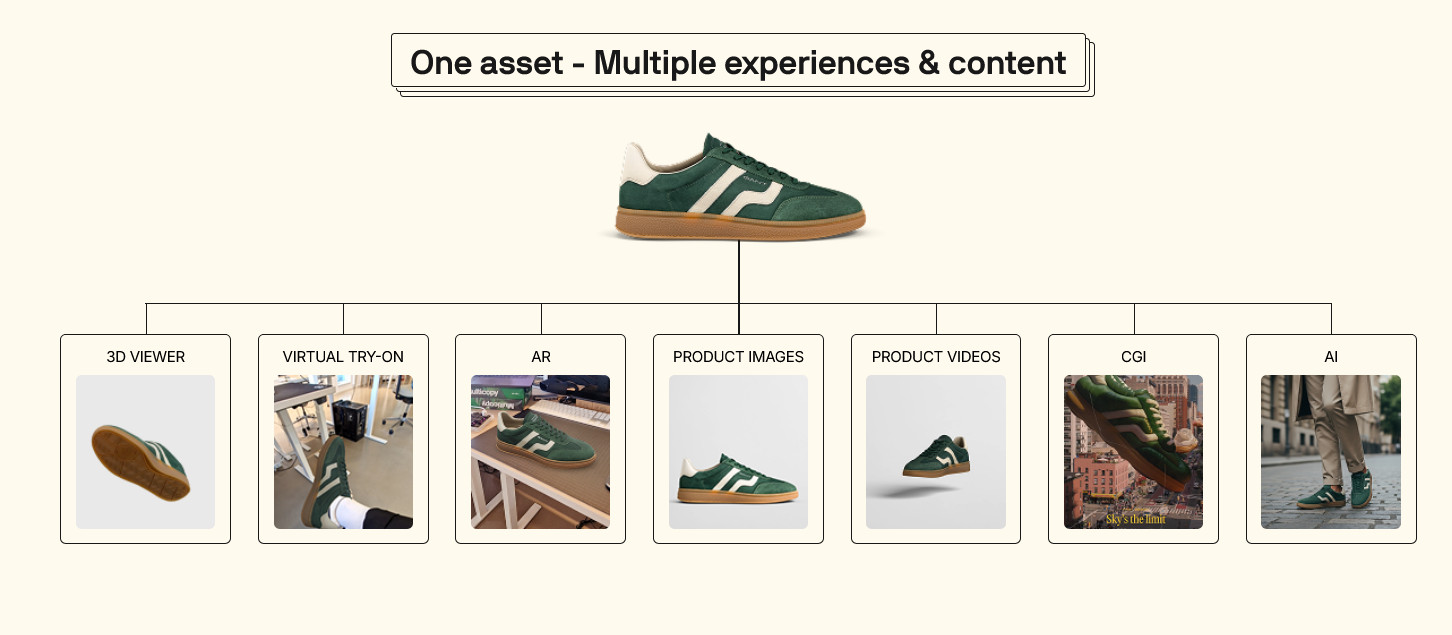
In this modern marketing landscape, brands need a smarter production model. Fibbl offers exactly that by generating images, video, CGI, and 3D content from a single 3D asset within a unified pipeline, rather than across multiple separate pipelines. This streamlined process allowed GANT to cut both time and cost by 50%.
What AI Means for Footwear Brands Today
First, let’s get one thing out of the way: AI is not a single tool. Rather, it’s a comprehensive marketing stack reshaping how footwear brands design, produce, and sell in 2026. The question is no longer whether to adopt AI, but how to deploy it in the most efficient way:
Generative AI
Generative AI allows footwear brands to create design variations, lifestyle imagery, and ad content at a speed and volume that was previously impossible. Fibbl, for example, can produce studio-quality product images from 3D assets in just around 60-70 seconds, reducing both time-to-market and photoshoot expenditures.
Computer Vision
Computer vision is delivering measurable operational gains across the footwear supply chain. On factory floors, AI-powered cameras perform real-time quality control, identifying defects that human inspectors routinely miss.
While on the consumer side, computer vision enables virtual try-on and AR product placement, allowing shoppers to see footwear on their own feet before purchasing. This directly addresses uncertainty and purchase anxiety, the primary driving factors behind returns.
Automation
Automation is reshaping footwear manufacturing and content production simultaneously. Swiss brand ON made headlines earlier this year for its revolutionary “LightSpray” technology. Traditionally, a footwear product is touched by as many as 200 hands on the production line, but LightSpray can produce it in as little as 3 minutes.
Outside of footwear manufacturing, automation enables companies like Fibbl to generate packshots, lifestyle images, and dynamic video ads, all from a single 3D asset. This eliminates the manual workflows that have historically made scaling prohibitively expensive, slow, and tedious to roll out across a large catalog with thousands of SKUs.
Key AI Use Cases in Footwear
From design studios to digital storefronts, AI is being deployed across the footwear value chain. But not every application delivers equal commercial impact. For brands looking to drive measurable outcomes on conversion, returns, and content efficiency, three use cases stand above the rest:
AI for Product Content Creation
Traditional photography is expensive, slow, and difficult to scale across a full catalog. Whereas AI-powered platforms can generate studio-quality packshots and lifestyle images from a single 3D asset, completely bypassing photo shoots while maintaining visual consistency across SKUs.
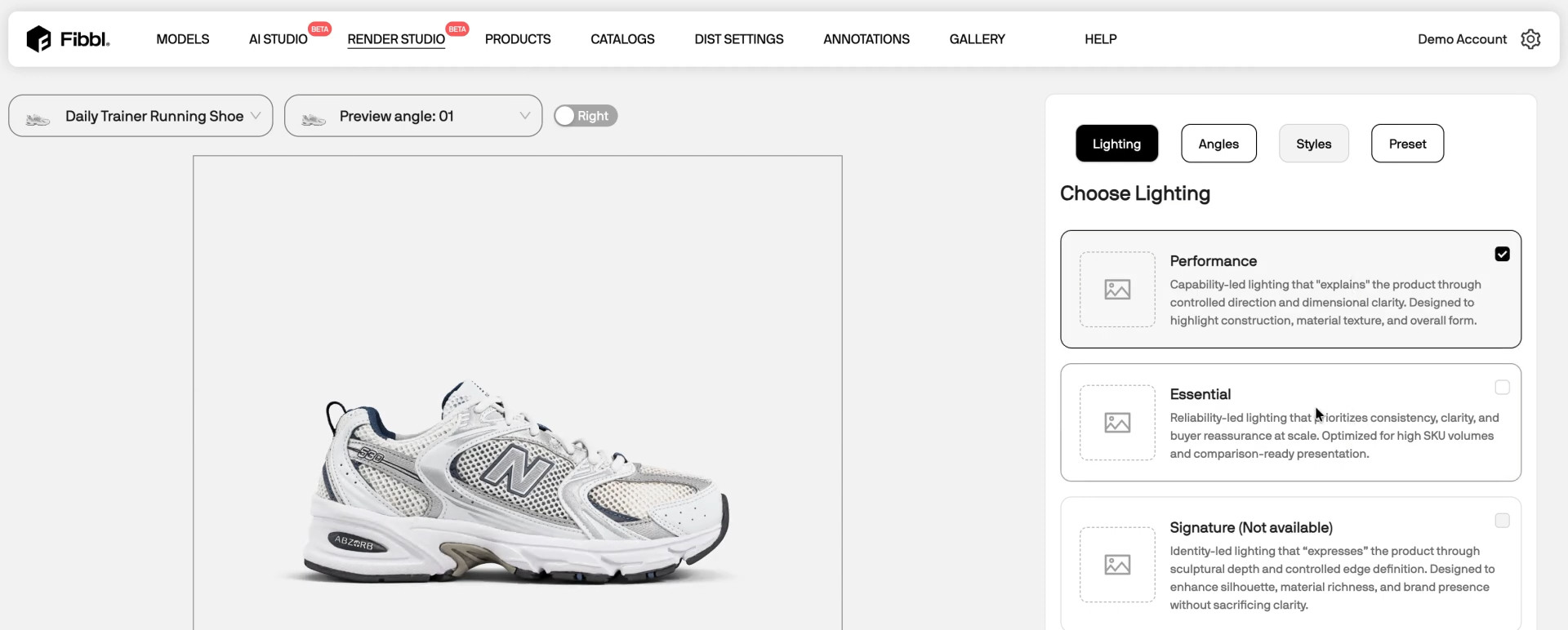
Instead of sending products to a 2D studio, brands can send them directly to Fibbl. The Fibbl ARC 3D scanner, purpose-built to capture complex footwear materials like leather, mesh, rubber, suede, and textiles, creates true-to-life digital twins of products with sub-millimeter accuracy. Once uploaded to the platform, anyone on the team can create product images for multiple use cases using the user-friendly Fibbl Render Studio.
AI for Footwear Design
According to a study by the National Library of Medicine, between 63% and 72% of people currently wear ill-fitting shoes, leading to painful conditions such as calluses and bunions. AI is now changing that.
IAMBIC, an AI footwear company, uses machine learning to map more than 20 biometric foot variables. They claim their AI maintains a 98% fit accuracy rate and has processed over 50,000 scans since launching in 2020. Thanks to AI, a fully custom-made shoe that would traditionally cost between $3,000 and $10,000 now starts at just $550.
AI for Supply Chain and Consumer Insight
As much as 30% of global apparel production, including footwear, is never sold at full price, with more than a third ultimately marked down to cost. The result is widespread margin erosion, as inventory fails to convert at full retail value. AI is changing that.
McKinsey research shows that using AI for demand forecasting can reduce supply chain errors by 20–50%. This leads to major business gains, including up to 65% fewer lost sales from stockouts, 5–10% lower warehousing costs, and 25–40% better administrative efficiency.
On the consumer side, AI tools like Shopify Sidekick streamline day-to-day operations by analyzing store data, assisting with order management, and generating product content. Similarly, AI add-ons for WooCommerce enable instant customer support through chatbots, and generate SEO-friendly product descriptions.
AI for Personalized Shopping Experiences
Virtual try-on is the most direct application of AI to the personalized shopping problem. It lets customers see footwear on their own feet in real time, from any device, before they buy, eliminating the guesswork that drives returns.
The numbers behind it are hard to ignore. Shoppers who engage with virtual try-on are 45% more likely to purchase on their first visit. Shopify data shows that brands using VTO see a 40% decrease in returns, while one case study recorded a 52% increase in purchases after deployment.
Consumers also spend 2.5x longer on product pages featuring 3D content, and 61% are more likely to return to brands that offer AR experiences.
Why Product Content and Personalized Shopping Are the Biggest AI Opportunities
For brands already selling online, two AI applications offer the best return: content creation and personalized shopping. While backend tools like AI design or automated supply chain management have their uses, content and personalization happen right at the very end. The “buy or bounce” moment.
Both content creation and personalized shopping don’t just optimize the business; they directly drive sales, and the numbers speak for themselves. Brands with rich, immersive product content have witnessed the following numbers:
- 80% increase in time spent on product pages.1
- 6.3% CVR uplift.1
- 30.27% improvement in CTR.1
- 13.79% in return on ROAS.1
- 10.9% ATC uplift.2
- 52% increase in purchases.3
- 2.5x uplift on Shopify PDPs.4
The data is self-evident: AI product content produces better business outcomes.
Benefits of AI for Footwear Brands
Footwear, being part of a broader fashion industry, is defined by speed, shifting trends, and razor-thin margins. In this environment, an effective marketing strategy is crucial. Here is how AI is transforming footwear branding, streamlining production, eliminating content bottlenecks, and improving commercial performance:
Efficiency, Speed, and Competitive Edge
At a broad level, AI helps footwear brands make smarter design decisions and improve how products are created. It also simplifies manufacturing and allows brands to react much faster to changes in the market compared to traditional methods. Additionally, AI-driven forecasting enables more accurate alignment between supply and demand, reducing excess inventory and overproduction.
From Content Bottleneck to Commercial Performance
Interactive 3D content increases time on page by up to 80%. Immersive product pages lift add-to-cart rates, click-through rates, and first-purchase likelihood, all within the existing e-commerce infrastructure, with no app download or additional friction required.
Real Examples of AI-Powered Product Experiences in Footwear
Theory is one thing; commercial validation is another entirely. Across multiple markets and brand tiers, AI-powered product experiences are consistently producing measurable performance gains that are increasingly difficult to overlook. Here are some real-world use cases of footwear brands integrating AI in their stores:
- GANT
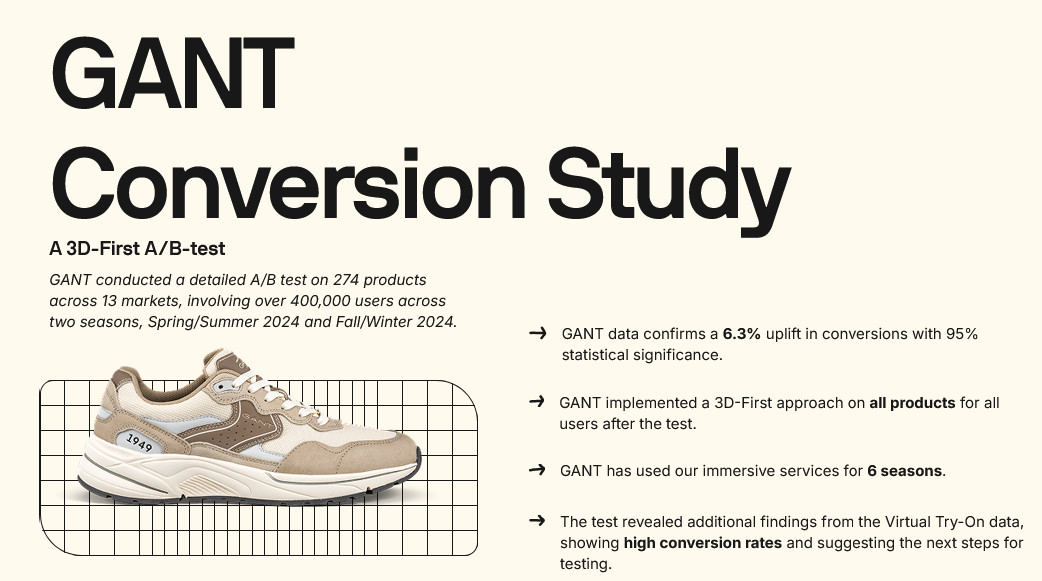
GANT ran what is arguably the most comprehensive 3D-first e-commerce test on record. Across 274 products, 13 markets, and 400,000+ users, 3D product experiences delivered a 6.3% conversion lift with 95% statistical significance. GANT has since digitized 1,349 shoes and fully transitioned from 2D photography to 3D for six consecutive seasons.
- ZACH
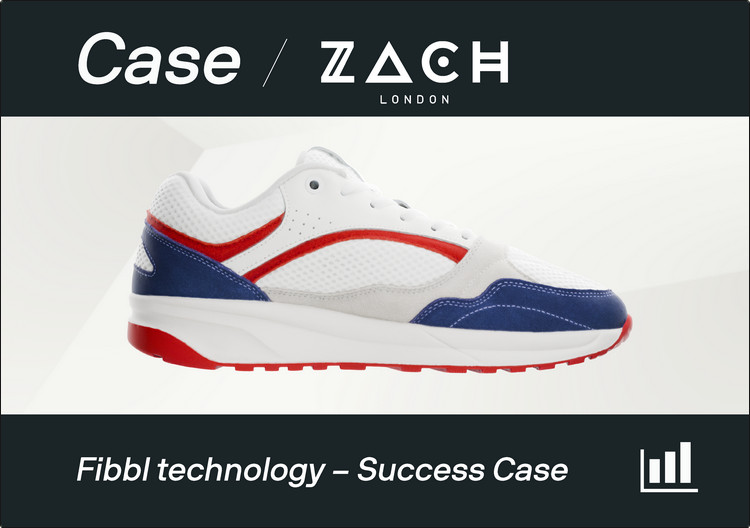
Zach Footwear recorded a 29.4% reduction in returns after deploying 3D and virtual try-on. This was significant enough that the brand reallocated its entire traditional photography budget toward expanding its 3D strategy.
- Nubik
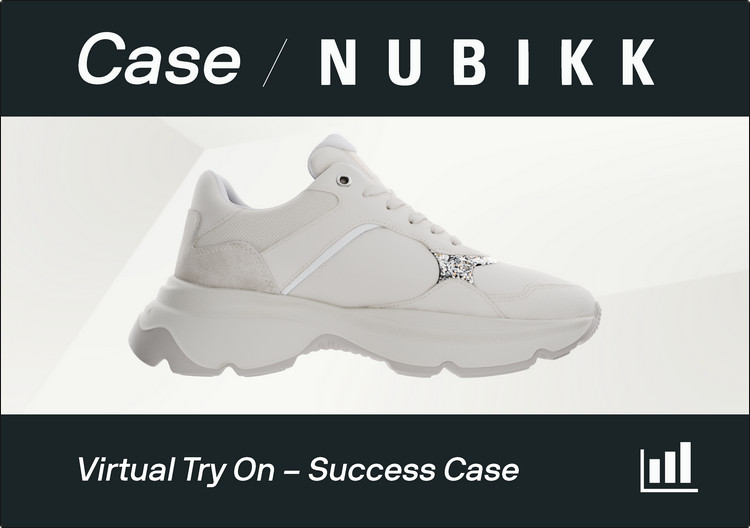
Nubikk, a Dutch footwear brand, ran a controlled split test by sending half of its website traffic to the old interface as a baseline. The other half was shown a new 3D user interface to compare performance and user behavior between the two versions. The brand observed a 12% increase in click-through rates, alongside a 52% uplift in transactions, all thanks to VTO.
Conclusion
The competitive pressure in footwear is not easing. If anything, it’s compounding by each passing day. AI is no longer a fancy, new trend to be monitored from a distance. It’s a commercial lever being actively pulled by the brands leading the footwear space.
Success today requires shifting from manual workflows like traditional product photoshoots to an AI-powered scalable content solution, like Fibbl. It’s built specifically for footwear and bags. By combining 3D scanning with automated content creation, we replace slow, costly workflows with faster and more scalable digital production. This helps brands turn product content into a real growth driver while delivering better ROI.
To save you time and effort, we’ve identified The Best AI Tools for Product Photography in our guide here.