Quick Summary
Visual commerce is the use of rich visuals, from photography to 3D, AR, and virtual try-on, to sell products online. For wearable products like footwear, 3D paired with AR and try-on has the highest impact. It lifts conversion and cuts returns. This guide covers what it is and how to implement it.
Online shoppers cannot touch a product, feel the material, or try it on. Visual commerce closes that gap. It uses rich visuals, from photography to interactive 3D, AR, and virtual try-on, to make an online product feel real. For footwear and other wearable goods, getting this right decides conversion.
This guide is a practical map. What visual commerce is, the technologies inside it, why 3D sits at the core for wearable products, and how to roll it out. We build 3D product visualization experiences for footwear and bag brands, so the examples are grounded in real results.
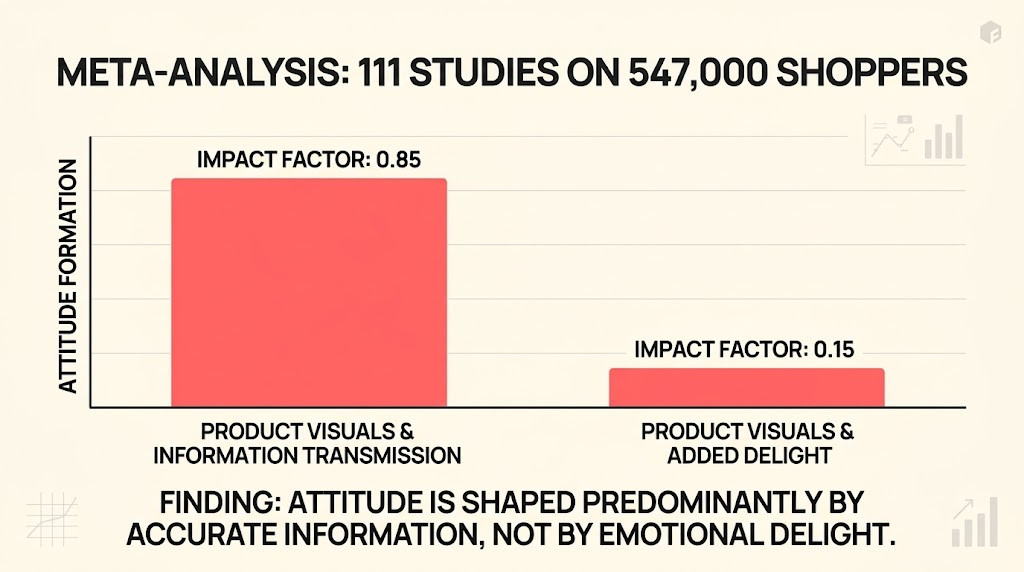
The stakes are not soft. A peer-reviewed meta-analysis of 111 studies and over 547,000 shoppers found that product visuals shape attitude mainly by transmitting information, not by adding delight. In plain terms, better visuals help people decide. Better decisions mean more sales and fewer returns.
The shift is already underway. Shoppers now expect to explore products, not just view them, and the brands that meet that expectation are pulling ahead.
What Is Visual Commerce?
Visual commerce is selling online through rich, interactive visuals, not flat images alone. It lets a shopper see and explore a product before they buy.
It covers a family of technologies:
- 2D and 360-degree photography
- Interactive 3D models
- Augmented reality and virtual try-on
- AI-generated product lifestyle imagery
- Product video
- Product configurators
- Shoppable user-generated content
Each one does the same job. It gives the shopper a clearer, more honest view of the product. The thread running through all of them is information. Visuals sell because they answer questions. What does the material look like? How does it sit? How big is it? The richer and truer the visual, the more it answers.
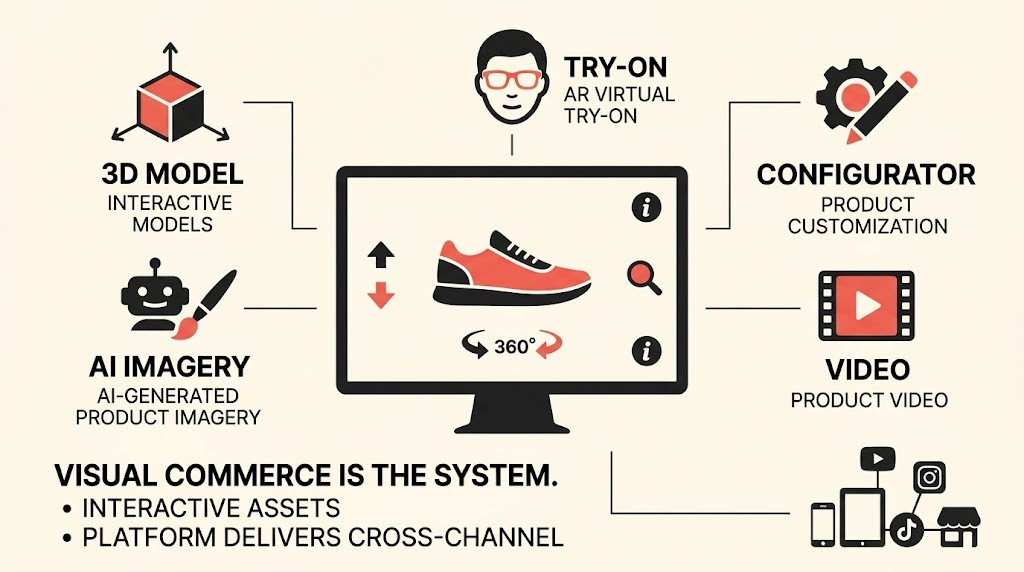
You’ll hear related terms like immersive commerce and 3D commerce. They both describe the deeper end of the same idea. There, the shopper explores a product in three dimensions instead of scrolling static photos. A visual commerce platform is simply the system behind it. It makes these assets and delivers them across your channels.
Keep in mind, visual commerce is not just better product photography. Photography is one input. Visual commerce is the whole system. The interactive assets, plus the platform that ships them everywhere.
Why Visual Commerce Matters for Ecommerce Brands
The problem is simple. A shopper on a product page decides with less information than they would have in a store. They cannot pick up the shoe. Visual commerce narrows that gap, and the payoff shows up in two numbers. Conversion goes up, and returns come down.
The reason is practical, not decorative. The same meta-analysis we cited earlier found utilitarian value predicts purchase intent more strongly than hedonic value, 0.511 against 0.467. Shoppers reward visuals that help them decide more than visuals that look impressive. Fit and accuracy beat novelty.
Returns are the other half of the equation. When the product matches the image, fewer orders come back. When it does not, they do. For footwear, where fit and material drive most returns, accurate visuals directly affect margin.
Independent, fashion-specific research backs this. A study found AR raises dwell time and conversion and reduces returns, while expecting physical and digital to combine rather than replace each other.
The mechanism is confidence. A shopper who can inspect a product from every angle and see it on their own foot stops second-guessing. Confident shoppers convert, and they return less.
The Core Technologies Inside Visual Commerce
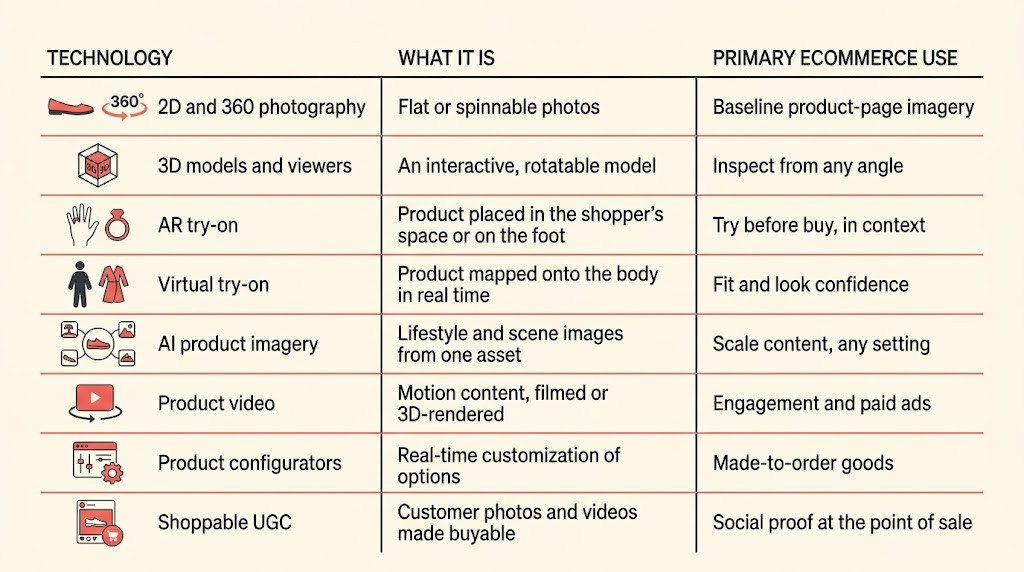
Visual commerce is not one tool. It is a stack. Here is each technology, what it does, and where it earns its place.
Technology |
What it is |
Primary ecommerce use |
|---|---|---|
2D and 360 photography |
Flat or spinnable photos |
Baseline product-page and PLP imagery |
3D models and viewers |
An interactive, rotatable model |
Inspect from any angle |
AR try-on |
Product placed in the shopper's space or on the foot |
Try before you buy, in context |
Virtual try-on |
Product mapped onto the body in real time |
Fit and look confidence |
Lifestyle and scene images from one asset |
Scale content, any setting |
|
Product video |
Motion content, filmed or 3D-rendered |
Engagement and paid ads |
Product configurators |
Real-time customization of options |
Made-to-order goods |
Shoppable UGC |
Customer photos and videos made buyable |
Social proof at the point of sale |
2D and 360-degree product photography
Photography is the baseline. Flat images and a 360 spin still anchor most product pages. On-body, assembled shots tend to outperform flat lays for general shoppers, though highly fashion-involved buyers can prefer flat lays. Match the shot to the audience, and produce enough angles, each doing one clear job.
Done well, photography still pulls its weight as the entry layer.
3D product models and interactive viewers
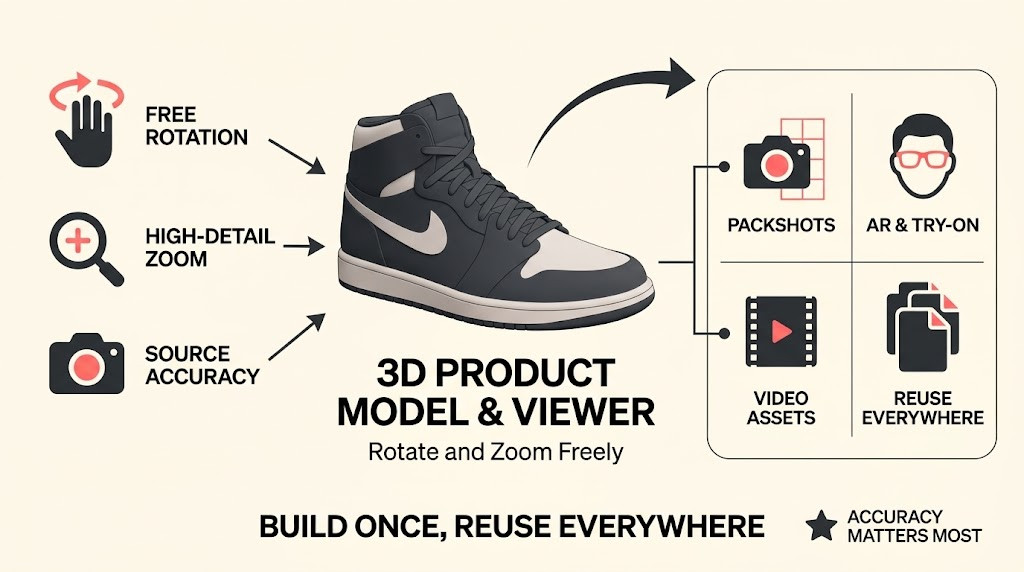
A 3D model lets the shopper rotate and zoom the product freely. This is the heart of 3D commerce. One accurate model becomes the source for packshots, AR, try-on, and video, so you build once and reuse everywhere.
It is also the asset every other technology depends on, so accuracy here matters most.
Augmented reality (AR) try-on
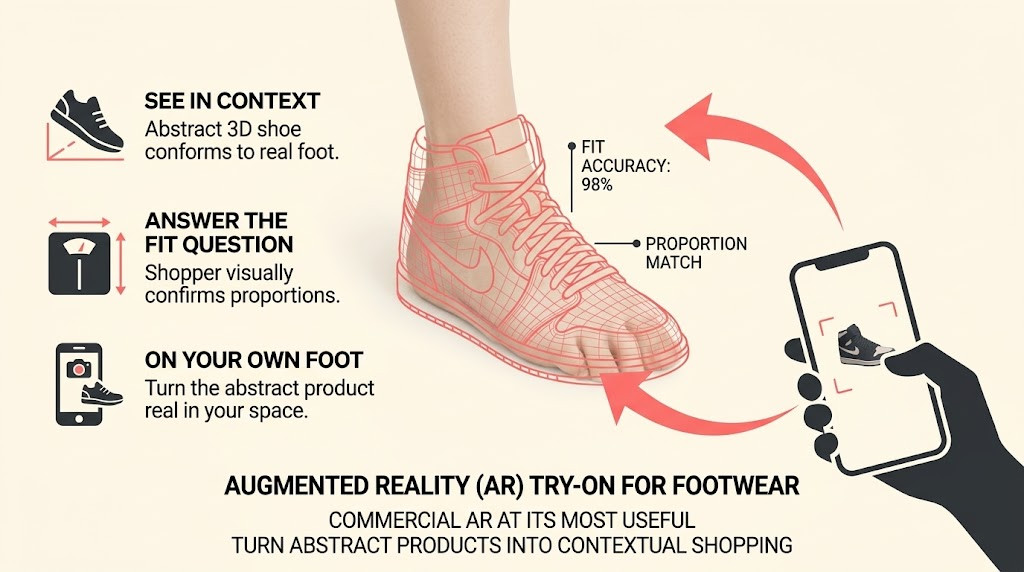
AR places the product in the shopper's own space, or on their foot, through a phone. It is commercial augmented reality at its most useful, turning an abstract product into something the shopper sees in context. For the deeper technical picture, see our AR shoe try-on guide.
For footwear, AR turns the fit question into something the shopper can answer themselves.
Virtual try-on (VTO)
Virtual try-on maps the product onto the shopper in real time. For footwear, the shoe appears on the foot as they move. It attacks fit uncertainty directly, which is why it moves conversion and returns. We compare the options in our virtual try-on software roundup. Run a Woocommerce-powered store? We have a solutions guide for that as well.
It is the closest an online shopper gets to standing in front of a mirror.
AI-generated product imagery
AI imagery generates lifestyle and campaign shots from an existing asset, without a photoshoot per scene. From one 3D capture, you can produce the product in any setting. See how AI images work from a single asset.
That means a summer set and a winter set from the same shoe, with no reshoot.
Product video
Video comes in a few forms. Traditional lifestyle and product shoots, and fully 3D-generated motion rendered from an existing asset. The traditional route is slow and shot per SKU. The 3D route is different. You generate dynamic, catalog-wide video without a new shoot every season. GANT did exactly this, producing 392 video assets from 196 SKUs and lifting click-through by 30.27% and ROAS by 13.79%. Read more.
That is the difference between filming every SKU and generating them from assets you already have.
Product configurators
Configurators let shoppers customize options in real time, like a sofa fabric or a car trim. They suit made-to-order and highly configurable goods, such as furniture. For finished wearable products like footwear, they are rarely the point, and they are not the focus of this guide.
Naming them keeps the guide honest, even though they sit at the edge of what most footwear brands need.
Shoppable user-generated content
Shoppable UGC turns customer photos and videos into buyable posts. It adds social proof at the moment of decision. It complements the technologies above rather than replacing the accurate product view they provide.
Think of it as the trust layer on top of the product layer.
What Visual Commerce Looks Like in Practice
Put together, these technologies change what a product or collection page does. Instead of a strip of flat photos, shoppers get an experience. They spin the shoe, zoom into the stitching, place it on their foot with AR, and watch a short product video, all without leaving the page.
The strongest visual commerce examples combine several layers. GANT runs 3D-first product pages and generates catalog video from the same assets. Zach Footwear pairs 3D with virtual try-on to cut returns. A bag brand adds AR so shoppers can judge size in their own hands: one asset, several experiences, one consistent product.
None of this asks the shopper to download an app or learn anything. They tap, spin, and try, the way they already use a phone. That low friction is why these experiences convert, not just impress.
Why 3D Commerce Is the Core for Wearable Products
For physical, wearable products, 3D paired with AR and virtual try-on is the highest-impact visual commerce technology. More than configurators, more than UGC. Wearable products are judged on fit, material, and how they look in use, and only 3D-based experiences answer all three.
The evidence here is unusually strong. Across 1,099 effect sizes, 111 studies, and 547,415 participants, the single strongest driver of the AR and VR customer experience was the perceived quality of the visual asset, at a path coefficient of 0.623. The experience is only as good as the asset behind it. A rough model undermines the whole thing.
Premium brands feel this most, since a poorly rendered flagship product reads worse than no 3D at all.
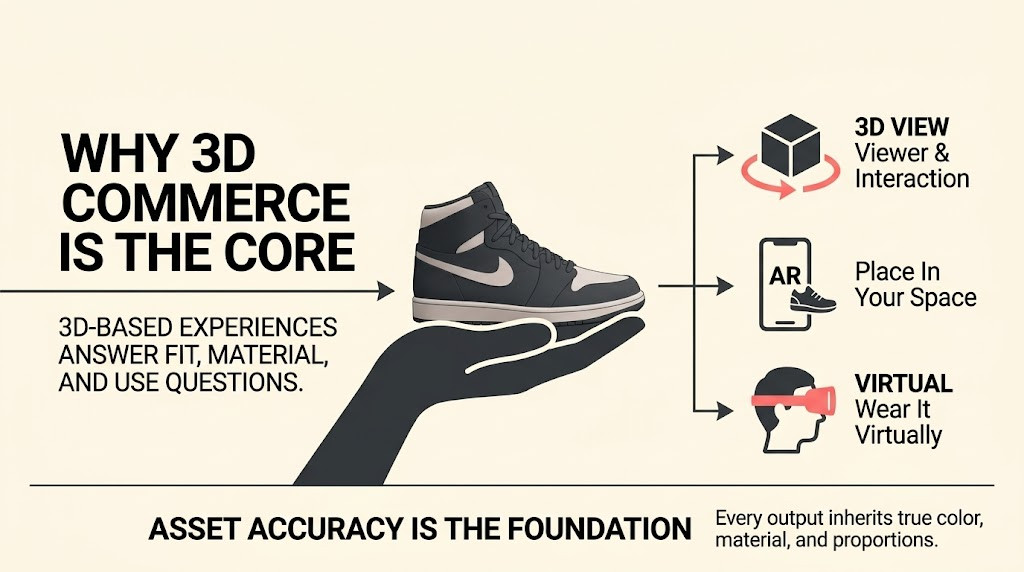
This is why asset accuracy is the foundation, not a detail. An accurate 3D capture holds color, true material, and true proportions. Every downstream output- the viewer, the AR view, the try-on- inherits that accuracy. Get the asset right, and the rest follows.
This applies well beyond footwear. Any product a shopper wears or handles benefits from the same approach. Footwear, bags, gloves, accessories, and headwear and hats all live or die on material and fit, which is exactly what 3D captures.
It is worth being clear about the alternatives. Configurators shine for made-to-order goods, but you choose a finished sneaker; you don’t configure it. UGC builds trust, but it cannot show a product that isn’t on the market yet. For wearables, 3D, AR, and try-on do the work the others cannot.
Benefits of Visual Commerce for Footwear, Bag, and Similar Brands
The benefits are not abstract. Named footwear brands have measured them.
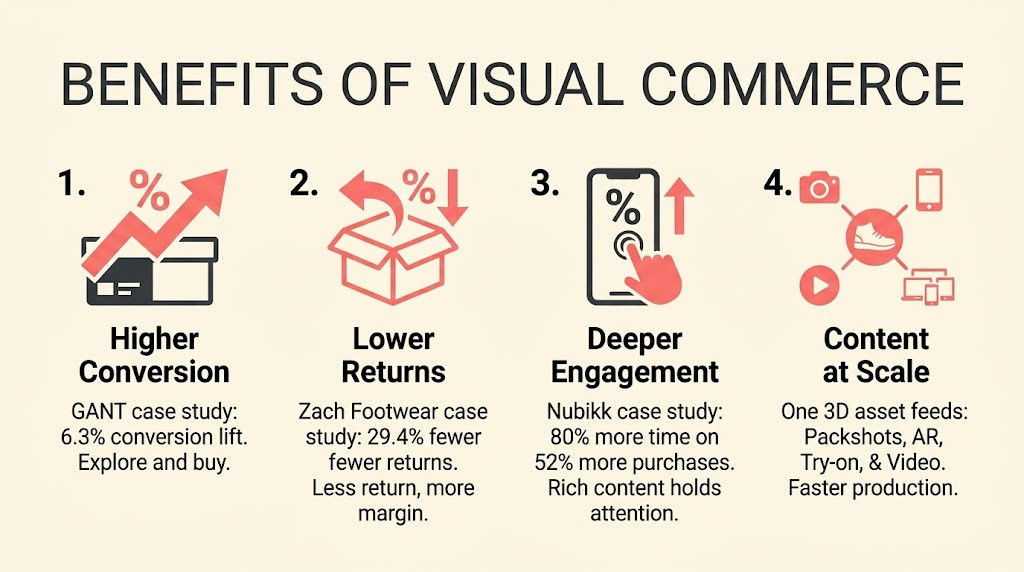
- Higher conversion. GANT ran 3D-first product pages across 13 markets and lifted conversion by 6.3% (Fibbl, GANT case study). Shoppers who can explore a product buy more often.
- Lower returns. Zach Footwear cut returns by 29.4% after adding 3D and virtual try-on (Fibbl, Zach case study). When the product matches the image, fewer orders come back.
- Deeper engagement. Nubikk saw time on product pages rise 80% and purchases rise 52% (Fibbl). Rich content holds attention, and attention converts.
- Content at scale. One 3D asset feeds packshots, AR, try-on, and video. You produce more, faster, without a shoot per SKU.
Across its base, Fibbl has 3D scanned more than 18,000 shoes and powered over 50 million product interactions. The pattern holds across brands and catalogs.
There is a quieter benefit too. Because every image, AR view, and video comes from one asset, content cost stops scaling with your catalog. You stop paying per shot, per colorway, per channel. And every avoided return is margin kept.
How to Implement a Visual Commerce Strategy
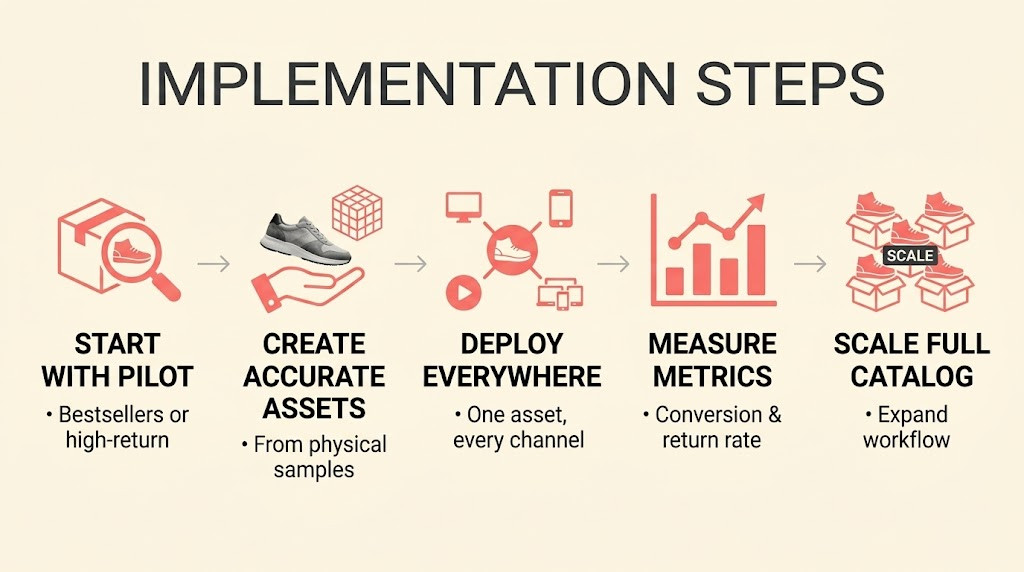
You do not roll visual commerce out all at once. You prove it, then scale. Here is the sequence that works.
Start with a pilot product range
Pick a focused set to start. Bestsellers, hero styles, or your highest-return products. A small pilot gives you a clean read on impact before you commit the whole catalog.
Choose products where the impact will be obvious, so the read is clear either way.
Create accurate 3D assets from physical samples
Send physical samples and capture them as accurate 3D assets. This is the foundation the whole strategy rests on. Accuracy here determines quality everywhere downstream, so don’t cut corners on capture.
A managed capture partner handles this, so your team ships samples and gets production-ready assets back.
Deploy one 3D asset across every channel
Use each asset everywhere. The product page, AR, try-on, ads, email, and marketplaces all pull from the same source. One asset means one source of truth, so your product looks consistent across every channel instead of drifting between shoots.
This also eliminates the per-channel reformatting that quietly eats up your team's time.
Measure engagement, conversion, and return rate
Track the metrics that matter. Compare engagement, conversion, and return rate for products with visual commerce against those without. Tie the results to revenue, so the pilot earns its expansion.
Watch engagement first, since it moves before conversion and signals the rest is coming.
Scale across your full catalog
Once the numbers hold, expand. The workflow that worked on the pilot repeats across the catalog, season after season. This is where the build-once, reuse-everywhere cost advantage compounds.
New colorways and seasonal drops slot into the same pipeline, without starting over.
Choosing a Visual Commerce Partner Platform
Not every visual commerce platform is built for wearable products at scale. A few criteria separate a real partner from a demo.
- Asset quality: the whole experience rests on it, so judge it on your hardest product
- Distribution reach: it should deploy across your store, marketplaces, and channels from one integration
- Scale: it has to handle thousands of SKUs, season after season, not just a pilot
- Proven results: look for named case studies in your category, with conversion and return numbers
For a deeper comparison, see our roundup of the best 3D product visualization software and our buyer's guide to choosing a 3D commerce provider.
One more test. Ask a shortlisted platform to run your hardest product, a reflective patent shoe or a complex mesh runner. How well it holds that is how well it will hold your catalog.
Visual Commerce for Other Wearable Product Categories
The wearable logic extends further than footwear. The same 3D approach works for bags, gloves, accessories, and headwear and hats. Each is judged on material and detail, and each gains from an accurate, explorable view. Fibbl covers bags alongside footwear, and has expanded into gloves, accessories, and headwear.
For categories outside that standard list, a bespoke approach is possible. If a product has real material and fit detail worth showing, it can be captured and brought into the same visual commerce workflow. The technology is not limited to a fixed set of categories. It is limited to products worth seeing clearly, which is most of them.
The test is the same across categories. Does the shopper need to judge material, texture, or fit before buying? If yes, an accurate 3D asset helps them decide and helps you sell.
Getting Started With Visual Commerce With Fibbl
Visual commerce has moved from a nice-to-have to the standard for selling physical products online. For footwear and other wearable goods, 3D paired with AR and virtual try-on is the core of it, and accurate assets are the foundation. Fibbl works with the leading brands across the globe.

Fibbl builds those assets for footwear, bags, and a growing set of wearable categories, then deploys them across every channel from one integration. The results, from GANT to Zach Footwear, are measured, not promised.
The best way to judge it is on your own products. Get a free product scan or book a demo to see the quality and plan your rollout.
Frequently Asked Questions
Does visual commerce only help my online store, or B2B too?
Both. Brands use 3D to build wholesale catalogs and show products to retail partners before physical samples even exist. That cuts sample shipping and speeds up the B2B sales cycle, not just the online store.
What product categories are a good fit for visual commerce?
Any product judged on material, fit, or detail. Footwear, bags, gloves, accessories, and headwear are strong fits. Highly configurable made-to-order goods lean more on configurators. If a shopper needs to see a product closely before buying, it fits.
What is the technical lift to implement 3D visual commerce?
Lighter than most teams expect. The work is in producing accurate assets. Once those exist, deploying them is a lightweight, copy-and-paste level integration into your product pages. With Fibbl, a single script handles distribution across channels.
How is visual commerce different from product photography?
Photography is one type of visual commerce, not the whole of it. A great packshot is still a flat image. Visual commerce adds the interactive layers, like 3D, AR, and try-on, that let a shopper explore a product instead of just looking at it. Most brands need both.
Do I need 3D for every product to start?
No. Start with a pilot, usually your bestsellers or highest-return styles. Prove the impact there, then expand. You do not need the whole catalog in 3D on day one.