Quick Summary
Looking for the best visual commerce platform? Your pick depends on your product and format. Fibbl leads for 3D-scanned experiences for wearable brands. Whatmore wins for shoppable UGC. Bambuser owns live commerce. Five platforms reviewed by category below, with pricing and best-fit use cases.
Every visual commerce platform sounds the same on its homepage: rich visuals, higher conversion, happy shoppers. The pitch rarely changes.
The reality is different. A platform built for live selling looks nothing like one built for 3D-scanned products. One captures real objects in 3D. The other streams video. Same label, different jobs.
Pick the wrong one, and you pay for features you never touch. Worse, you miss the format your shoppers actually want.
So this guide reviews five platforms. Each wins a different category. None of them is best at everything.
Visual commerce is still early. The brands setting up now are the ones shoppers will remember.
Why Listen to Us
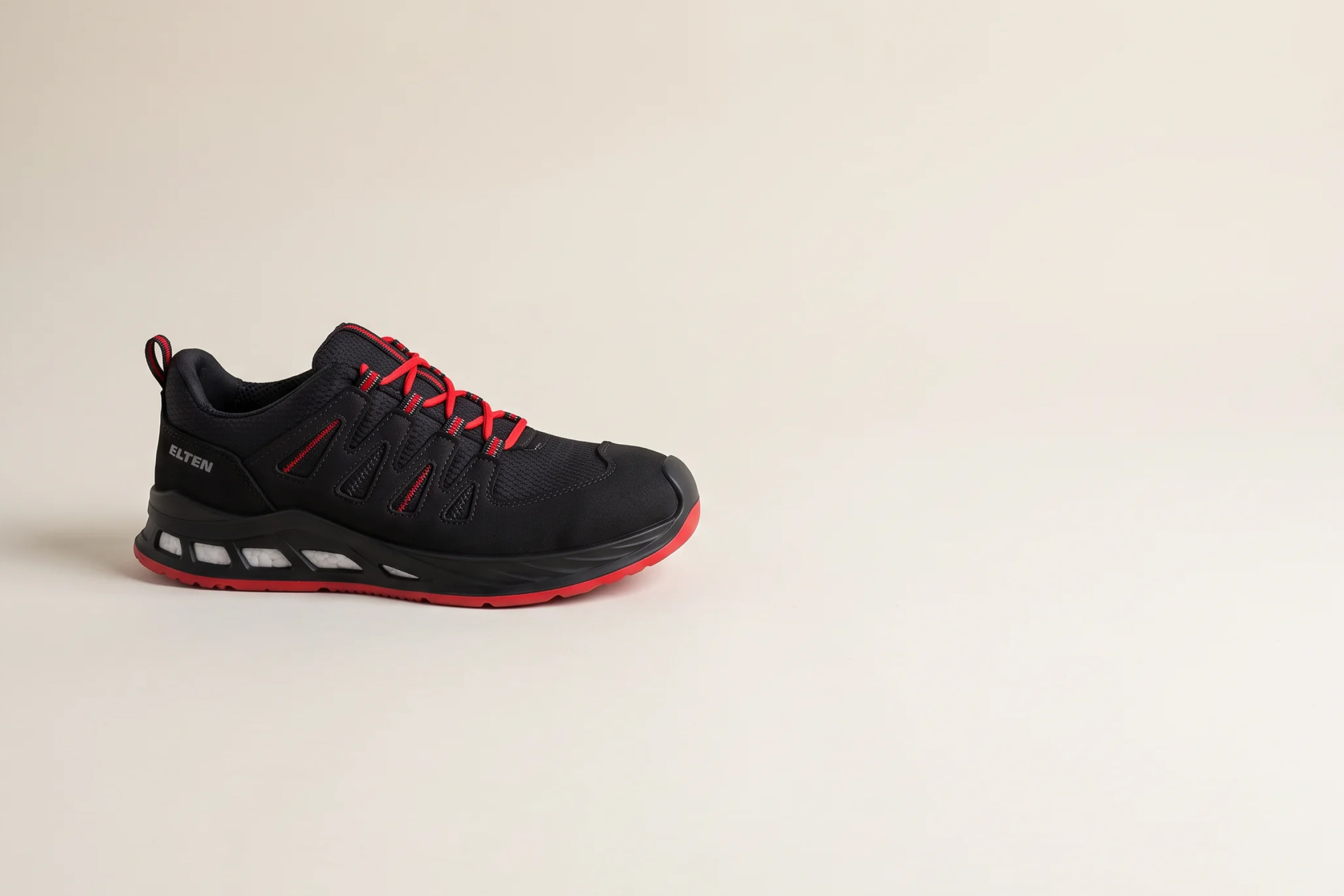
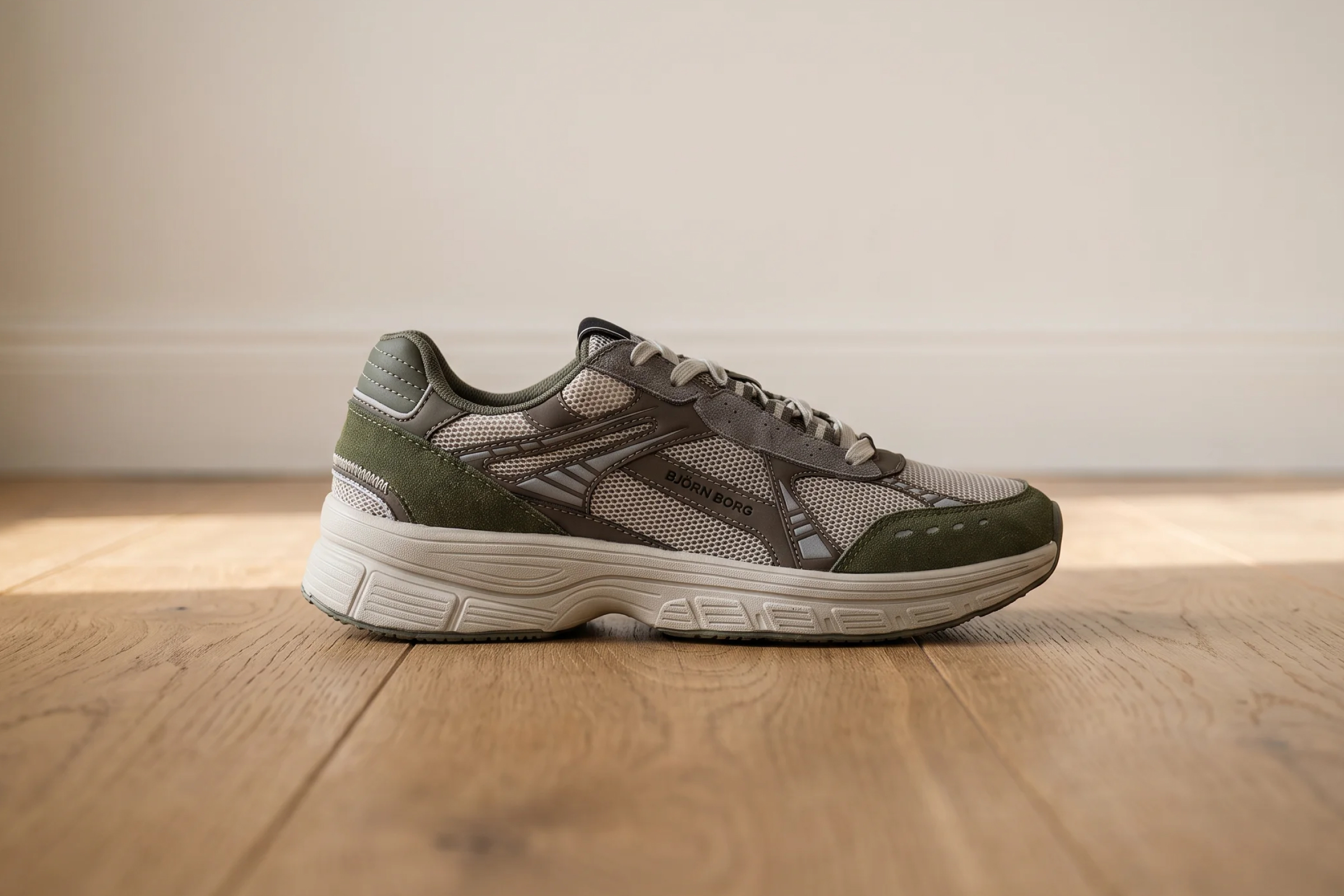
Fibbl builds visual commerce experiences for brands that primarily sell products worn on the body. That focus shows in the results.Gant went 3D-first and lifted conversion. Zach Footwear cut returns by 29%. Samsonite, Tumi, and Elten run on the same pipeline.We have tracked over 30 million shopper interactions with 3D and AR assets. That data shapes how we judge every platform here.

Since we are a visual commerce platform ourselves, we made sure the reviews we covered were honest. Each platform below wins a category we do not. We have watched brands partner with the wrong vendor and stall. Fit is the difference between a pilot and a rollout.
What Is a Visual Commerce Platform?
A visual commerce platform creates and delivers interactive product visuals across your store and channels. It replaces flat images with assets shoppers can explore. The goal is simple. Answer the questions a photo cannot. What does the material look like? How big is it? How does it move?
Most visual commerce platforms specialize in one or two of these formats:
- 2D and 360-degree product photography
- Interactive 3D models
- Augmented reality and virtual try-on
- Shoppable video and live shopping
- User-generated content, tagged and made shoppable
- Product configurators for custom builds
- AI-generated product imagery
Under the hood, these tools do one of two jobs. Some create the assets. Others display them and drive engagement.
Creation tools capture or build the visual. A 3D scan, a configurator model, a rendered image. This is the hard, expensive part.
Delivery tools put visuals in front of shoppers. Video widgets, live players, and UGC galleries live here. They need assets to show.
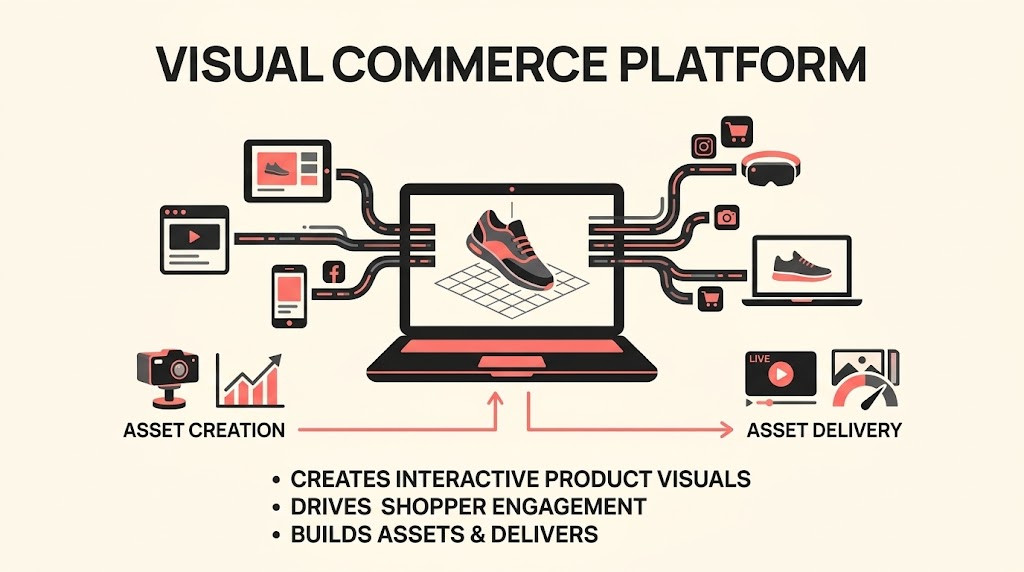
This split explains the price gaps. Creating a photorealistic 3D asset costs more than showing a video you already own.
A few platforms do both. Fibbl creates 3D assets and distributes them as 3D viewers, AR, and video from one source. That matters at scale.
You will also hear immersive commerce and 3D commerce. Both describe the deeper end, where shoppers explore products in three dimensions.
No single tool leads in every format. That is why category fit matters more than a long feature list.
Benefits of Visual Commerce for Your Store
Better visuals do more than look good. They answer the questions that stop a sale.
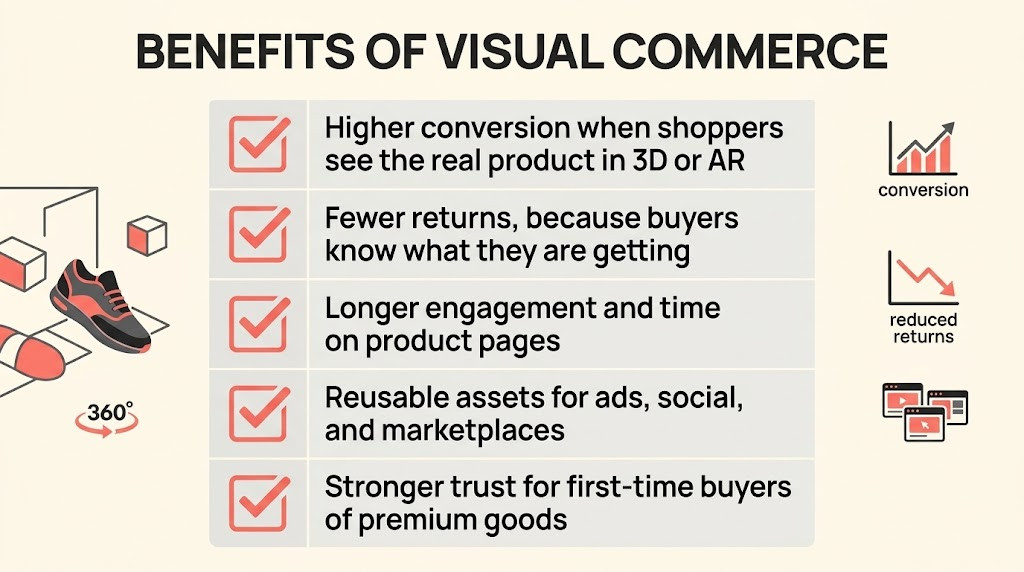
- Higher conversion when shoppers see the real product in 3D or AR
- Fewer returns, because buyers know what they are getting
- Longer engagement and time on product pages
- Reusable assets for ads, social, and marketplaces
- Stronger trust for first-time buyers of premium goods
The research backs this up. A 2025 meta-analysis found that information had the strongest effect on shopper attitude, at 0.546.
In plain terms, shoppers buy when their questions get answered. Richer visuals answer more of them.
The returns effect is just as real. Fibbl clients have seen returns fall by 29% after moving to 3D-first product pages. That is the margin you keep.
There is a content angle too. One 3D asset can feed your product page, ads, and social feeds.
That reuse changes the math. You stop paying for a new shoot every time a channel needs fresh creative.
Visual commerce is not a cost. Done right, it pays for itself in conversion and fewer returns.
Top Visual Commerce Platforms Reviewed and Compared
Platform |
Best for |
Pricing |
Free trial |
|---|---|---|---|
Fibbl |
3D-scanned experiences for wearable brands |
Custom annual plans |
Yes, free product scan |
Whatmore |
Shoppable UGC video |
Free tier, paid from ~$59/mo |
Yes |
Zakeke |
3D product configurators |
From ~$29/mo, 3D on higher tiers |
Yes, 14 days |
Zolak |
Furniture and home brands |
From ~$25/mo plus modules |
Demo-led |
Bambuser |
Live commerce |
From ~$199/mo |
Demo-led |
Please note the pricing mentioned here are estimates, not quotes. Every visual commerce vendor changes tiers, and scanned-3D platforms price by catalog and scope.
i) Fibbl: Best for 3D-Scanned Experiences for Wearable Brands
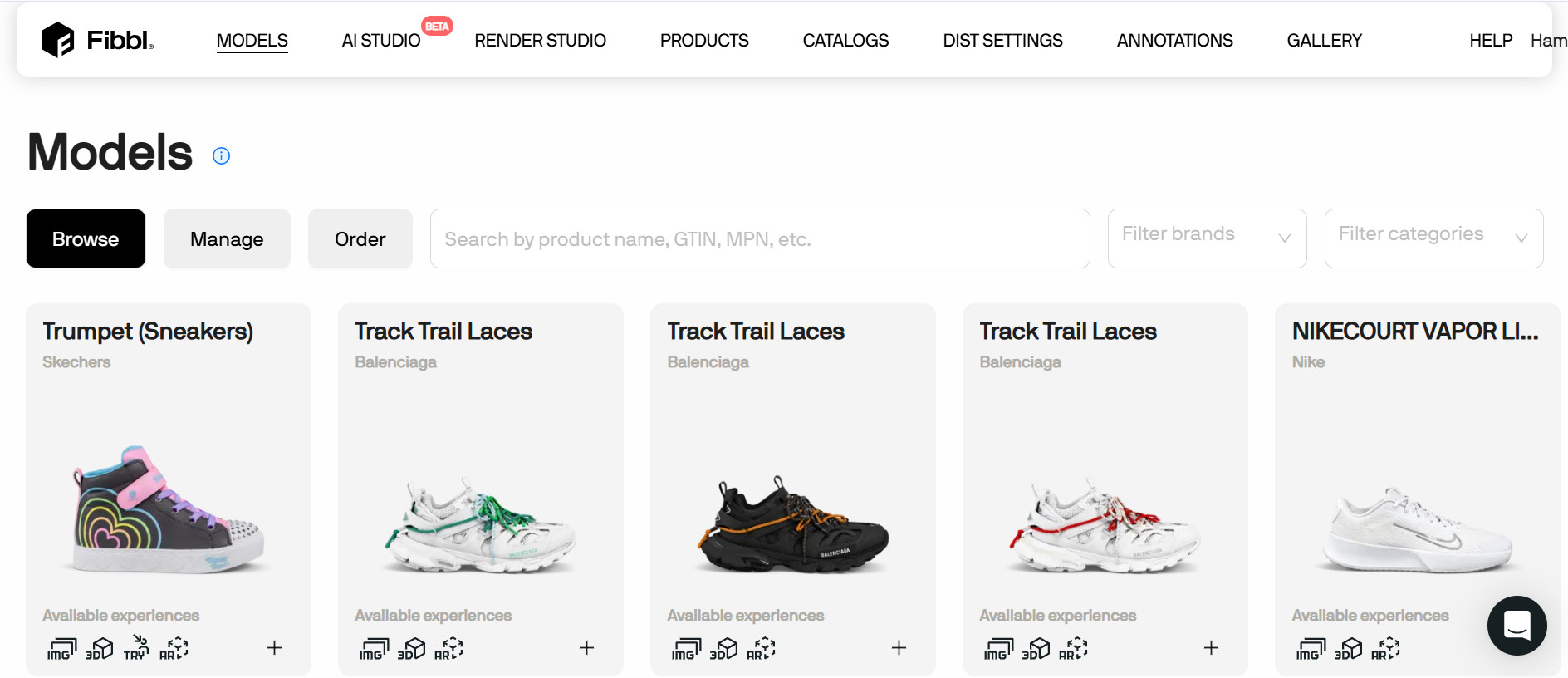
Fibbl is the best visual commerce platform for brands that sell body-worn products.
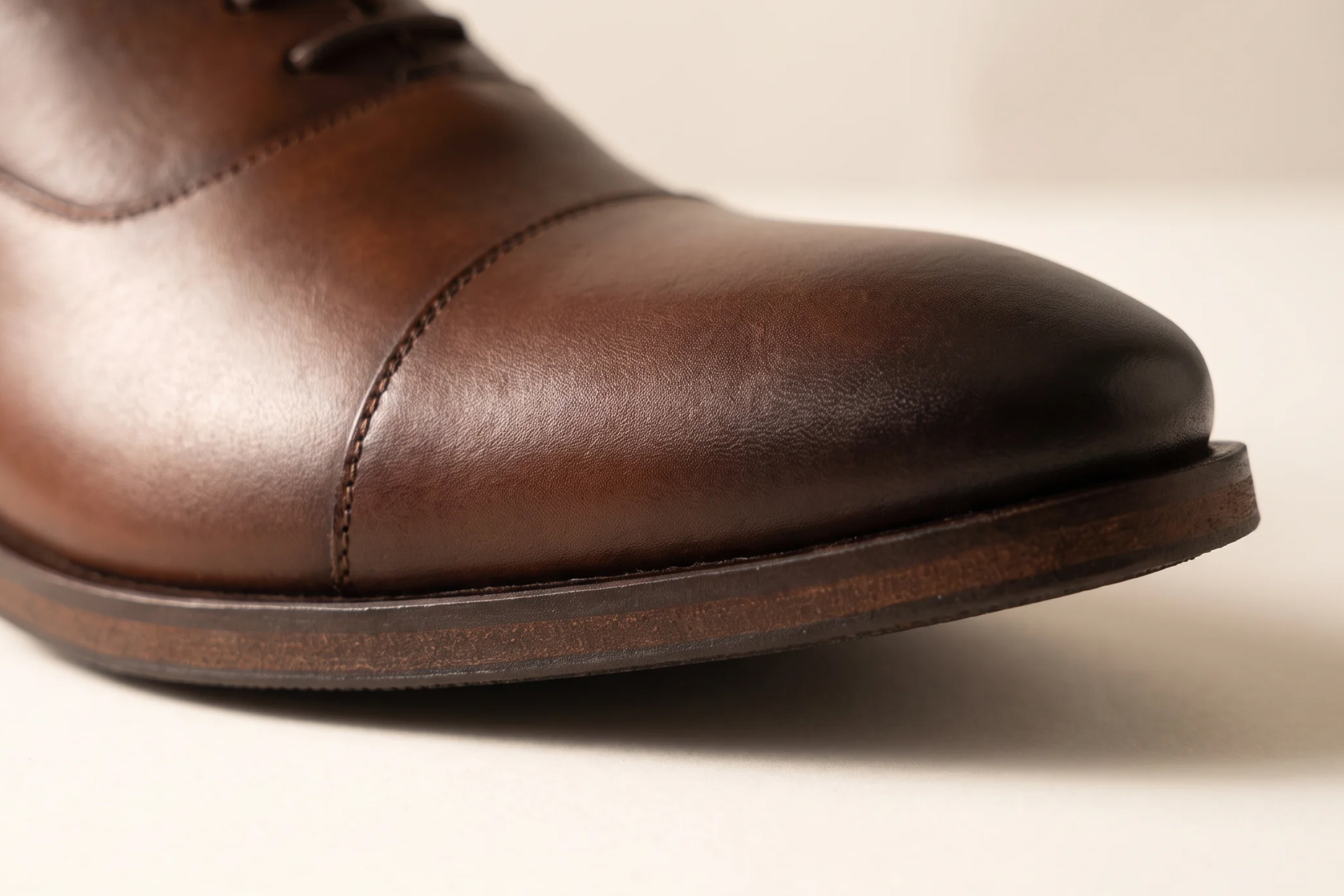
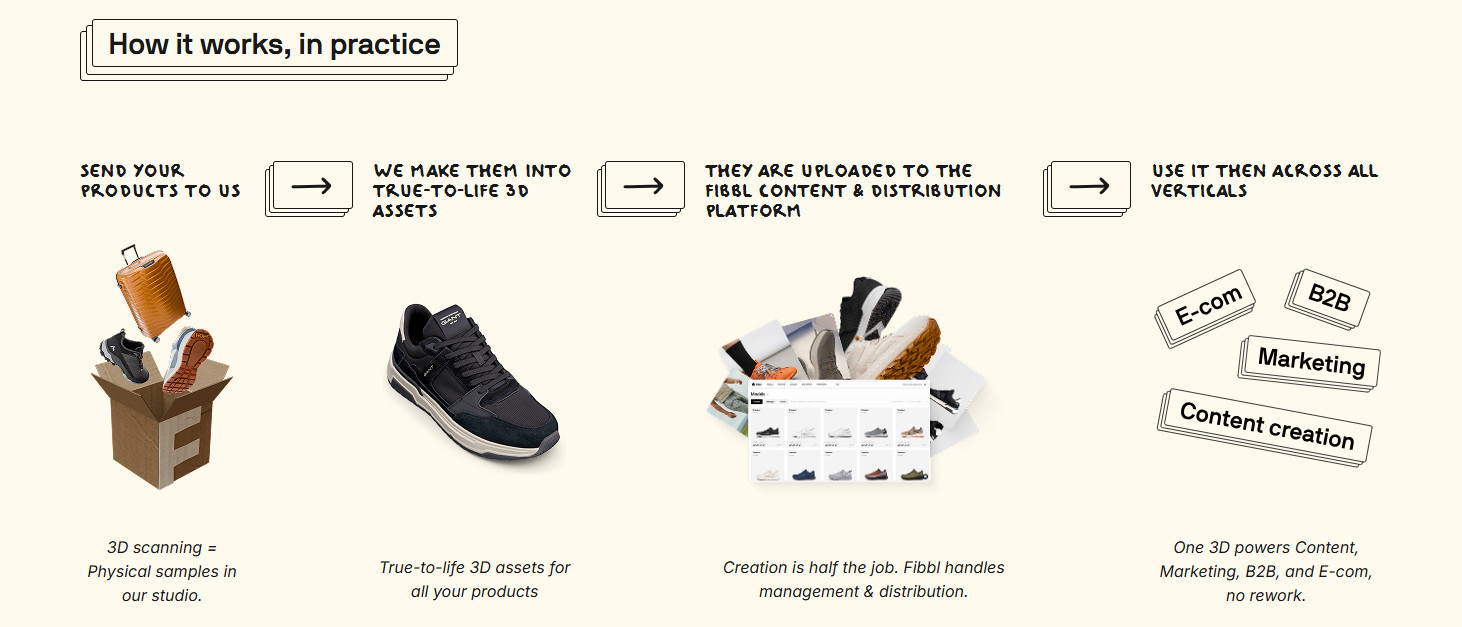
It scans real products with proprietary hardware. The result is a photorealistic 3D asset, accurate down to the stitching and material.
That accuracy is the point. Leather, mesh, rubber, and textiles are hard to fake. Most 3D looks close but wrong.
Reflective and semi-reflective materials break many scanners. Fibbl's hardware is tuned for exactly these surfaces.
Most 3D vendors model products by hand. That works for a few SKUs. It breaks at catalog scale. Fibbl was built to scale to thousands.
One scan becomes everything. A 3D viewer, AR, virtual try-on, packshots, lifestyle images, and video ads, all from a single asset.
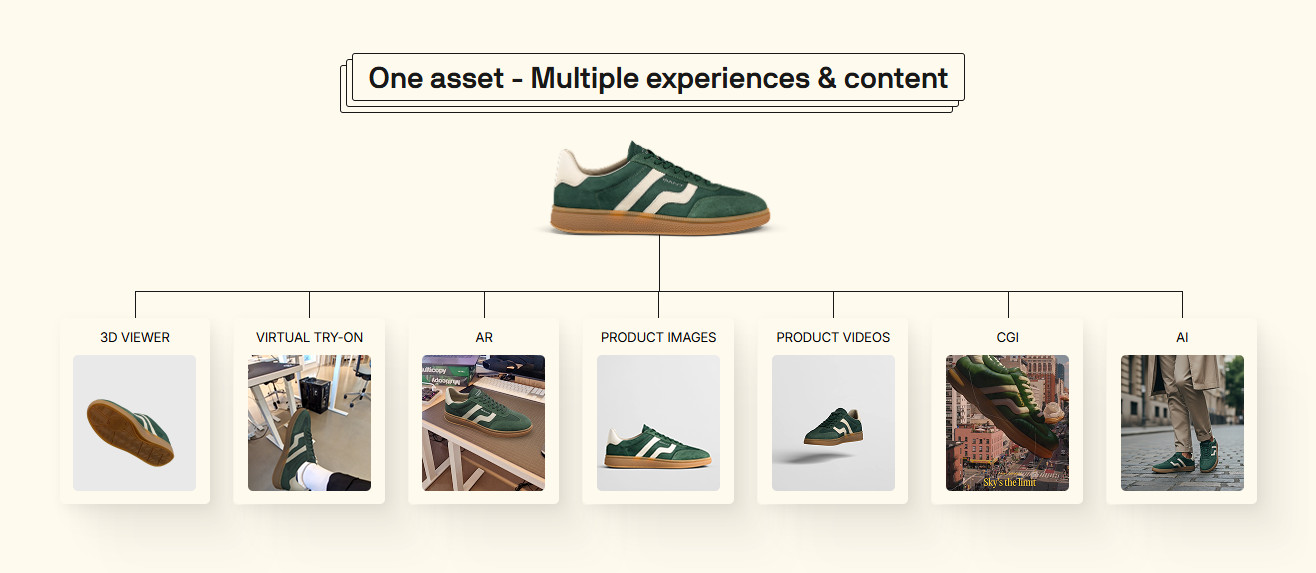
The integration is one setup. New assets flow to your store, ads, and social automatically. No reshoots per channel.
Picture a footwear brand with 2,000 styles. Hand-modeling that catalog takes years. Scanning it runs like a production line.
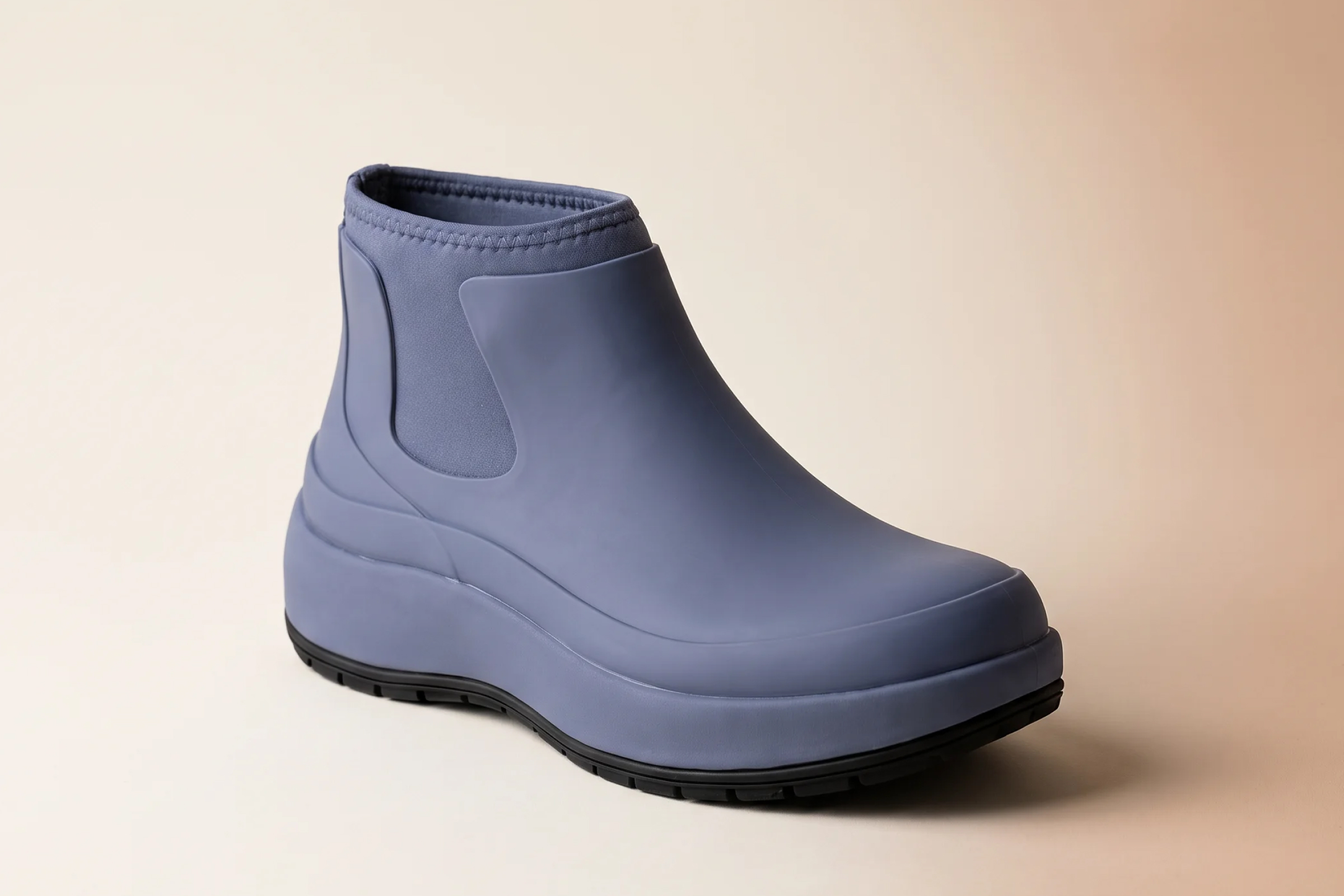
Footwear and bags were the start. Fibbl now covers more of what people wear and carry:
If your category is not on that list, Fibbl still scans it. There is a page for custom and unlisted products. If it is worn or carried, Fibbl can capture it.
Key features
- Proprietary capture hardware with sub-millimeter accuracy
- Material-optimized for leather, mesh, rubber, and textiles
- One integration that distributes 3D and AR everywhere
- Virtual try-on for footwear
- Dynamic imagery and video from a single 3D asset
Best for: footwear, bag, and accessory brands that want true-to-life 3D at full catalog scale.
ii) Whatmore: Best for Shoppable UGC
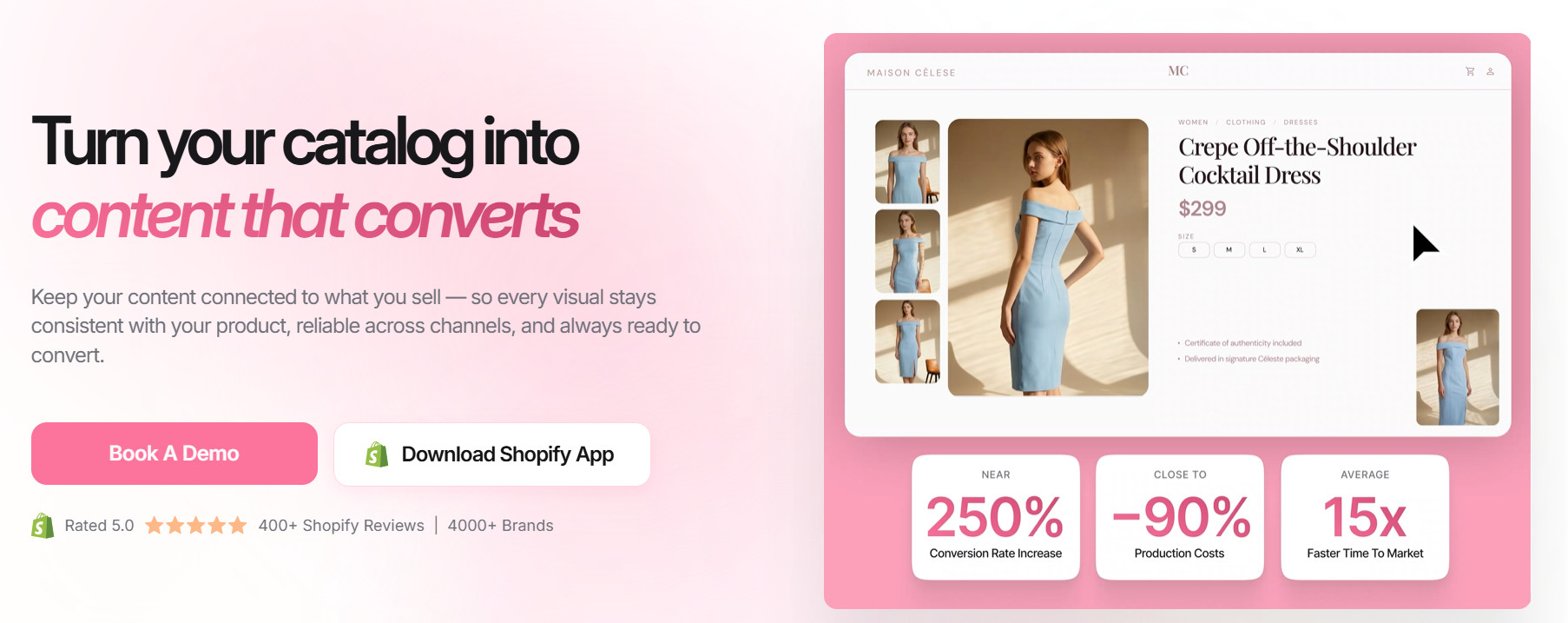
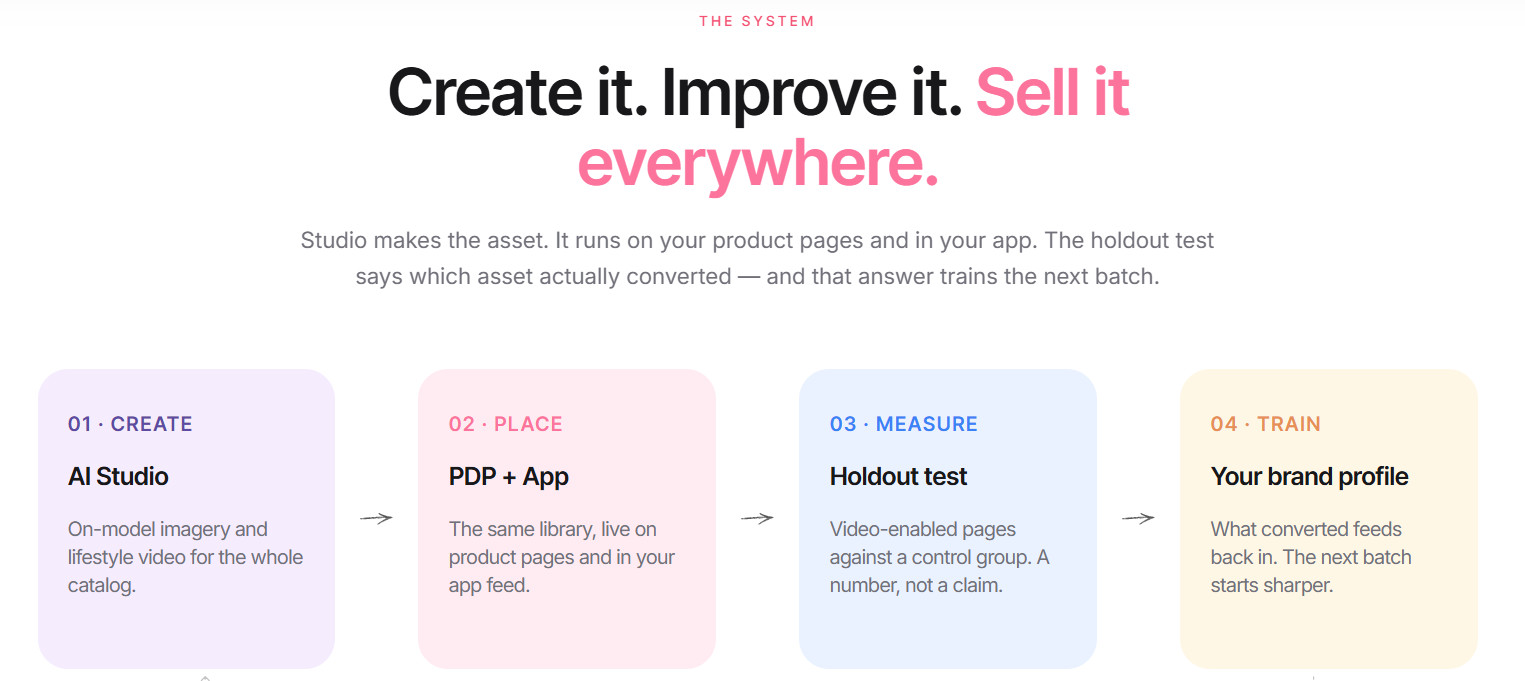
Whatmore turns social video and UGC into shoppable content on your store.
It imports clips from TikTok, Instagram, and creators. AI tags the products inside each video. Shoppers buy without leaving the page.
You do not reshoot anything. Whatmore repurposes footage you already have. That keeps content costs low.
Picture a shopper on a product page. A short creator clip autoplays. They tap the tagged item and add it to the cart. No new tab, no friction.
It displays videos as autoplay carousels, stories, floating widgets, and grids. These sit on your homepage, product, and collection pages.
It leans toward delivery, not creation. You bring the video. Whatmore makes it shoppable and measures the result.
Social proof does the selling here. Real people using the product beat a polished studio shot for many shoppers.
It also fits how younger buyers already shop. They trust a creator clip more than a banner.
It works best when your content pipeline is already busy. If creators post about you weekly, the videos pay for themselves.
Key features
- Daily auto-sync of product tags
- AI product tagging inside video
- Multiple on-site video layouts
- Full-funnel analytics, from views to conversions
- Works with Shopify, WooCommerce, Magento, and more
Best for: brands with steady creator and UGC video that want it shoppable, fast.
iii) Zakeke: Best for 3D Product Configurators
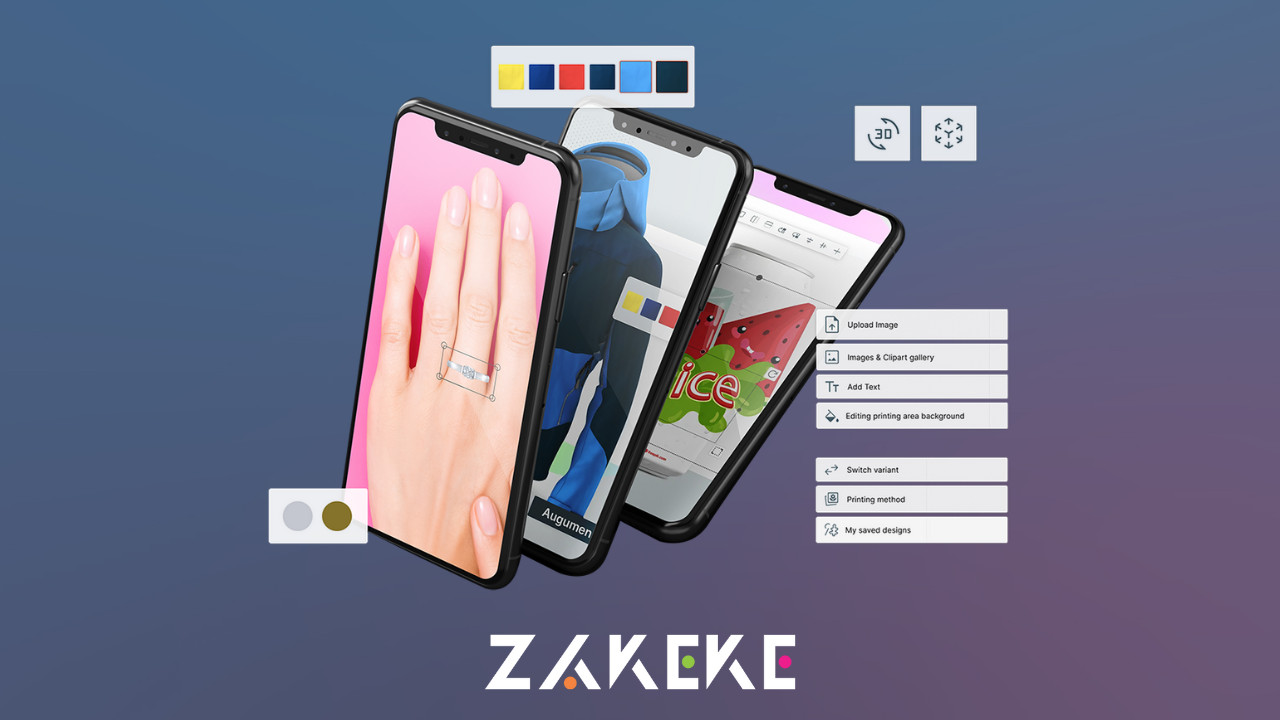
Zakeke is the pick for products people customize before they buy.
Shoppers choose colors, materials, text, and components in real time. They see each change instantly in 3D. Then they view it in AR at real size.
It fits made-to-order goods. Think furniture, print, jewelry, and promotional products.
Configuration turns a browser into a builder. That involvement lifts intent before the shopper reaches checkout.
A buyer designing a custom chair is a good example. Swap the fabric, change the legs, preview it in the living room. Then order with confidence.
Higher tiers add API access and white-label options. That suits brands building configuration into their own stack.
The value is fewer wrong orders. When a buyer designs it themselves, the product matches the expectation.
It also cuts support load. Customers answer their own questions inside the configurator instead of emailing you.
Key features
- Real-time 3D configuration
- WebAR preview at true scale
- Text and image personalization
- API and white-label options on higher tiers
- Broad ecommerce and Salesforce integrations
Best for: stores selling configurable or personalized products across many variants.
iv) Zolak: Best for Furniture and Home Brands
Zolak builds visual commerce experiences for furniture and home decor brands.
Big items are the hardest to buy online. Will the sofa fit? Does the color match the room? Zolak answers both before checkout.
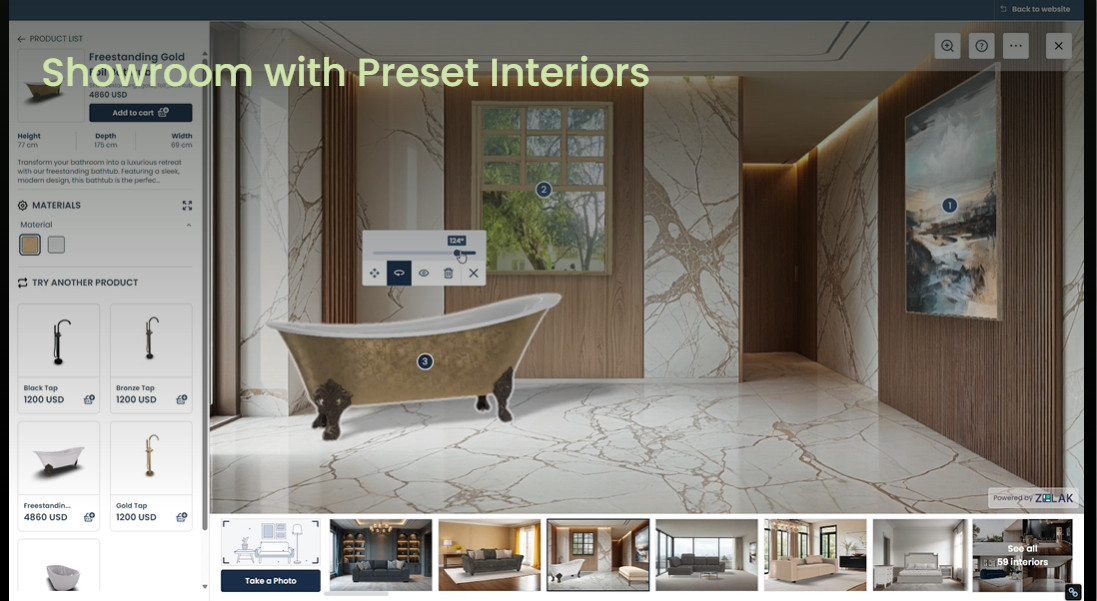
Shoppers place products into a real room with AR. Or they drop items into pre-designed interiors from Zolak's library. They can also upload a photo of their own space.
A virtual showroom lets buyers explore sets and swap pieces. An AI configurator handles endless variations.
Seeing a piece in your own room settles the doubt fast. That confidence is what closes a big-ticket sale.
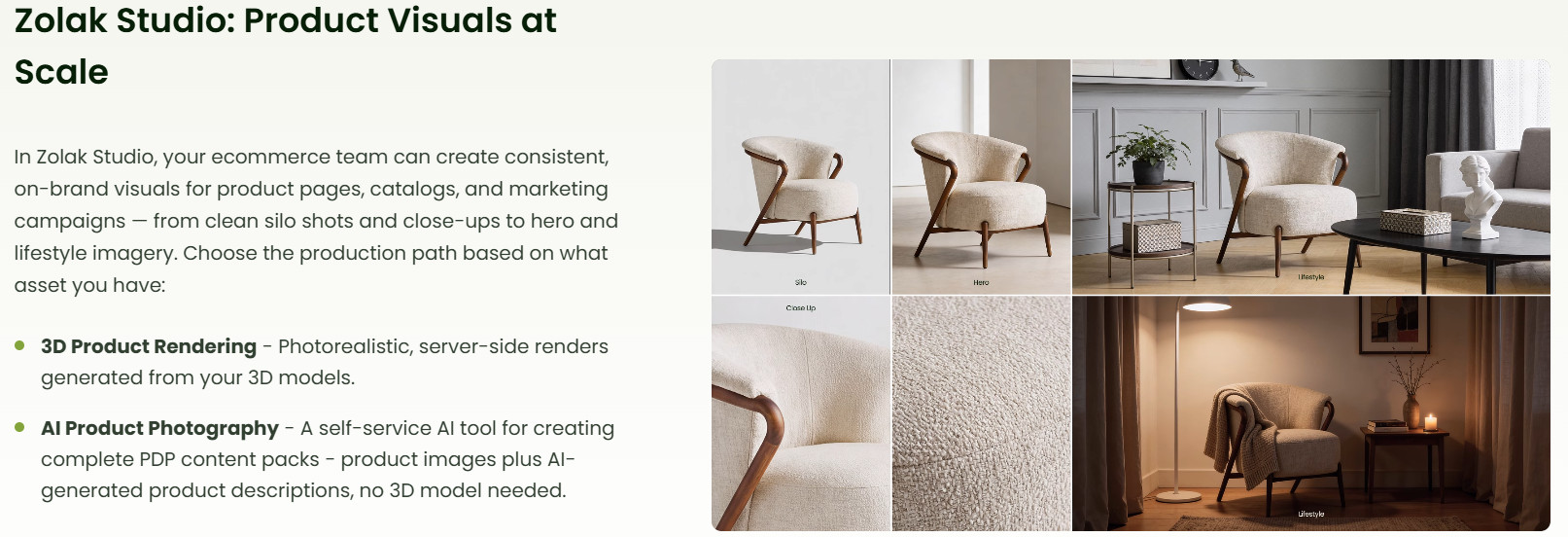
Zolak Studio adds on-demand product imagery. You get render-quality visuals for the site and social without a photo shoot.
Furniture returns are painful and costly to ship. Cutting them protects margin more than in most categories.
Pricing starts low and scales with modules. Smaller home brands can start without a large commitment.
Key features
- Room visualization with AR and uploaded photos
- 3D virtual showrooms for furniture sets
- AI configurator for unlimited variants
- Zolak Studio for on-demand product imagery
- A low monthly base that scales with modules
Best for: furniture and home brands that need in-room visualization.
v) Bambuser: Best for Live Commerce
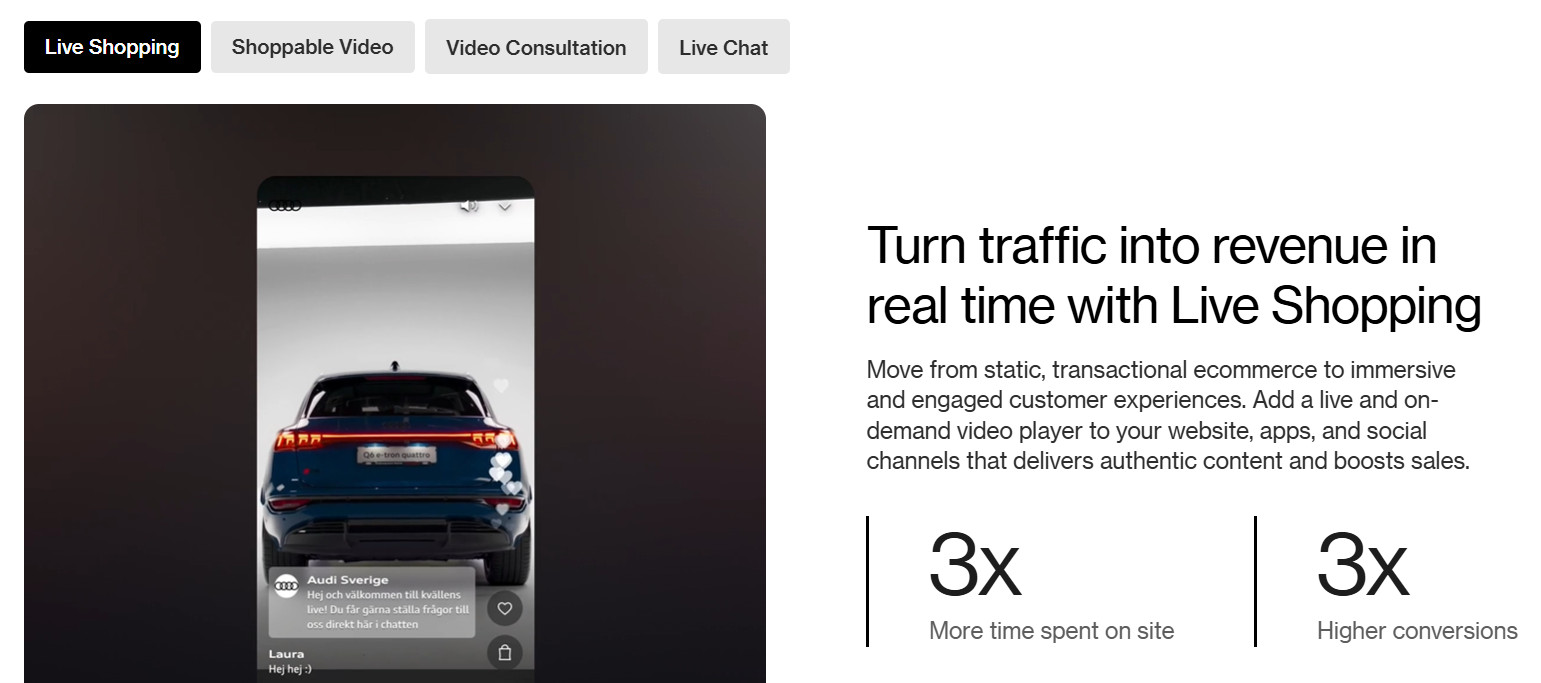
Bambuser leads live video shopping. If your strategy is live selling, start here.
It runs high-energy live broadcasts and one-to-one video consultations. Product cards appear during the stream. Viewers add to cart without leaving the player.
Live commerce works like a modern shopping channel. A host demos products. Viewers ask questions and buy in the moment.
The replays keep working after the stream ends. One event becomes a shoppable video you reuse for weeks.
Shoppable on-demand video and in-show AI chat round out the platform. The chat can reply in your brand voice during a busy stream.
It is enterprise-grade and priced that way. Fashion, beauty, and lifestyle brands get the most from it.
Live selling builds urgency that static pages cannot. Limited drops and expert demos push viewers to act.
It needs a plan and a host. This is a content commitment, not a widget you switch on.
Key features
- Live one-to-many broadcasts
- One-to-one video clienteling
- Shoppable on-demand video
- AI chat replies in your brand voice
- Real-time sync with Shopify, Salesforce, and Adobe Commerce
Best for: fashion, beauty, and lifestyle brands investing in live shopping.
How We Evaluated These Platforms
We did not rank these one to five. Each wins a different job. Here is what we weighed:
- Category fit, the format each platform does best
- Visual quality and how real the experience feels
- How well it scales across a full catalog
- Integration effort with common ecommerce stacks
- Pricing and free-trial access for testing
We also leaned on our own data. Thirty million tracked interactions tell you what shoppers actually use.
Furthermore, we weighed distribution, not just creation. An asset that never leaves the product page is half-used.
A platform can be excellent and still be wrong for you. Fit beats feature lists every time.
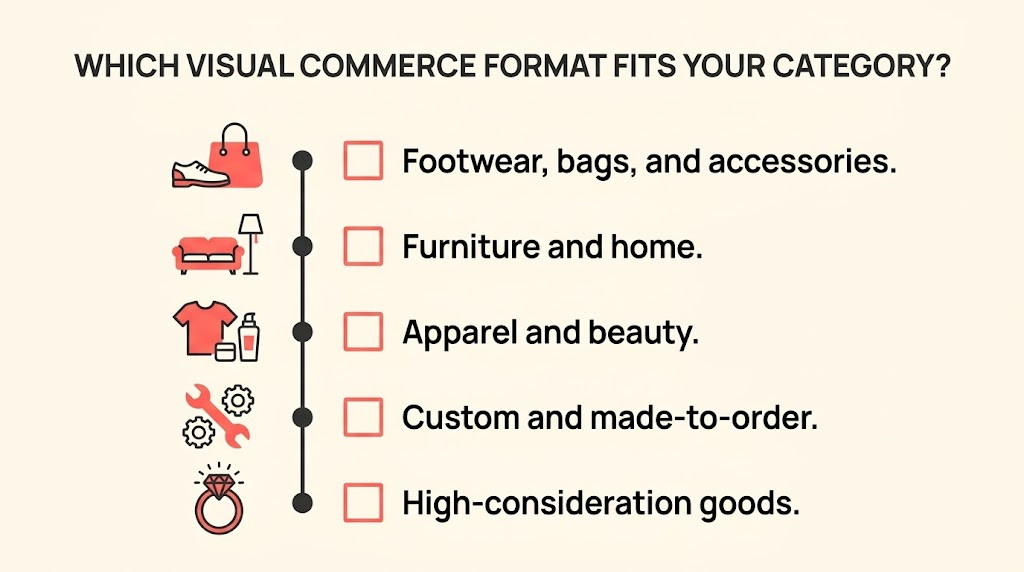
Which Visual Commerce Format Fits Your Category?
Format should follow product. The same tool rarely fits a sofa and a sneaker. Here is a quick map.
- Footwear, bags, and accessories. Shoppers want to see fit, material, and detail. Scanned 3D and try-on win here.
- Furniture and home. Scale and placement matter most. In-room AR removes the biggest doubt before checkout.
- Apparel and beauty. Live demos and creator video build trust. Motion shows how a product moves and wears.
- Custom and made-to-order. Buyers design the product themselves. A 3D configurator makes the choice concrete.
- High-consideration goods. Think jewelry or electronics. Detailed 3D and zoom answer the questions a photo cannot.
Match the format to the doubt. Ask what stops your shopper, then pick the visual that removes it.
Some brands span two of these. A footwear label that also sells caps and belts fits neatly into one scanned-3D pipeline.
Wearable brands are a special case. Fit is emotional, and materials are hard to judge online. That is why 3D scanning and try-on matter more here than anywhere else.
Signs You Need a Visual Commerce Platform
Not sure if your business needs visual commerce experiences? These signs usually mean yes:
- Returns keep rising because products look different in person
- Shoppers ask the same sizing and material questions
- Your product photos cannot keep up with your catalog
- Competitors already offer 3D, AR, or try-on
- You reshoot everything after each rebrand or channel launch
If two or more sound familiar, flat images are costing you sales. The gap only widens as your catalog grows.
How to Choose the Right Visual Commerce Platform
Start with your product, not the feature grid. The product decides the format.
- Sell products worn or carried on the body? You need true-to-life 3D and try-on. Fibbl is built for that.
- Sell furniture or decor? You need in-room AR. Look at Zolak.
- Is live selling your thing? Bambuser.
- Sitting on creator videos? Whatmore makes it shoppable.
- Selling customizable products? Zakeke handles configuration.
Next, check three things. Does it scale to your whole catalog? Does it fit your stack? Can you trial it first?
Watch for the trap of buying features you will not use. A cheaper tool that fits beats a bloated one that does not. Involve the team that will run it. A tool nobody updates goes stale in a month.
The best visual commerce platform matches how your customers shop.
Common Mistakes to Avoid When Partnering with a Visual Commerce Vendor
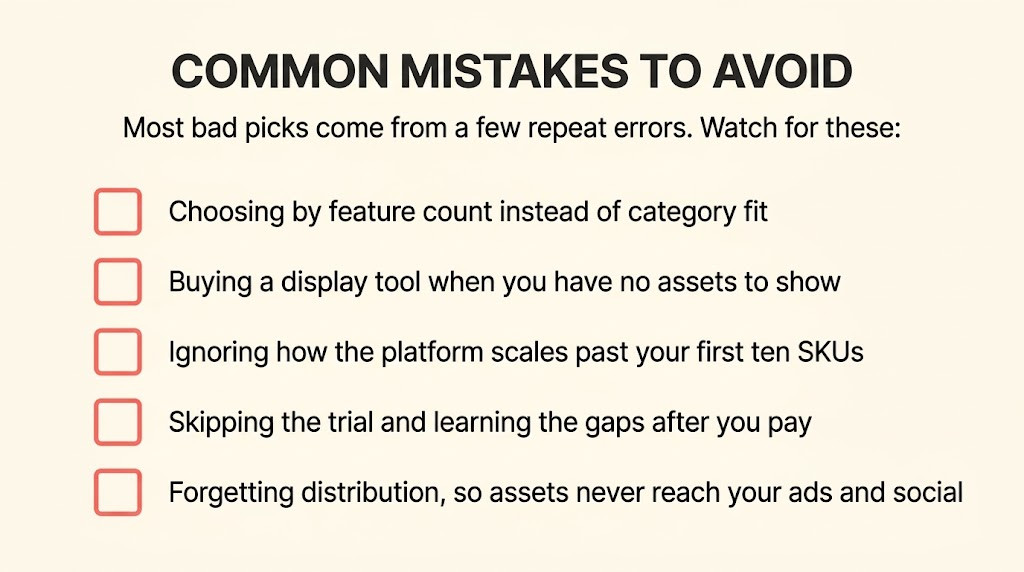
Most bad picks come from a few repeat errors. Watch for these:
- Choosing by feature count instead of category fit
- Buying a display tool when you have no assets to show
- Ignoring how the platform scales past your first ten SKUs
- Skipping the trial and learning the gaps after you pay
- Forgetting distribution, so assets never reach your ads and social
The last one is common. Great 3D that lives on one product page is a wasted investment. Ask each vendor how assets reach your ads and marketplaces. If the answer is vague, so is the value.
How Much Does a Visual Commerce Platform Cost?
Pricing splits by what the visual commerce platform does. Delivery tools are cheap. Creation and enterprise tools cost more.
- UGC and video widgets: free tiers up to a few hundred dollars a month
- Configurators: from around $29 a month, more for 3D and API access
- Furniture visualization: a low monthly base plus usage-based modules
- Live commerce: enterprise pricing, often from $199 a month
- Scanned 3D for full catalogs: custom annual plans tied to SKU volume
Cheaper is not better. A tool that fits your product beats a costly one that does not.
For scanned 3D, price tracks scope. Weigh it against the returns and conversion it moves, not a flat fee.
Always trial or demo first. Test on your real products, not the vendor's polished samples.
Conclusion
There is no single best visual commerce platform. There is a best one for your product.
Fibbl, Whatmore, Zakeke, Zolak, and Bambuser each own a lane. Pick the one that fits your format and your goals.
If you sell footwear, bags, or anything worn on the body, Fibbl is built for you. It turns one scan into 3D, AR, try-on, and video, at catalog scale.
Start where the pain is sharpest. Scan your best sellers, measure the lift, then roll out across the catalog.
See how it works, or book a demo. You can start with a free product scan.
Frequently Asked Questions
What is a visual commerce platform?
It is software that creates and delivers interactive product visuals. Think 3D, AR, try-on, shoppable video, and configurators. It replaces flat images with assets shoppers explore.
What is the best visual commerce platform?
There is no universal winner. Fibbl leads for 3D-scanned wearable products. Bambuser leads live commerce. Whatmore leads shoppable UGC. Match the tool to your product.
Is visual commerce worth it?
Yes, for most brands with visual products. It lifts conversion and cuts returns. Fibbl clients have reduced returns by 29% with 3D-first pages.
What is the difference between 3D commerce and visual commerce?
Visual commerce is the broad category. It covers all interactive visuals. 3D commerce is the deeper end, where shoppers explore products in three dimensions.
Can one platform handle 3D, AR, and video?
Some can. Fibbl creates a single 3D asset, then outputs AR, try-on, packshots, and video from it. Most tools handle only one format.