Quick Summary
Most 3D commerce examples are screenshot galleries. This one is not. Five brands, five different problems. GANT chased conversion. LOCI fixed a broken photo workflow. Joya built a forecasting tool. Samsonite scaled past the gimmick. ELTEN went 3D across every channel. Here is what worked, and why.
Most 3D commerce examples posts show you pretty pictures. A rotating shoe here, an AR button there. They rarely tell you why the brand did it.
That is the wrong question to skip. The interesting part is not the 3D commerce feature. It is the problem that pushed the brand to build it.
The five brands below each started somewhere different. One had a slow photo studio. One had a forecasting headache. One just wanted a conversion lift.
None of them set out to reinvent anything. They solved a narrow problem, then found the asset was worth far more than expected.
Here are five real 3D commerce implementations. Five starting points. Five different places they ended up.
Read them for the motivation, not the screenshots. That is where the useful lessons hide.
What 3D Commerce Covers
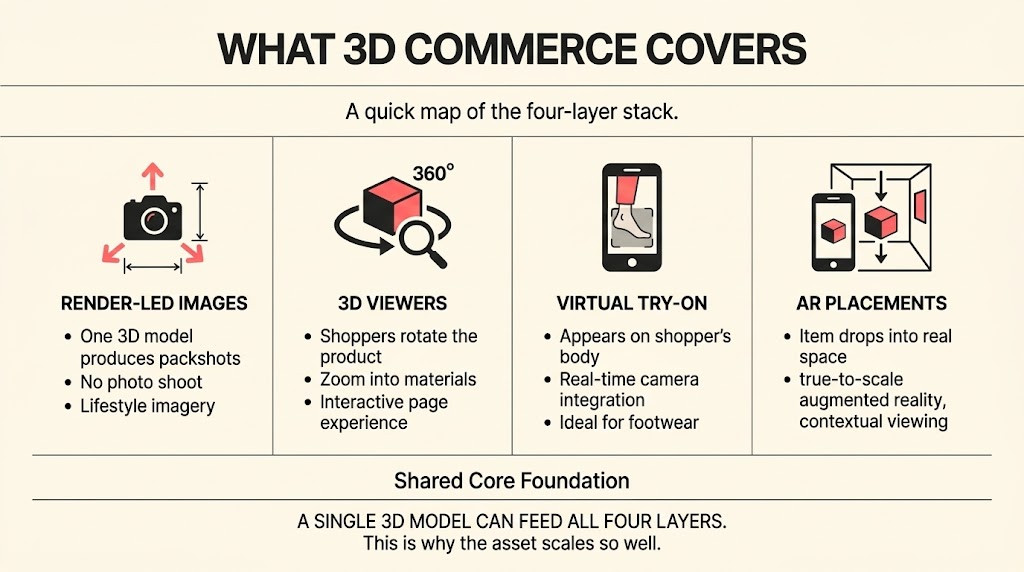
First, a quick map. 3D commerce isn’t just one feature; it’s a stack of four interconnected layers: render-led images, 3D viewers, virtual try-on, and AR placements. All five brands leverage several of these layers, but understanding the technical requirements and resource investments needed can help your team plan effectively for adoption.
- Render-led images. One 3D model produces packshots and lifestyle imagery, with no photo shoot.
- 3D viewers. Shoppers rotate the product and zoom into materials on the page. See an example 3D viewer in action.
- Virtual try-on. The product appears on the shopper’s body through the camera. An example? Virtual try-on for footwear.
- AR placements. The item drops into the shopper’s real space at true scale, through augmented reality.
These layers share one source. A single 3D model can feed all four, which is why the asset scales so well.
Keep these four in mind. Each brand below leans on a different mix.
1) GANT: Turning a Toggle Into a 6.3% Conversion Lift
GANT is a heritage apparel and footwear brand selling across 13 markets. Their e-commerce had matured, but the products still felt flat on screen.
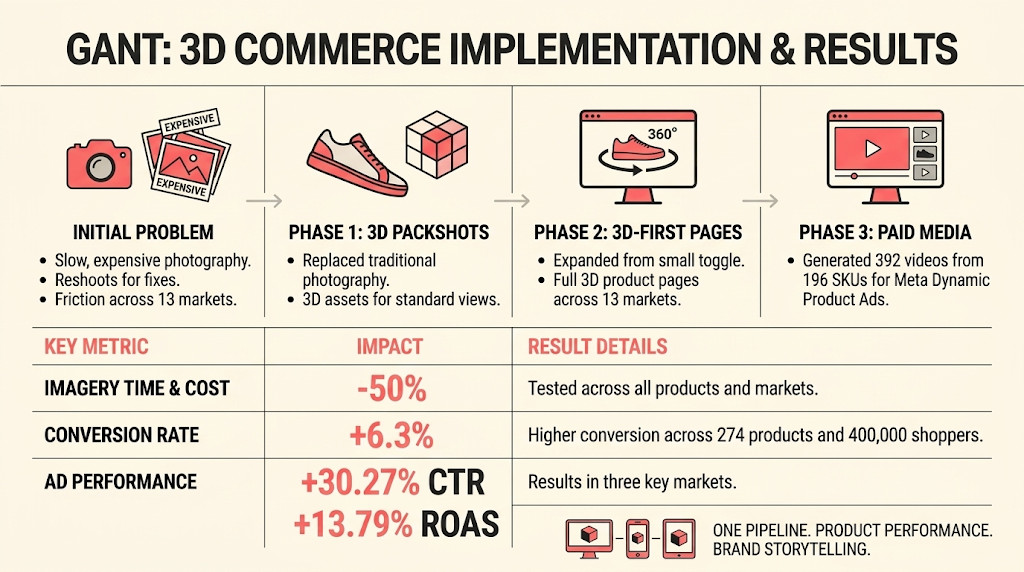
The problem was old and expensive. Photography was slow and costly. Reshoots piled up whenever post-production could not fix a shot.For a brand across 13 markets, that friction multiplied. Every new season meant another round of shoots and fixes.
GANT moved in three phases. First, 3D packshots replaced traditional photography. Then the site went from a small 3D toggle to 3D-first product pages across 13 markets.
The third phase was paid media. GANT generated 392 motion videos from 196 SKUs for Meta Dynamic Product Ads.
That last number matters. Turning a still catalog into hundreds of ad videos without a film crew is the quiet win.
The results were hard to argue with:
- 50% less time and cost on product imagery
- 6.3% higher conversion, tested across 274 products and 400,000 shoppers
- 30.27% higher click-through and 13.79% better ROAS in three markets
André Lago, Global E-commerce Director, named the core challenge as “the difficulty of experiencing products through a screen.”
Why did it work? GANT did not flip a switch and hope. It moved in stages and measured each one. This careful approach can help brands feel more confident in adopting 3D commerce.
The toggle was the tell. A hidden 3D button barely gets used. Making the page 3D-first is what moved conversion.
It did not stop at product pages. GANT reused the same assets to make premium CGI brand films. One pipeline, product performance and brand storytelling both. Read GANT’s full 3D journey.
2) LOCI: Replacing a Broken Photography Workflow Entirely
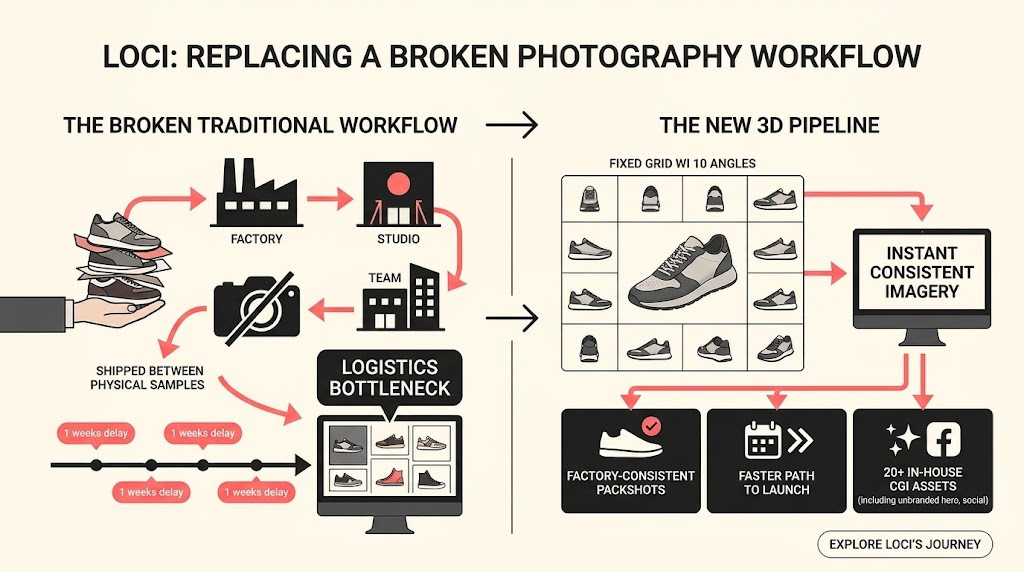
LOCI is a vegan sneaker brand run by a lean team. Its bottleneck was not creativity. It was logistics.
Factory samples shipped back and forth between teams and suppliers. Reshoots ate into weeks. Product pages drifted, with lighting, scale, and backgrounds all slightly off.
So LOCI scrapped the old pipeline. It converted 100% of its range, over 200 shoes, into 3D models.This was not a test on a few hero styles. It was the whole catalog, moved at once.
Each product follows a fixed template of ten angles. Six locked down for packshot consistency. Four were held back for marketing and creatives.
Emmanuel Eribo, the CEO, was blunt. Traditional photography, he said, “was slowing us down more than helping us.”
Why did it work? The template. Six locked angles meant every shoe looked like it belonged to the same brand. Consistency at scale is boring, and it is the whole point. A lean team cannot afford a shoot per SKU.
The payoff was consistency and speed. No more sample shipping, no more almost-right images, and a faster path to launch.
Then the creative team went further. It produced 20-plus CGI assets in-house for hero sections, paid social, and launches, including a Nicki Minaj drop. See LOCI’s story.
3) Joya: Using Retailer Votes to Order Three Months Earlier
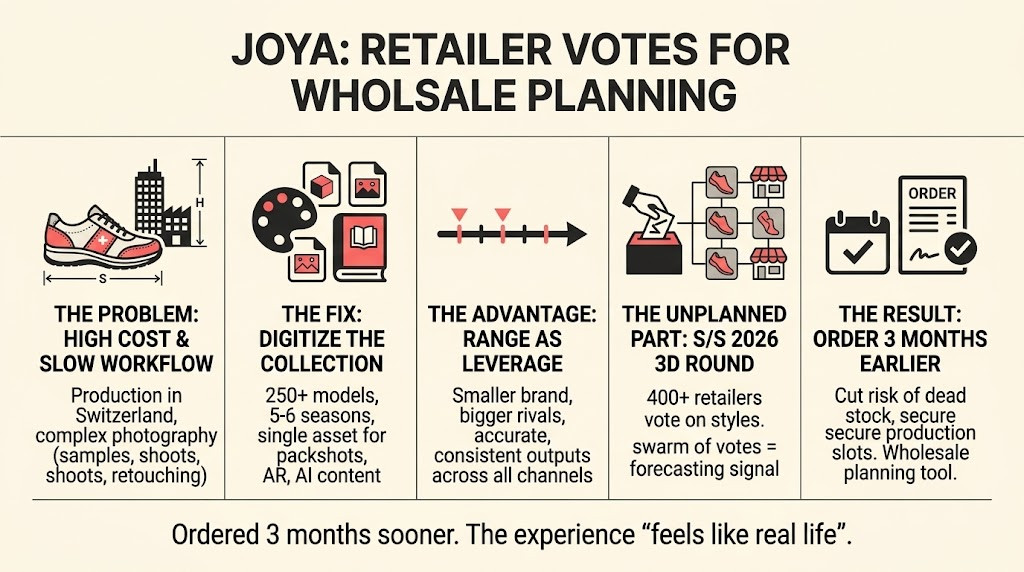
Joya makes Swiss comfort footwear. Its problem started with cost. Production in Switzerland is expensive, and photography made it worse.
Samples, shoots, retouching, and inconsistent lighting all slowed the business down. So Joya digitized the whole collection.
That meant 250-plus models across five to six seasons. The assets powered packshots, virtual try-on, B2B catalogs, landing pages, and AI lifestyle content.
For a smaller brand facing bigger rivals, that range of output is a real advantage. One asset library does the work of a full studio.
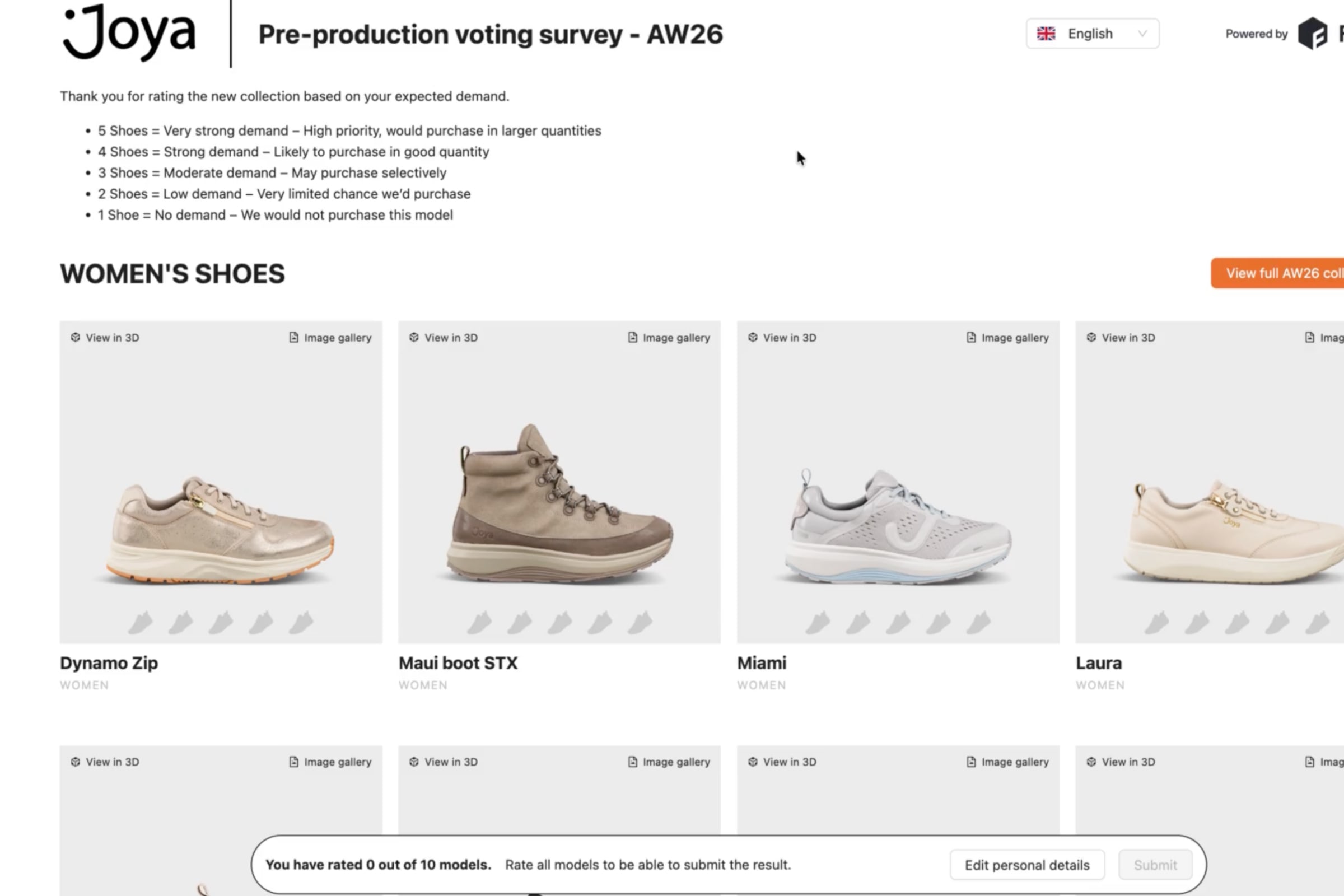
Then came the unplanned part. For Spring/Summer 2026, Joya moved its second sample round entirely into 3D.
Over 400 retail partners used a voting tool to rotate, review, and rate styles. That swarm of votes became a forecasting signal.
Joya could place factory orders earlier, with far less blind guessing. A photography fix had quietly become a wholesale planning tool.
Why did it work? Because retailers were already going to judge the samples. Doing it in 3D just made the judging faster and earlier.
Ordering three months sooner is not a small edge in footwear. It buys production slots and cuts the risk of dead stock.
Co-CEO Claudio Minder framed the goal simply: an online experience that “feels like real life.”
4) Samsonite: Scaling Past the Gimmick Stage After a Slow Start
Samsonite leads global luggage, with a multi-brand portfolio. Managing content across all those brands is hard on its own. Its first steps into 3D did not stick. That failure is the most useful part of the story.
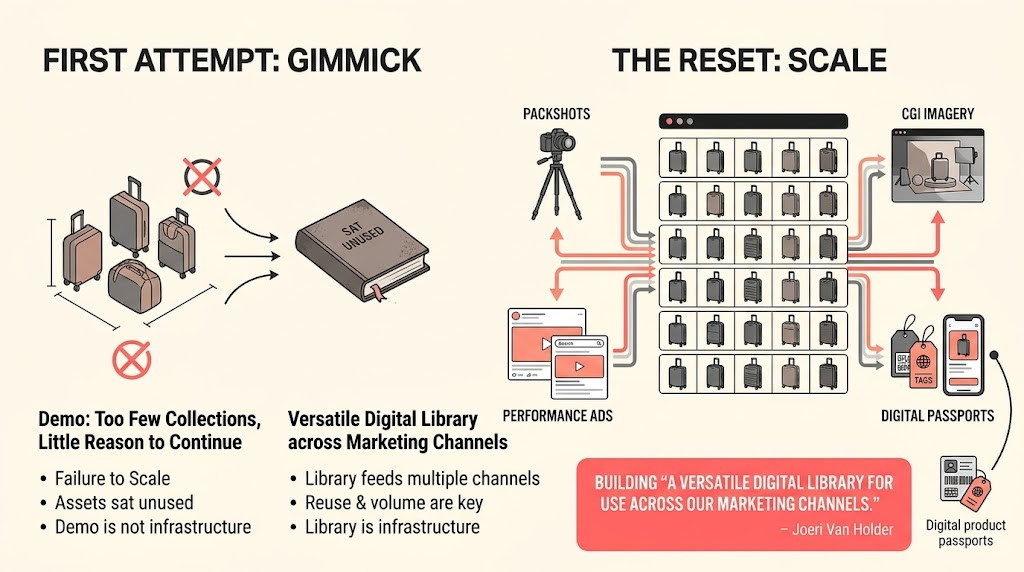
An early attempt stalled at the gimmick stage. Too few collections, too little reason to keep going. The assets sat unused.The reset was about scale. Samsonite rolled out 3D-first product experiences across 19 markets.
The logic changed too. One 3D model now feeds packshots, CGI, and performance ads. It became a library, not a one-off.
Joeri Van Holder, Senior Digital Marketing Manager, described the win as building “a versatile digital library for use across our marketing channels.”
Why did it work the second time? Volume and reuse. Enough collections went 3D that the assets earned their keep across channels.
The first attempt failed for a simple reason. A handful of models is a demo. A full library is infrastructure. That library keeps finding new jobs. The same assets are moving toward digital product passports, a use nobody planned at the start.
See Samsonite’s 3D experience.
5) ELTEN: Going 3D-First Across Every Channel, Not Just the Product Page
ELTEN is Europe’s leading safety footwear maker. Its challenge was standing out in a crowded, practical market.
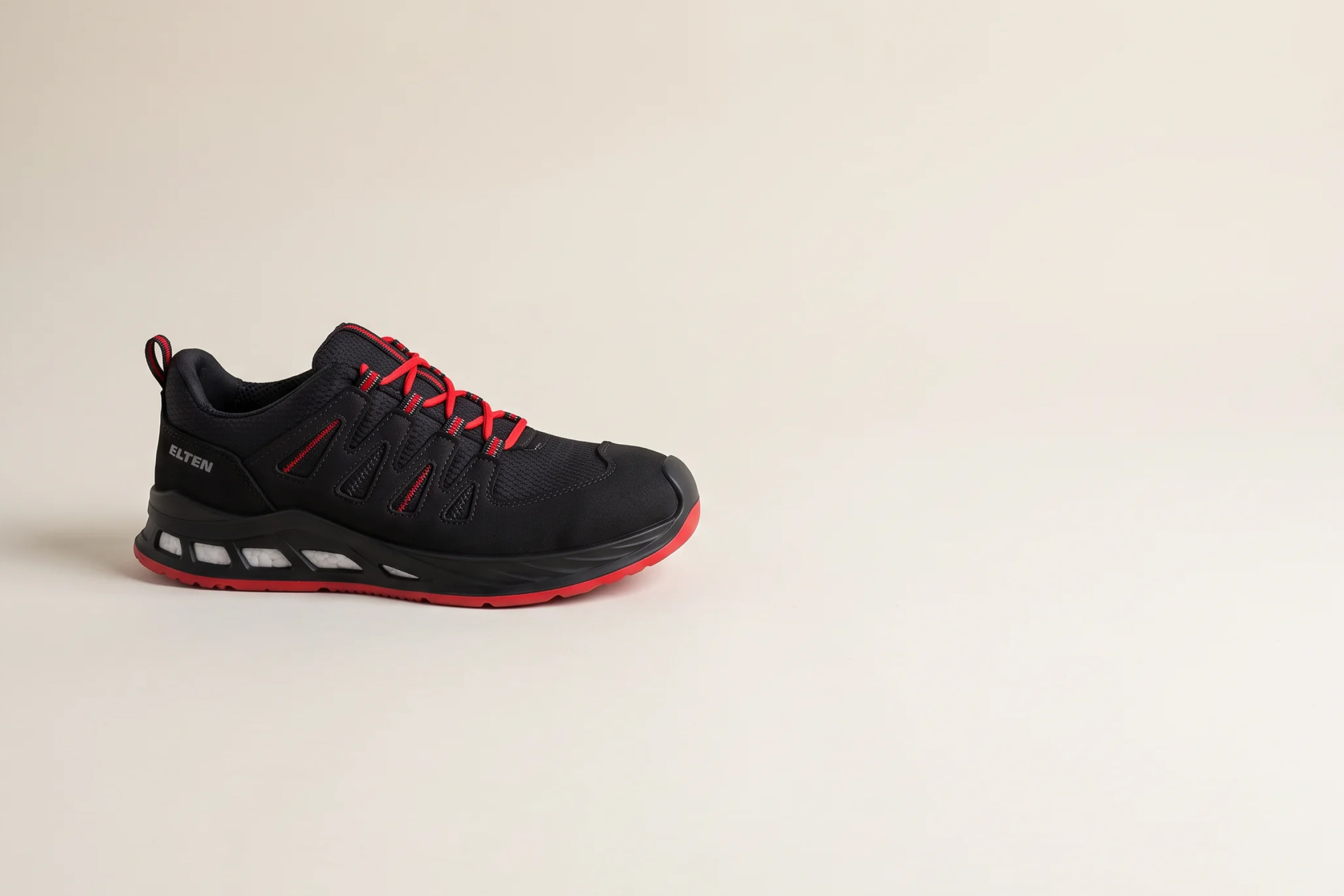
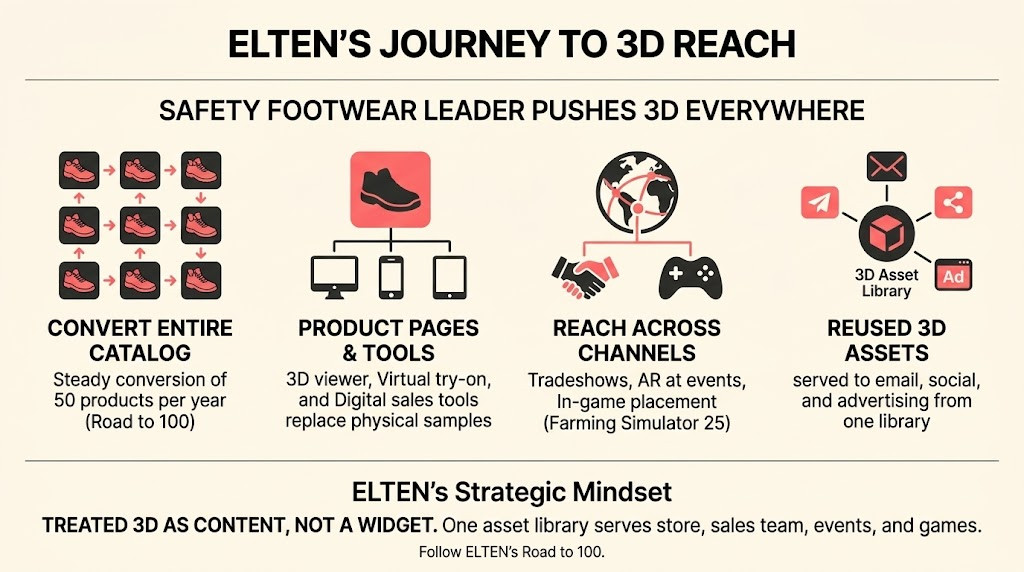
Most brands stop 3D at the product page. ELTEN pushed it everywhere its customers are. It sells to distributors, buyers, and workers, not just online shoppers. So one channel was never enough.
The rollout spanned channels:
- 3D viewer and virtual try-on on product pages
- 3D models at trade shows and in digital sales tools, replacing physical samples
- AR experiences at events, so buyers see products in their space
- In-game placement inside Farming Simulator 25
- Reused 3D across email, social, and advertising
The plan has a name: the Road to 100. ELTEN aims to convert its entire catalog to 3D, about 50 products a year, until nothing is left flat.
That patience is the point. A steady 50 a year turns a big catalog into a finished library without a crunch.
Why did it work? ELTEN treated 3D as content, not a widget. Once the asset exists, every channel is fair game.
Safety footwear is a rational purchase, sold hard in B2B. Cutting sample logistics for the sales team is real money.
The lesson is reach. A single asset library can serve the store, the sales team, an event, and even a video game.
What These Five Brands Had in Common
Different brands, different categories, different goals. But the pattern underneath is almost identical.
Line the five up and three habits stand out. They are worth copying, whatever you sell:
i) They started small and specific. Nobody chased a vision. LOCI wanted consistent images. Joya wanted a cheaper photographer. GANT wanted a conversion lift.
ii) They tested instead of asserting. GANT ran the numbers across 274 products. Joya let 400 retailers vote. Proof came before rollout.
iii) The asset outlived the use case. This is the real story. Each brand ended up somewhere it never planned:
- CGI brand films for GANT and LOCI
- B2B catalogs and demand forecasting for Joya
- Digital product passports for Samsonite
- In-game placement for ELTEN
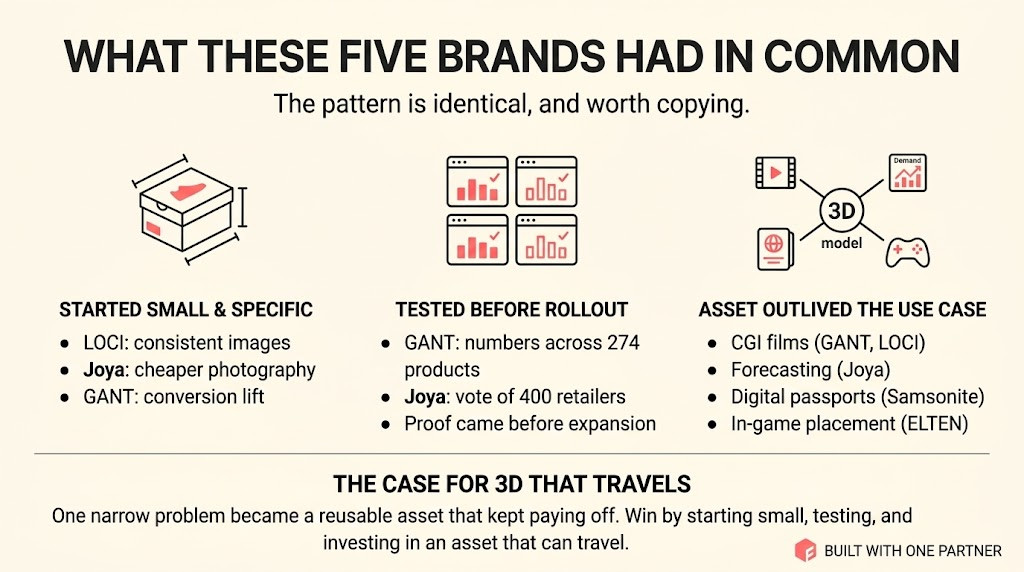
One narrow problem became a reusable asset. That asset kept paying off in places the brand never budgeted for.
Look at the destinations. Brand films, forecasting, product passports, a video game. Not one was in the original brief.
This is the case for 3D that spreadsheets miss. You buy it to solve one thing. You keep it for ten.
It also explains why the winners scaled. A 3D asset that sits on one page is a cost. One that travels is an investment.
And one more thing they shared. They all built it with the same 3D commerce partner.
How Fibbl Can Help You Implement 3D Commerce
That partner is Fibbl. Every brand above runs on the same pipeline.
Fibbl scans real products with proprietary hardware. One accurate 3D asset then powers packshots, a 3D viewer, virtual try-on, AR, and video.
It is built to scale. This is a catalog production line, not a project for five hero products.
Footwear and bags were the start. Fibbl now covers more of what people wear and carry:
If your product is not on that list, Fibbl still scans it. There is a page for custom and unlisted categories. If you have a business case, Fibbl can capture it.
You do not need to commit the whole catalog on day one. Start narrow, as these five brands did.
Pick the problem that annoys you most. Slow shoots, high returns, or thin ad content. Solve that one first.
Then watch where the asset travels. If these five are any guide, it will not stay on the product page.
Begin with a free product scan, or book a demo. Then let the asset surprise you.