Quick summary
AI product photography is already part of everyday production at some brands, but no two use it the same way. Zalando uses AI for most of its on-site marketing content, with its creative team controlling the look. Mango features AI images quite regularly on its store and labels them in plain words. Zara and H&M have used AI imagery with real models. Joya and Rumpf, both Fibbl customers, generate images around 3D models of their real shoes to keep the product accurate.
AI product photography is past the experiment stage at some brands. Yet, the label covers very different practices: re-dressing existing model photos, building digital twins of real models, and generating images from a 3D model of the real shoe.
For ecommerce and creative leads, the practical question is how other brands keep these images accurate and accountable. This article answers it with six examples as of October 2026: Zalando, Mango, Zara, H&M, Joya, and Rumpf. Each covers what the brand does (or did), where the images appear, how it keeps them under control, and one lesson. Worth mentioning, Joya and Rumpf are Fibbl customers.
Every claim comes from dated sources the brands or their partners published, and an approach is only called a success where the brand reported a result. New to the AI photography topic? Start with Fibbl’s guide to how AI product photography works.
How we chose these AI product photography examples
Every brand in this article passed the same three tests before it was included, so each example is real, visible to shoppers, and specific enough to learn from:
- A dated source published by the brand itself or, for Joya and Rumpf, by Fibbl about its customer.
- AI imagery that shoppers actually see in a store, in a campaign, in an email, or in a social post.
- A practice specific enough to describe precisely and learn one thing from.
Dates matter. The evidence for Zalando, Mango, Joya and Rumpf is from 2026. The evidence for Zara and H&M is from 2025, so we describe both in the past tense and make no claim that either brand still works this way.
1. Zalando: AI-generated marketing imagery with human creative review
Source: Zalando
What Zalando does with AI-generated images
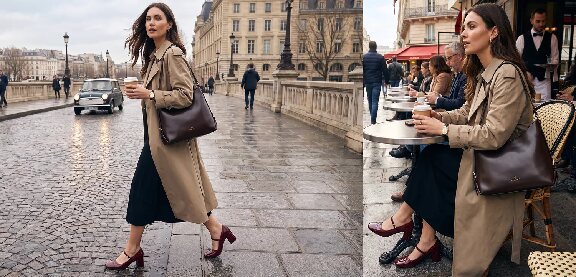
Zalando's corporate site said on 6 May 2026 that 90% of its on-site marketing content is now AI-generated. The work starts from trends in its own platform data, and its engine can write a simple prompt for an initial visual.
Where Zalando's AI images appear
Zalando’s 90% figure covers banners, trend highlights, campaign imagery and teasers on its website and app. It does not cover product detail pages or advertising outside Zalando. Separately, Zalando has made AI videos from existing product photography, and where a product page has one, the video is the first thing a shopper sees.
How Zalando keeps AI images on-brand
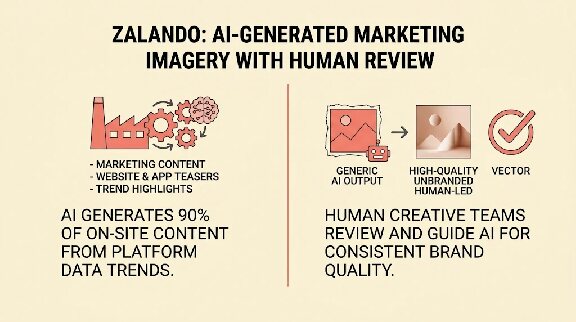
Zalando says its creative team defines the taste and final look, and guides the AI to keep the small human details of a real shoot, such as subtle textures and real-life lighting. Its process graphic shows three steps: a generic AI output, iteration with human taste added, and a final result at brand quality. Major human-led productions, such as its spring/summer campaign, still run on the site.
The lesson from Zalando
Use AI where speed and local relevance matter, and keep human taste and review in the loop.
2. Mango: AI-generated product images labeled on the product page
Source: Mango
What Mango does with AI-generated images
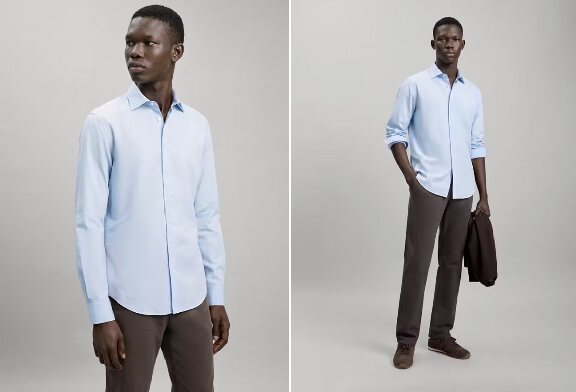
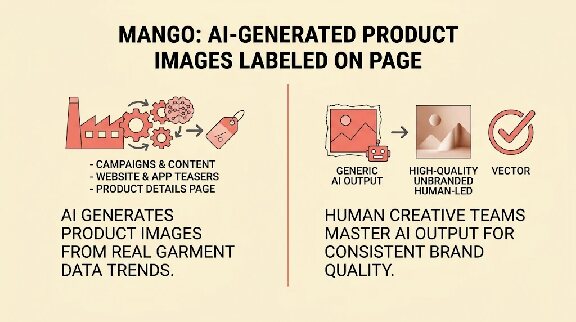
As of November 2026, Mango uses AI images quite frequently for its stores, with a simple plain line disclaimer: “These images have been generated with AI”. The practice follows a July 2024 campaign that Mango called its first entirely generative AI collection, the Mango Teen Sunset Dream collection.
Where Mango's AI images appear
Mango’s AI label appeared on product pages mainly. Here are a couple of examples, Teen girl skirt page and a Teen boy shirt page. The 2024 Sunset Dream campaign was available across 95 Mango markets.
How Mango labels and finishes its AI images
For its July 2024 Sunset Dream campaign, Mango photographed each real garment and trained a generative AI model to place it on a model. Its art team then selected, retouched, edited, and mastered the images in its photography studio. On the product page, the label sits in the description.
The lesson from Mango
Tell shoppers in plain words, at the point where they decide, that an image was made with AI.
3. Zara: AI re-dressing of existing model photos, with model consent
Source: Zara
What Zara did with AI-generated images (reported December 2025)
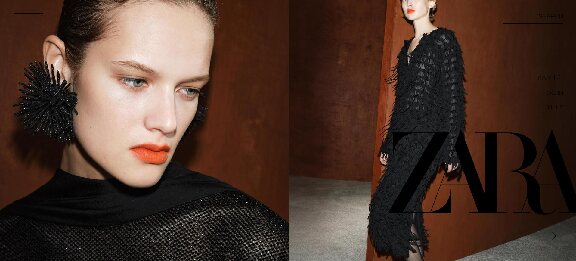
In December 2025, City AM reported, and Reuters followed, that Zara was using AI to create new images of real models wearing different outfits, built from existing photo shoots. Zara had not directly announced the practice itself.
Where Zara's AI images appear
City AM reported that Zara’s AI-generated model images appeared in its online store. So this account comes from press reports rather than the company’s official statement.
How Zara handles model consent and pay
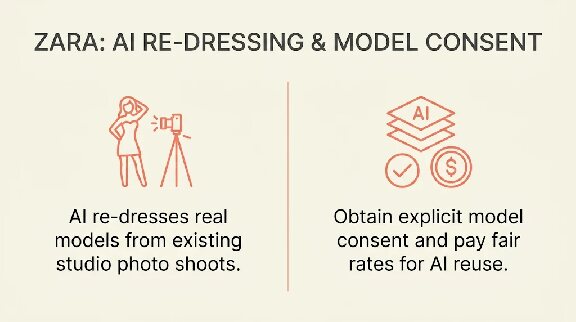
In the same reporting, a spokesperson for Inditex, Zara’s parent company, said the company used AI “only to complement our existing processes”, worked with models on a mutual basis and paid them in line with industry best practice. A model told City AM they had been asked to approve AI edits of their images and would be paid the same as for another shoot.
The lesson from Zara
If AI reuses a person's photos, get their consent and pay them.
4. H&M: AI digital twins of models, with consent and labels
Source: H&M
What H&M did with AI digital twins (from July 2025)
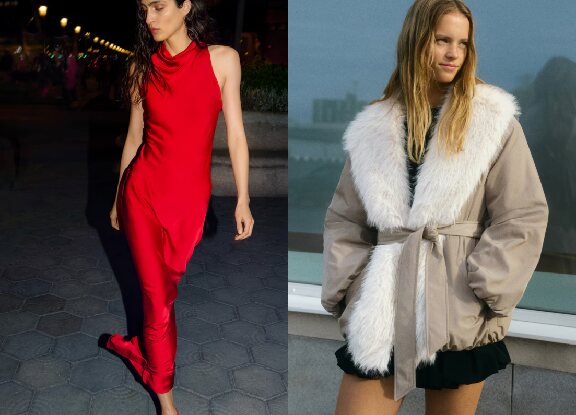
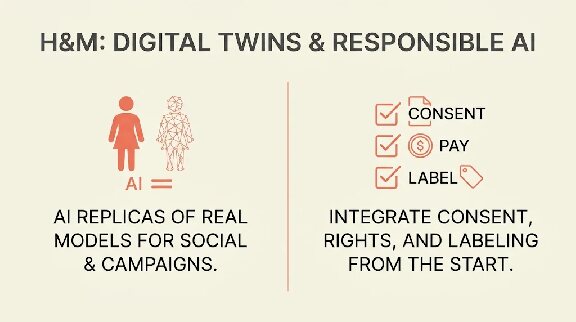
H&M Group's newsroom announced on 2 July 2025 its first images featuring digital twins, which are AI replicas of real models. H&M had said in March 2025 that it would create digital twins of 30 models. The first set showed denim looks against backdrops of fashion capitals, co-created with a dedicated team and released with a behind-the-scenes film. H&M said more would follow in fall 2025.
Where H&M's AI images appear
H&M used the digital-twin images in social media and campaign imagery, not on product pages.
How H&M handles consent, pay and labels
The models in H&M’s digital-twin project kept the rights to their digital twins and were paid under their agreements. The July 2025 images carried a label in the corner identifying them as digital twins. One participating model described the arrangement as professional, collaborative and transparent.
The lesson from H&M
Build consent, ownership and labeling into the process from the start.
5. Joya: AI lifestyle images generated from 3D models of real shoes
Source: Joya
What Joya does with AI-generated images
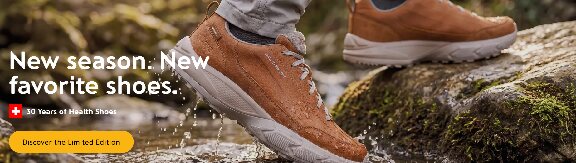
Joya, a Swiss shoe brand, creates all its lifestyle imagery with Fibbl's AI Studio. The company runs two shoots a year, each covering 15 to 20 new models, with AI assisting the workflow.
Where Joya's AI images appear
Joya’s AI-generated lifestyle images run on its website and social media, in magazine ads, on A1 and trade fair banners, and in B2B channels.
How Joya keeps the shoe accurate in AI images
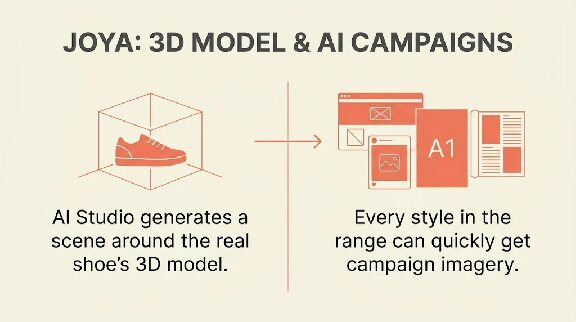
Fibbl’s AI Studio, which Joya uses, starts from the 3D model of the real shoe and generates the scene around it. The team selects the shoe and writes a prompt describing the setting and the people. Joya's autumn/winter 2026 posters lead with the sole, so the sole in the image has to be the real one.
The lesson from Joya
When images are generated around a 3D model of the real product, any style in the range can get campaign imagery, not only the few picked before a shoot.
6. Rumpf: AI hero images for newsletters, Instagram and product pages
Source: Rumpf
What Rumpf does with AI-generated images
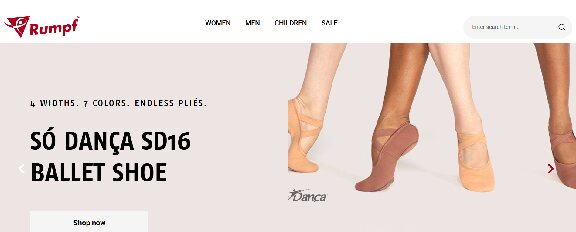
Rumpf, a dance shoe brand, generates images directly in Fibbl's AI Studio from 3D-scanned models. The creative team then sizes and adds text to the images using Figma for marketing purposes. Fibbl helps them with the entire workflow.
Where Rumpf's AI images appear
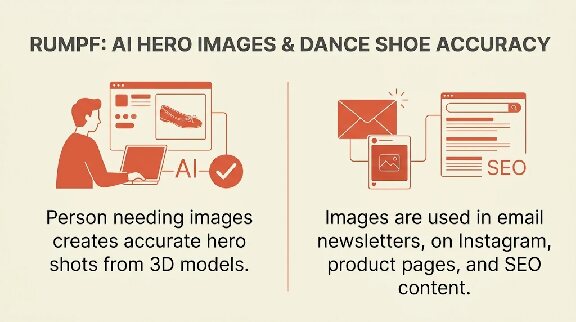
Initially, Rumpf’s AI hero images appeared in email newsletters and Instagram posts. However, the company has recently started using them on product pages and in SEO content, too.
How Rumpf keeps the shoe accurate in AI images
Rumpf's customers are dancing artists who check heel height, lacing, and sole, so an image that changed any of those details would mislead them. AI Studio starts from the 3D model of the actual shoe and generates only the setting.
The lesson from Rumpf
Start with one use case, test, and then expand.
AI product photography results: what each brand has reported
Three of the six brands in this article have shared results from their AI imagery: Zalando, Joya and Rumpf. Zalando reports its own figures, and Fibbl reports on Joya and Rumpf, so read these as company-reported numbers. Zalando's figures cover editorial and marketing content, not product-page photos.
Brand |
What was reported |
Reported by |
Source and date |
|---|---|---|---|
Zalando |
90% of on-site marketing content is AI-generated. Customers engage 10% more with this content. Production fell from six to eight weeks to a few days, with a target of under 24 hours. They have made 170,000 AI videos from existing product photography. These cover editorial and marketing content, not product-page photos. |
Zalando |
Zalando corporate site, 6 May 2026 |
Joya |
Lifestyle images can now be made for any model in the range, not around five per shoot, and all lifestyle imagery is AI-generated. These are operational changes, with no sales figures. |
Fibbl, the partnered vendor |
|
Rumpf |
Newsletter hero images are made in-house at short notice with no photo shoot, and the AI images now power Instagram, product pages, and SEO content, too. No performance figures. |
Fibbl, the partnered vendor |
We found no published results for AI imagery from Mango, Zara or H&M. None of the six brands has published sales or conversion figures for its AI images.
What footwear and bag brands can learn from these AI product photography examples?
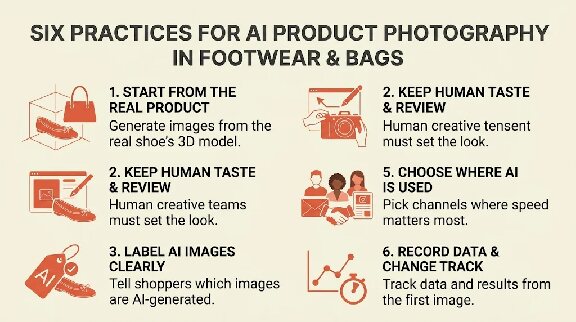
Zalando, Mango, Zara, H&M, Joya and Rumpf use AI imagery in different ways, but six practices show up across them. Each one below names the brands that show it so that you can go back to the full example. Together, they form a playbook for any brand testing AI product photography.
- Start from the real product. Joya and Rumpf generate images from the 3D model of the real shoe. Mango trained its model on real photos of each garment.
- Keep human taste and review. Zalando's creative team sets the look. Mango's studio retouched and mastered the images before they went out.
- Label AI images where shoppers see them. Mango labels its product pages. H&M labeled its digital-twin images.
- Get consent and pay people for their likeness. Zara and H&M both described consent and pay for the models involved.
- Choose where AI is used. Zalando uses it for marketing content and video, not product-page photos. Joya uses it for all its lifestyle imagery.
- Record what changes. Only Zalando has published performance numbers, and even those are self-reported. If you want to report results, start tracking with the first image.
For footwear and bag brands, accuracy lives in the details. Soles, hardware, stitching, and color are what shoppers check, as Rumpf's dancers and Joya's sole-led posters show. Start images from the real product and check each set against the item before it goes live.
AI product photography checklist for footwear and bag brands
Use the following AI product photography checklist to turn the six practices discussed above into a routine before your first asset goes live. While the checklist is primarily created for footwear and bag teams, where soles, hardware, stitching, and color get the closest inspection, it works for most product categories.
- Start images from the real product: a 3D model or approved product photos.
- Decide where AI images will and will not appear: campaigns, social, email, product pages.
- Check every image set against the real item (sole, hardware, stitching, color) before it goes live.
- Name one person who reviews and approves AI images.
- Label AI images in plain words where shoppers see them.
- If real people appear, get written consent and agree on pay and ownership.
- Record how many images you make, how long each takes, and where they run.
- Keep the source files so you can regenerate images when a product changes.
Test AI-generated product images on five of your products
Zalando, Mango, Zara, H&M, Joya and Rumpf use AI in different ways, but each set a clear rule for accuracy or accountability. The simplest way to judge AI imagery is to test it on your own range. Try 5 products free, or book a demo if you would rather talk it through first.