Quick summary
3D commerce rarely fails at the pilot stage. It stalls on the way to the full catalog. The main challenges involve getting buy-in and budget, building assets that hold up at volume, going live without slowing the store, and scaling past the first range. However, GANT, Joya or Samsonite have proven you can get past these challenges and implement and scale 3D commerce successfully.
3D commerce is easy to pilot and hard to roll out. Interactive 3D, AR, and virtual try-on can go live on a handful of products, with a few good models and one motivated team. A full rollout is a different job. It means producing, checking, and publishing 3D for hundreds or thousands of products, season after season.
That gap is where implementation often stalls. A rollout needs consistent, web-ready models and materials that look right on screen. It needs content ready before the samples arrive, a fast-loading store, and alignment between ecommerce, creative, and finance.
This guide covers seven challenges in the order brands meet them, from getting a pilot approved to scaling beyond it, and how brands get past each one. Fibbl has produced 3D for footwear and bag brands such as GANT, Joya, and Samsonite, and has scanned more than 20,000 shoes and bag SKUs till date. The challenges here come from that work and from conversations with many other brands evaluating 3D.
What 3D commerce implementation involves
3D commerce implementation has four parts, and each depends on the others.
- Making the assets. A photorealistic 3D model is made from the physical product. Scanning is one tool among several. Fibbl's view is that you start from the deliverables you need, not the scanner.
- The experience layer. The 3D viewer, AR, and virtual try-on sit on top of the model. Design the model and viewer together so the product looks right and loads fast.
- Connecting the assets to the store. Each model matches a product through a shared identifier, such as a SKU, GTIN, MPN, or item group ID. A script on the product page displays it.
- Reusing the asset. The same model can also produce packshots, video, and ads, so the work pays off beyond the product page.
In practice, projects tend to stall in two places: asset production, and scale. You can see how the four parts fit together in how Fibbl works end to end.
The seven challenges below follow the order brands meet them, across four stages: getting a pilot approved, building the assets, going live and scaling to the full catalog. Each one covers what it looks like in practice, why it happens, how brands get past it, and a published example. If you are mid-rollout, jump to the stage you are in. If you are still planning, read straight through.
Before you start: getting a pilot approved
No product gets scanned until the business agrees to try. The first challenge is winning that agreement, and the budget that comes with it.
Challenge #1: Getting internal alignment and budget before the first scan
What it looks like: Three teams have to say yes before the first scan. Ecommerce wants the experience. Creative wants to know what happens to photography. Finance wants proof.
Why it happens: One 3D asset feeds content, marketing, B2B, and ecommerce, so the project crosses team lines and budgets. No single team owns the decision.
Finance has reason to be careful. US retailers estimate that 15.8% of their 2025 sales, about $850 billion, would be returned, and 19.3% of online sales, according to merchant estimates in NRF and Happy Returns' 2025 Retail Returns Landscape (October 2025). With margins under that pressure, every new budget line gets questioned.
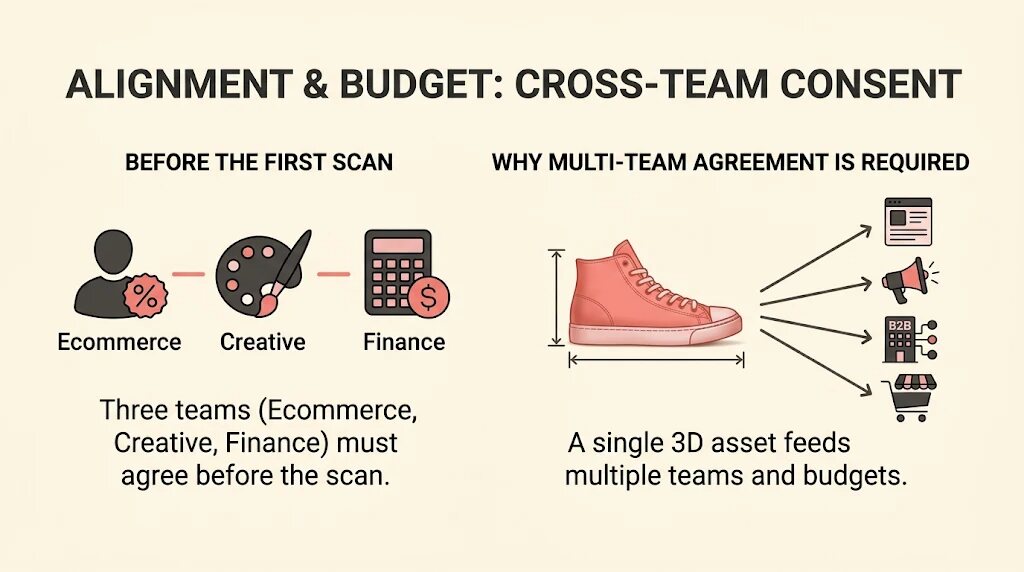
A common question is what happens to the in-house photography team. A common answer is that repetitive packshots move to 3D so that photographers can focus on lifestyle and campaign work. Brands usually want evidence before committing a full budget, so they start with a small set of products.
How brands get past it: Run a small, bounded test, with all three teams agreeing on the success metric before launch. Then the result settles the debate. Fibbl's free test covers 5 products.
Proof point: According to the GANT case study, GANT ran an A/B test of 3D-first against image-first across 13 markets, 274 products, and more than 400,000 users, with a 10% control group. 3D-first lifted conversion by 6.3% at 95% statistical significance. GANT also piloted before scaling at each phase: product pages, imagery, and paid media. One season of 3D packshots saved 50% of the time and 50% of the cost.
Joya started with one shoe and a practical problem, not a plan to go 3D-first. These results are the brands' own, and yours will depend on your range. See what the footwear A/B tests actually show before you set a target.
Building the assets: production and quality
Once the pilot is approved, the work shifts to creating and testing the assets. This is where most of the effort goes.
Challenge #2: DIY asset creation stalls
What it looks like: Many brands try to do it themselves at first. They buy a 3D scanner, hire a 3D artist to model by hand, or build their own viewer or try-on. Some try a store platform's built-in scanning feature and find the models are not good enough to publish. Others run a pilot they cannot extend. The usual tipping point is being unable to cover the full range quickly.
Why it happens: A 3D pipeline has several problems: capture, processing, textures, web optimization, the viewer, and distribution. Photogrammetry, NeRF, and Gaussian splatting are each one capture tool, with limits the rest of the pipeline has to plan for.
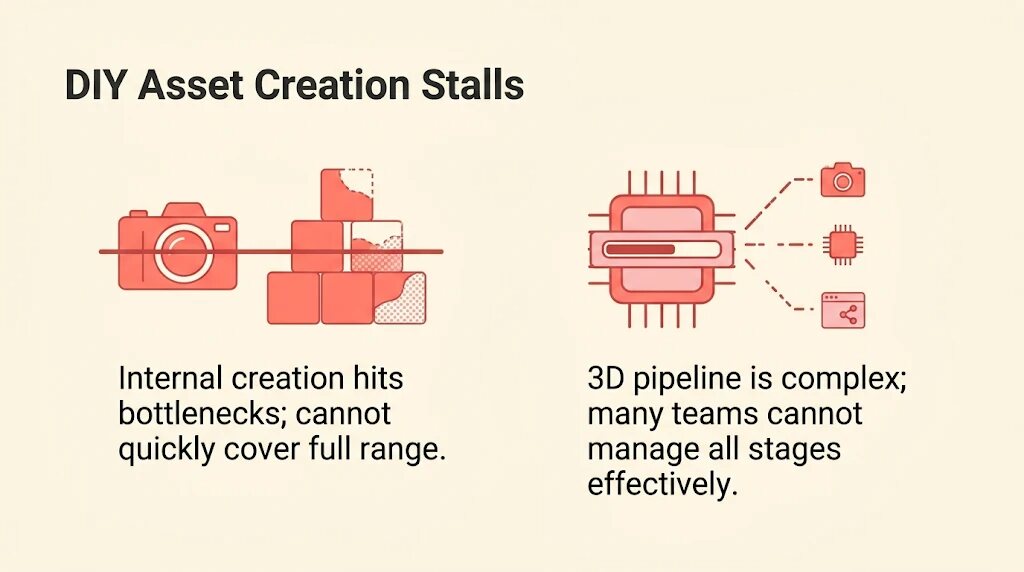
The common misconception goes like this: if we buy a scanner, we have a 3D model, and every opportunity opens up. Fibbl's Head of Production says this is not the case. A 2019 Khronos Group presentation described the same pain in illustrative speech bubbles, not survey results: products do not come with 3D data and cannot be scanned fast enough.
How brands get past it: Start from the deliverables, whether that is a web viewer, AR, packshots, or video, and work backward to the tools. Decide who owns the pipeline. No single tool solves it. Building in-house can work if you plan it as a pipeline from the start.
Proof point: Fibbl lived this. Its team bought scanners first and found scan times long and resource-intensive. It then built its own and, by Fibbl's account, improved scanning time by an order of magnitude, later cutting processing time by 25%. Each fix revealed the next bottleneck. The interview with Fibbl's Head of Production and CTO covers it in detail.
Challenge #3: Your existing 3D and CAD files may not work on the web
What it looks like: A brand already has 3D files from design and development. The plan is to reuse them, ideally through an automated process. Then the first files turn out far too heavy for a product page.
Why it happens: Design files are built for designers and offline rendering, not a shopper's phone. Four questions decide how much work sits in between:
- How many polygons does the model have?
- How large are the textures, and do they need downsampling?
- Does the model have the right shaders for the renderer?
- Is the mesh quad-based or triangulated? Web graphics need triangulated meshes.
Each answer adds or removes conversion work. Since the first thing brands ask about 3D is whether it slows their site, heavy files are a business problem. Khronos Group's 2019 presentation flagged this too, in illustrative speech bubbles: CAD tools do not easily produce the data ecommerce needs, and models can arrive upside down and need hand-tuning.
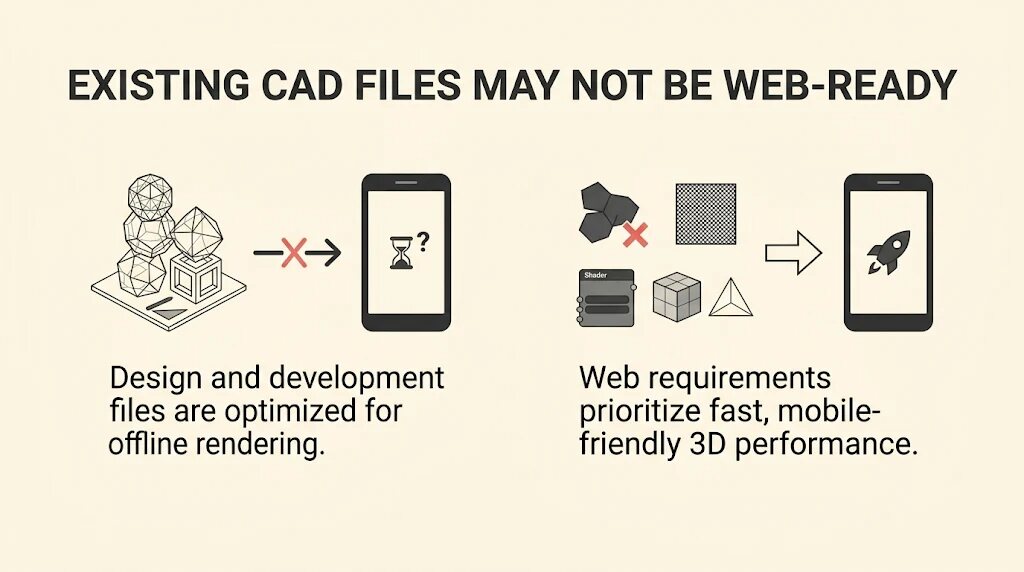
How brands get past it: There are two routes. Build the translation layer in-house, with people who know both design files and web delivery. Or produce the models again to one web-ready specification.
Proof point: Fibbl's CTO and Head of Production say that in some cases they found it cheaper and more effective to produce the models again than to translate old ones. Fibbl builds every model to its own specification.
Challenge #4: Material and color accuracy at scale
What it looks like: Leather, mesh, patent, and suede all behave differently under light. The model has to look like the real product in the viewer and in every rendered image. Brands typically run their own quality review before launch, and that is where accuracy gets tested. Reviewers tend to focus most on leather, reflective details, small printed text, and very dark materials.
Why it happens: One setup does not fit every product. A sneaker and a knee-high leather boot need different tool sets. Color must also hold across the whole chain, from raw capture through processing and textures to lighting in the viewer. A break at any step shows up as an off color on screen. Khronos Group's 2019 presentation made the same point with an illustrative couch that looked a different color on different devices, and the costly returns that followed.
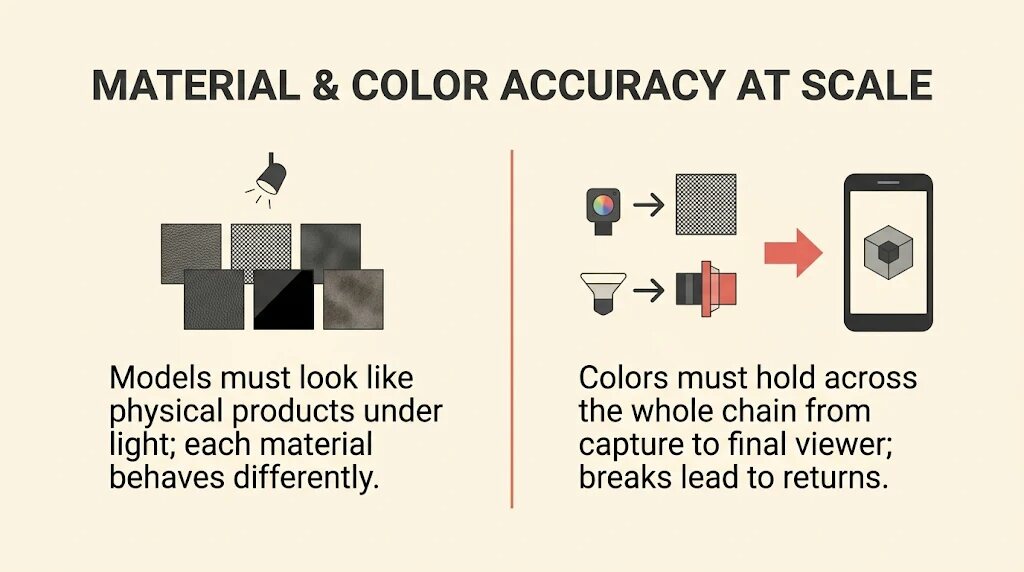
How brands get past it: Set up production per category, not per product, and agree what reviewers will check before the first model arrives. Fibbl states that every colorway can come from one sample, with the color set on the 3D model. A new pattern or a different material is generally a separate case and is scoped on its own. If a defect is found in a 3D model, fixing the model corrects every image, video, and experience made from it.
Proof point: Fibbl documented per-category blueprints in its Category Production Manual, like a car plant set up for a few model lines rather than every model. For some parts of some products, hard-surface modeling runs alongside photogrammetry to shorten lead time. Fibbl produces defined product categories. Products or materials outside the standard scope are discussed case by case.
Challenge #5: Deadlines arrive before the samples
What it looks like: Catalogs and launches have fixed dates, but the final product samples often arrive later. So the content is due before the product exists to photograph or scan.
An illustration (hypothetical): A brand is selling a spring collection to wholesale partners. The catalog has to reach buyers in January so they can place orders. The factory sends the final samples in February. Now the catalog needs images of shoes that have not arrived. The brand can send an incomplete catalog, or wait and miss the buyer window.
A common version of the problem: the wholesale catalog is due before the photo samples have arrived.
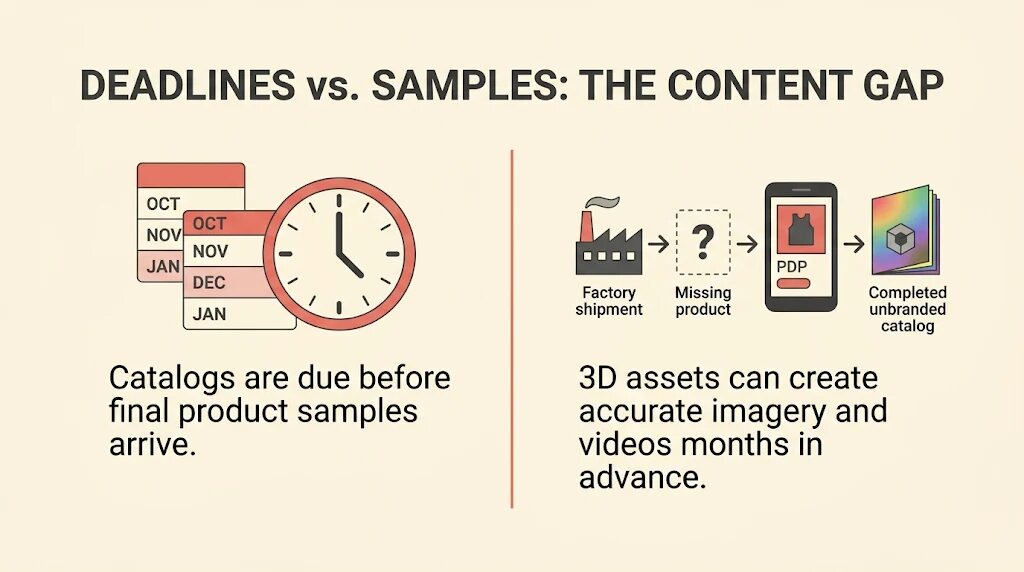
Why it happens: The calendar follows the buyers, not the factory. Photography needs the finished product on a booked studio day, so every slip in samples pushes the images back.
How brands get past it: 3D changes part of this. Once a physical sample reaches the studio, content is rendered, with no studio slot to wait for, and other colorways can come from the same sample. Here is how to still ship packshots when samples are late.
3D does not change the rest. The physical sample is still required. A late sample stops being a launch blocker and becomes a courier problem.
Proof point. For SS26, Joya had to place factory orders before its sales samples were ready and circulated. It moved the second sample round into 3D and invited over 400 retail partners to review, rotate, and vote on styles in a Fibbl-powered voting tool. Fibbl's homepage reports 2 to 3 months more selling time for Joya, because orders were placed earlier. Read the Joya case study.
Going live: store integration and performance
With assets ready, the next test is the live store: the right pages, fast loading, and real use.
Challenge #6: Store integration, page speed and shopper adoption
What it looks like: The store has thousands of product pages, a web team that guards page speed, and shoppers who may never notice a 3D button.
Why it happens: Matching hundreds of models to products by hand is slow and error-prone. Site teams worry, reasonably, about speed. And a viewer that sits out of sight gets little use.
How brands get past it: Each model is tied to its product through a shared identifier (SKU, GTIN, MPN, or item group ID), usually by importing the product feed. The system suggests matches and a person approves them, which keeps hundreds or thousands of models manageable.
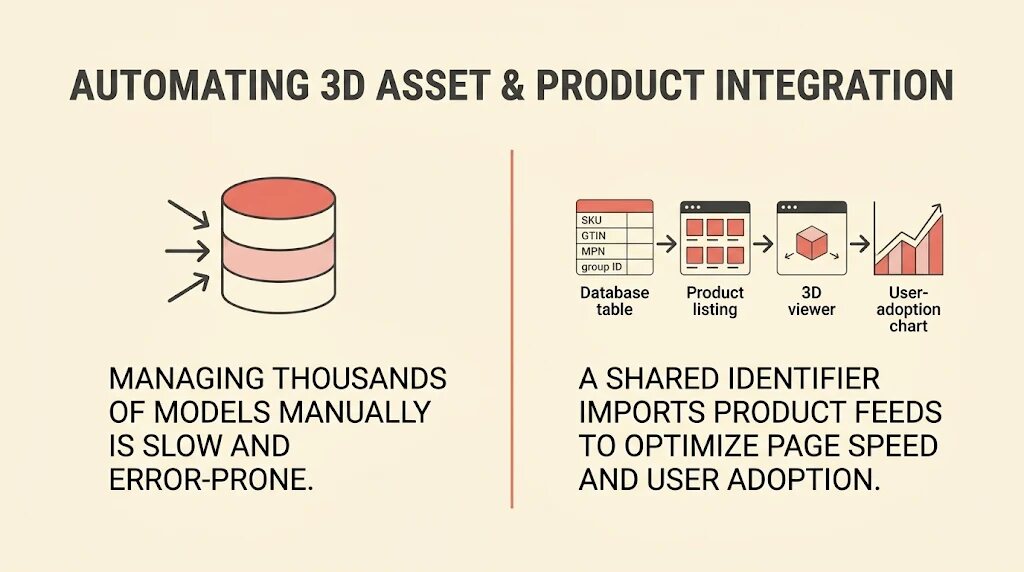
A short script goes once on the global product page template, using a dynamic variable, never hard-coded per product. If a product has a matching model, the 3D elements appear. If not, they stay hidden, and the page looks as usual. That lets you roll out gradually, since brands do not move from 2D to 3D overnight. Layout and styling stay with you, in normal HTML and CSS.
Devices need different files. The web viewer uses an optimized GLB, and iOS AR needs USDZ. Fibbl automates the compression and conversion to keep the experience consistent.
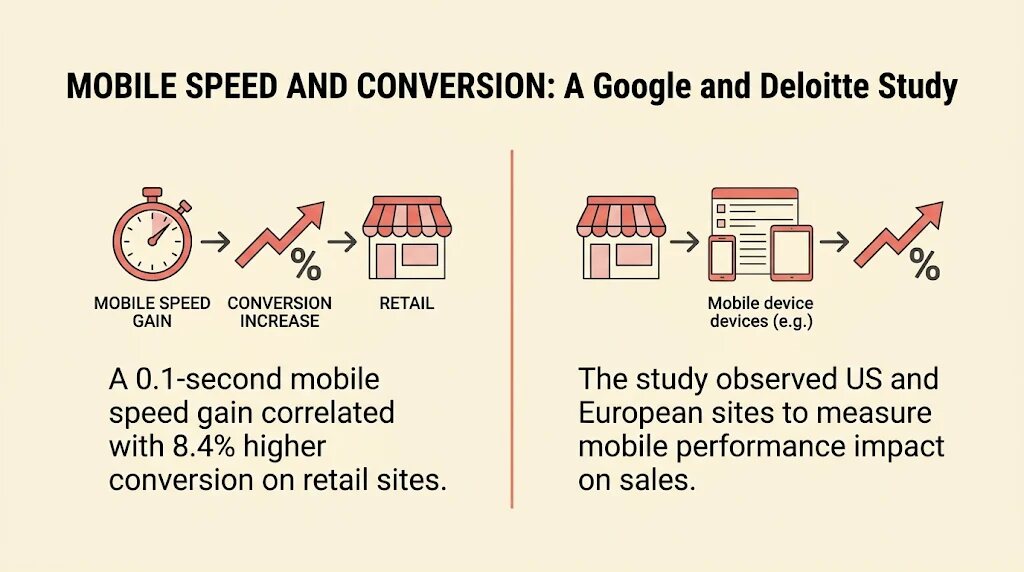
For speed, Fibbl built its own delivery because common content delivery networks weren't fast enough for 3D, and the script checks whether a model exists before doing anything else. Fibbl also commissioned an independent assessment of 3D and SEO from a Swedish digital marketing firm. Why the web team cares: in an observational study of 37 European and US sites, commissioned by Google and run by Deloitte and 55 at the end of 2019, a 0.1-second gain across four mobile speed metrics went with 8.4% higher conversion on retail sites. It was not a study of 3D.
Finally, add your measurement ID to the script, and events flow to your Google Analytics 4 property so that you can prove the return.
Proof point: GANT's 3D started behind a button, and usage hovered around 3%. Small changes to visibility and interaction design made it climb, and GANT then tested 3D as the default in the A/B test from challenge 1. Even in the image-first group, 16% of users still chose to interact with 3D. Placement changes how much 3D gets used.
Scaling: from pilot to full catalog
A pilot proves the idea. Scale tests the process, and the earlier challenges return at volume.
Challenge #7: The pilot works, but the full catalog does not follow
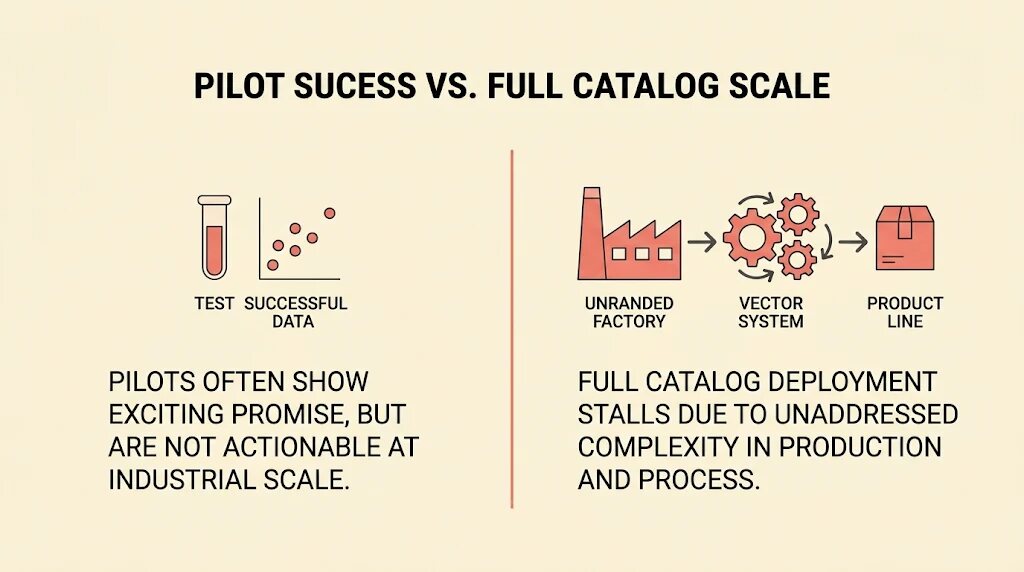
In July 2019, as it launched its 3D Commerce Working Group, Khronos Group, the developer of the glTF format, said retailers' experiments with 3D and AR product representations had been exciting but, so far, “not actionable at an industrial scale.”
What it looks like. The pilot is live, and the numbers look good. Then a new season arrives, a new category needs different handling, and the rest of the range never follows.
Why it happens: Scale is mainly a production and process problem. Fibbl's Head of Production describes an industrialization mindset: narrow the scope, standardize the processes, automate what can be automated and standardize what cannot, then keep revisiting the bottleneck. A pilot hides what only shows at volume: category and material differences, season timing, and product-to-model matching.
How brands get past it: Write a production specification per category. Plan scans around the season. Give the project one owner. Reuse every model across every output, so the work compounds.
Proof point: These are published rollouts, not pilots. GANT has produced its entire footwear range in 3D for six seasons, 1,349 shoes in total. Joya has produced more than 250 footwear models across five to six seasons and now produces its full SS and AW assortment in 3D. Samsonite is 3D-first on 19 markets. Across its work, Fibbl reports more than 20,000 shoes scanned and 72 million end-consumer interactions between April 2024 and August 2026. An interaction is a shopper rotating, zooming, switching colorways in 3D, or launching AR.
How to scale 3D commerce: a four-phase implementation roadmap
The following phases mirror how GANT and Joya rolled out 3D commerce for ther stores. They are a sequence, not a guarantee. For the mechanics, see this step-by-step implementation guide, and these brand examples and why each worked.
- Pick the pilot set—a small group of best sellers, or products where detail matters. You can try 5 products for free before committing a budget.
- Prove it with a test. Agree on the metric first. GANT's A/B test from challenge 1 is the model, with its 10% control group.
- Extend across range and seasons. Joya went from one shoe to more than 250 models across five to six seasons.
- Reuse the asset. The same model can power packshots and product videos. GANT created 392 videos from 196 products and tested them against still images in Sweden, Germany, and the UK, with 30.27% higher click-through and 13.79% higher return on ad spend.
In-house vs. Outsourced 3D commerce implementation: How to choose
Both in-house and outsourced routes are valid for 3D commerce implementation. The answer depends on your team and your range, and it can differ by stage.
Stage |
What an in-house team owns |
What a partner takes on |
|---|---|---|
Asset creation |
Capture equipment, 3D artists, processing, and the rules for each product category |
Scanning, modeling, and quality checks to one specification |
Viewer and delivery |
Building or choosing a viewer, optimizing files for each device, and fast delivery |
A viewer designed together with the models, plus file formats and delivery |
Store connection |
Matching models to products and maintaining the product page script |
Matching tools and a one-time script, while the brand keeps layout and styling |
Content reuse |
The rendering setup for packshots, video, and ads |
Renders made from the same model |
Season after season |
Staffing for peaks, new categories, and keeping the pipeline current |
Production capacity and a repeatable process across seasons |
A brand with an established 3D team and a narrow range may reasonably build. A brand with a large catalog that repeats every season usually needs a pipeline, not a project. If you already hold design files, factor in the translation work from challenge 3, since in some cases producing models again proves cheaper than converting them. If you are comparing partners, this buyer's guide to choosing a 3D commerce provider sets out what to ask.
3D commerce implementation readiness checklist
Answer these before you brief anyone, in-house or outside, about your 3D commerce plans:
- How many products do you launch per season, and across how many categories?
- When do final samples arrive, compared with when content is due?
- Which store platform do you use, and who owns the product page template?
- Who owns the 3D project internally, from approval to rollout?
- What is the one metric that would prove the pilot worked?
- Which products go first, and why those?
- Do you already have 3D files, and to what specification?
- Who reviews the models before they go live, and what will they check?
Start your 3D commerce pilot with five products
3D projects tend to stall between the pilot and the full range, so start small and measure it. Try 5 products free: Fibbl scans the samples in its Warsaw studio, no credit card is needed, and you keep the 3D asset. If you would rather talk it through first, book a demo.