Quick Summary
3D visualization vs photography is a real decision, not a trend. 3D wins on consistency, speed at scale, cost over time, and reuse across channels. Photography still wins for small catalogs and authentic editorial work. The honest answer is to pilot a few products and decide by category.
You run a traditional photography workflow. It works, mostly. But the shoots are slow, the costs repeat, and 3D keeps coming up.
So here is the real question. For your product pages, is 3D product visualization worth the shift, and how far should you go?
This guide compares 3D visualization vs. photography for ecommerce. Not a hit piece. Traditional photography still earns its place.
We’ll define both, compare them honestly, and show where each one wins. Then you can decide, category by category. This is a mid-funnel call, not a leap of faith. You can move one shelf of the catalog and keep the rest.
What is Traditional Product Photography?
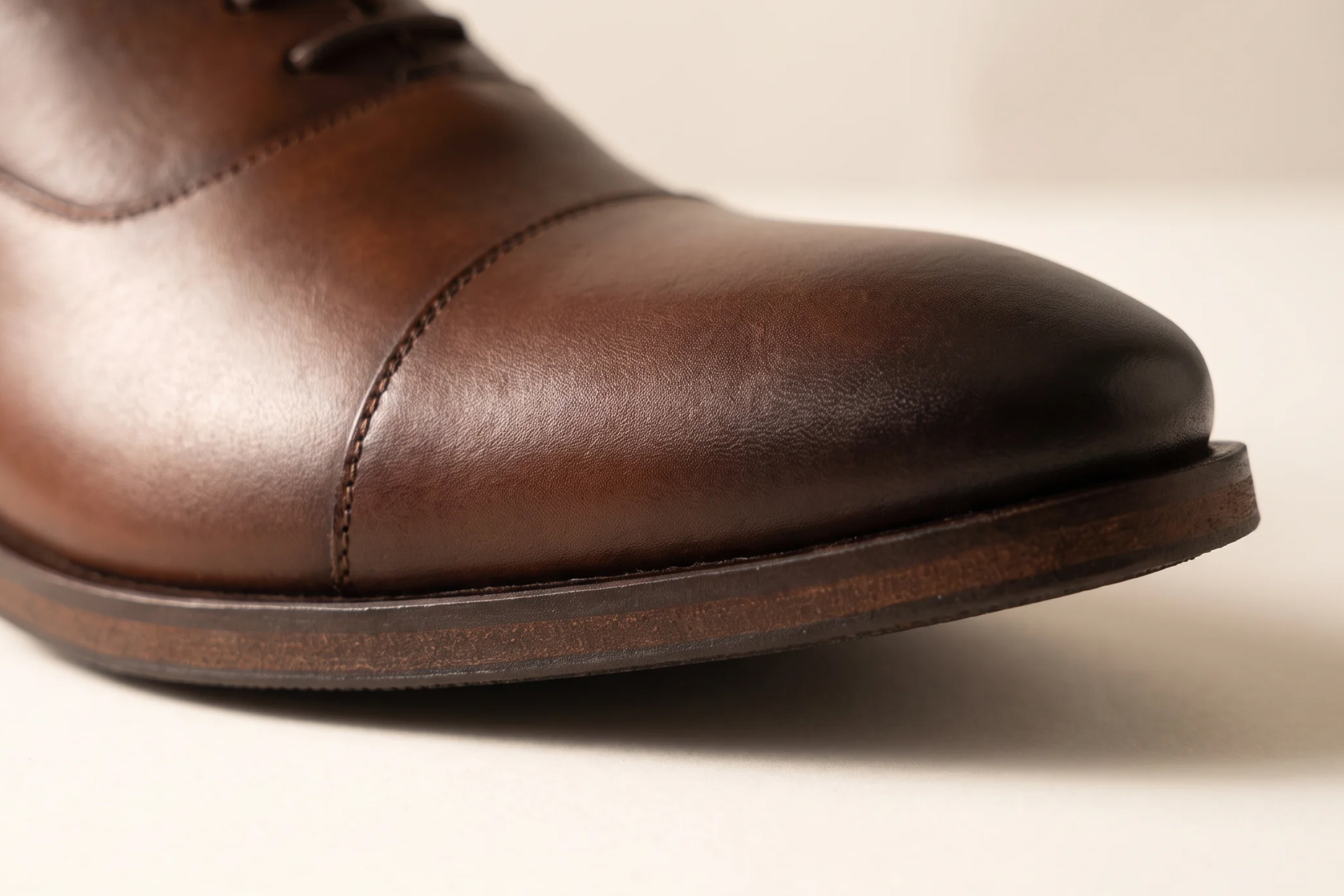
Traditional product photography captures the real product with a camera: a photographer, a lit set, and the physical sample.For ecommerce, it usually means two kinds of shots. Clean packshots on white, and lifestyle images in a styled scene.
It is the default for most stores. The skills are known, the gear is available, and the output is trusted. Done well, it is beautiful. A skilled photographer and a good set still produce stunning images.
The catch is the process. Every shot needs the sample, the setup, and the edit. That repeats for every product.
Quality also depends on the day. A different photographer or light rig can shift how a product looks.
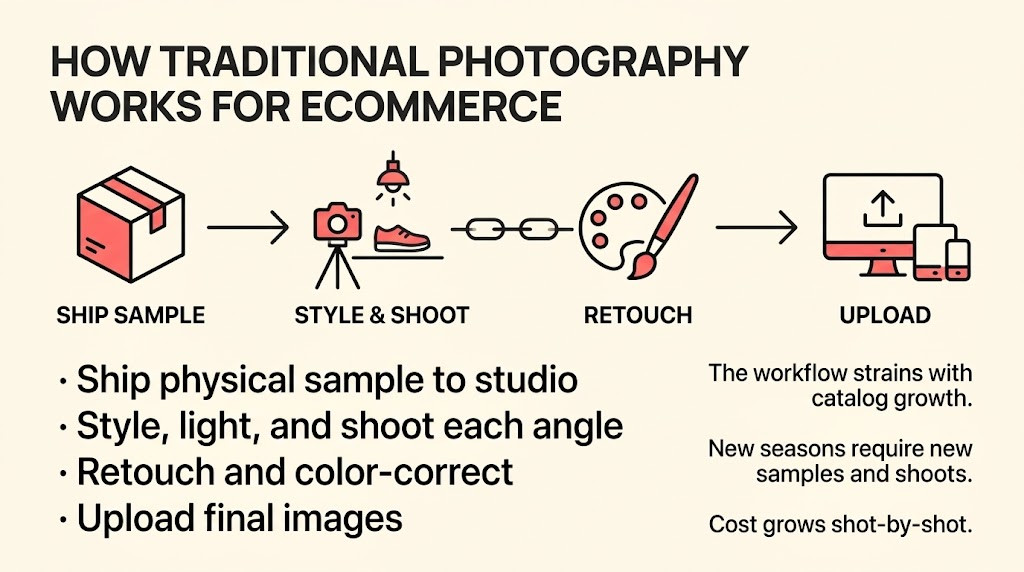
How Traditional Photography Works for Ecommerce
The workflow is a chain. Each link adds time and cost.
- Ship the physical sample to the studio
- Style, light, and shoot each angle
- Retouch and color-correct in post
- Upload the final images to the PLP and PDP
For a small drop, this is fine. For a large catalog, it strains fast.
A new season means new samples and new shoots. A rebrand can mean reshooting everything you already have.
Many footwear brands feel this most on packshots, where volume is high, and consistency is hard to hold.
None of this means photography is broken, though. It means the costs grow with your catalog, shot by shot.
What Is 3D Product Visualization?
3D product visualization uses rendered images made from a 3D model of the real product. The model comes from a 3D scan.
Once you scan the product, you can render images from any angle. Those images sit on your collection and product pages like photos.However, the tech can go a step further, allowing you to view the assets in an interactive 3D viewer. The shopper rotates the product and zooms into the material.
To be clear on scope. This guide is about visualization, the images and the on-page 3D view. Not the full suite of try-on and AR.
The input is a high-fidelity 3D scan. Accurate geometry and true color are what make the render look real.
Done well, a shopper cannot tell a render from a photo. The difference is what happens behind it.
How 3D Visualization Works for Ecommerce
The workflow front-loads the effort, then scales cheaply.
- Scan the real product once
- Reconstruct it into an accurate 3D model
- Render packshots and lifestyle images from any angle
- Publish images and an optional 3D viewer to the PLP and PDP
The first scan is the work. After that, new images are renders, not reshoots.
The model also stays accurate over time. The same product looks identical next season, with no drift.
Need a different angle, background, or color? Re-render it: no sample, no studio, no booking.
See how brands move from photography to this pipeline step by step.
The trade is clear. You spend more up front on the scan, then far less on every image after it.
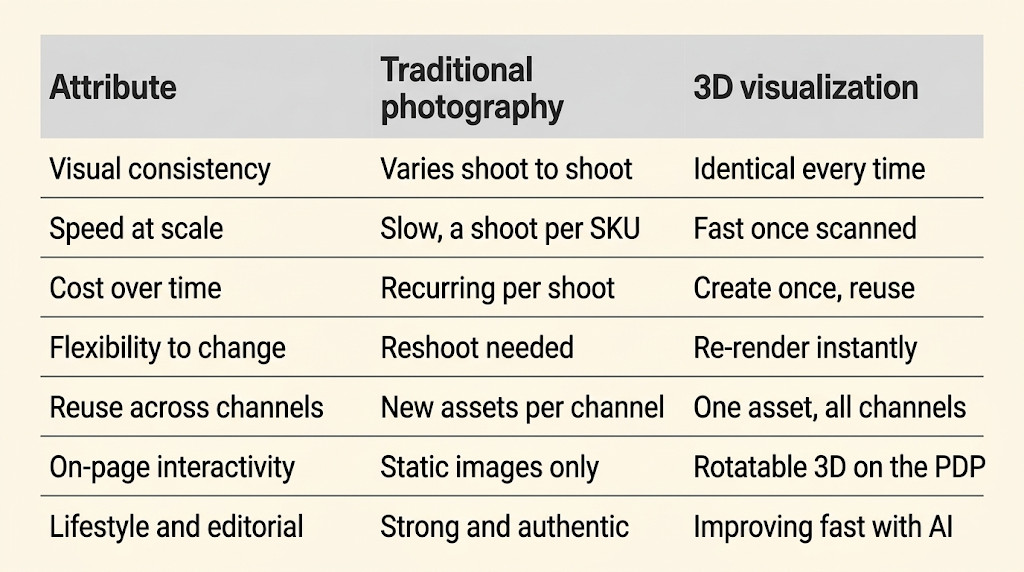
3D Visualization vs Traditional Photography: A Quick Comparison
Here’s where 3D wins. After that, an honest look at where photography still holds up.
Consistency Across the Whole Catalog
Photography drifts. Lighting, scale, and background shift between shoots and photographers.
3D renders from a fixed template. Every product sits at the same angle, scale, and light.
On a collection page, that uniformity reads as quality. The grid looks designed, not assembled.
Shoppers feel it even if they cannot name it. A clean, even grid builds trust in the brand.
Speed and Scale
A shoot moves one product at a time. Scanning front-loads the work, then output is near-instant.
Once a product is a 3D model, a hundred new images are a render job, not a hundred bookings.
That is how brands digitize whole seasons in weeks instead of months.
Speed changes what you can launch. New products reach the page without waiting on a studio slot.
Cost Over Time
Photography is a recurring cost. You pay again for every shoot, every season, every reshoot.
3D front-loads the spend into the scan. After that, each new image costs a fraction of a shoot.
The math flips with volume. The bigger the catalog, the more 3D saves.
Reshoots are the hidden tax photography carries. With 3D, fixing an asset is an edit, not a bill.
Flexibility to Iterate
Want a new angle, a seasonal background, or a color test? With photography, that means a reshoot.
With 3D, you re-render. Change the scene in software and export a new set in minutes.
That speed lets you test creative without a studio, then roll out what works.
It also kills the sample bottleneck. You do not need the physical product in hand to make the change.
One Asset Across Every Channel
A photo is made for one use. New channels often need new shoots.
A 3D asset feeds them all: product pages, ads, email, and social draw from the same model.
That consistency carries across channels too. Your ad and your PDP finally show the same product.
That reuse is why 3D pays off beyond the PDP. One source, many outputs.
Interactivity on the Product Page
A photo is static. The shopper looks, but cannot explore. A 3D viewer lets them rotate the product and zoom into the stitching and texture.
That hands-on feel answers questions a flat image leaves open. Photography cannot do that.
More time spent exploring usually means more intent. A shopper who inspects a product is closer to buying.
Where Traditional Product Photography Still Wins
3D is not the answer to everything. We need to be honest about where photography still leads.
For a small catalog, the setup cost of 3D may not pay back. A quick shoot can be simpler. Likewise, if you launch a dozen products a year, photography may be all you need. Scale is what tips the balance.
Editorial content is the other case. The spontaneity of a real place and real light adds something a rendered scene can miss. Lifestyle campaigns lean on that human feel. A real model in a real moment still carries weight. It can also carry a story that a render will not. Place, mood, and a human subject matter.
That gap is closing fast, though. AI imagery built on 3D-scanned assets now puts accurate products into lifelike scenes.
In summary: Photography owns authentic, one-off moments. 3D owns everything you need at scale.
Product Categories Where 3D Visualization Works Best
3D pays off most where products are detailed, numerous, and hard to shoot well. That points to a clear set.
- Footwear. High SKU counts, tricky materials, and constant new seasons. 3D holds quality across the whole range.
- Bags and luggage. Shape and scale matter, and hard surfaces catch light badly on camera. 3D controls both.
- Headwear and hats. Fine texture and form that a flat photo flattens. Renders keep the detail consistent.
- Gloves and accessories. Small, detailed items shot in huge numbers. 3D removes the per-item shoot.
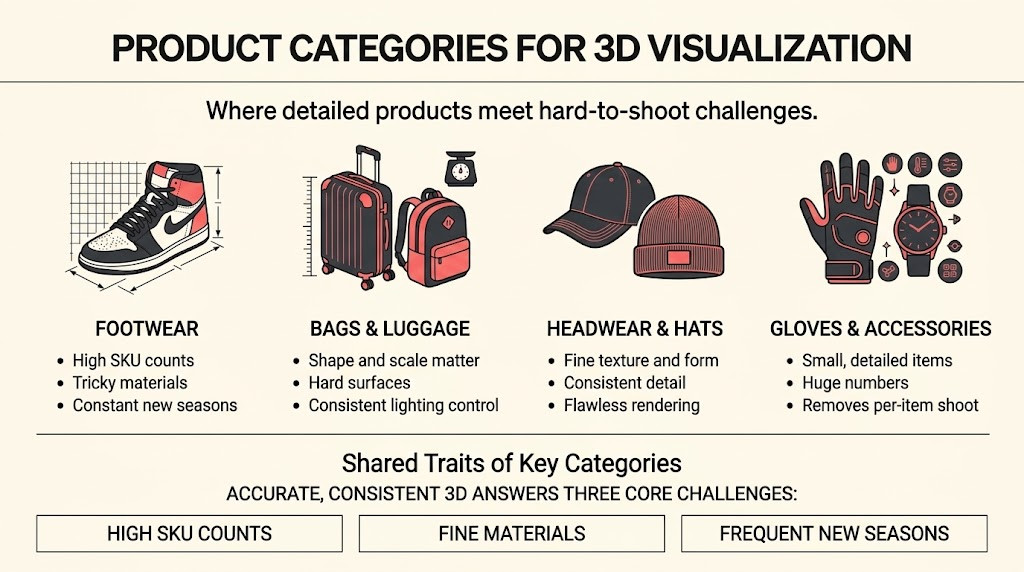
The thread is simple. Products worn or carried on the body gain the most from accurate, consistent 3D. These categories share three traits: i) High SKU counts, ii) fine materials, and iii) frequent new seasons. 3D answers all three.
If your category is not obvious, it can still work. All you need is a provider who believes in your vision.
3D Visualization Ecommerce Examples in Real Life
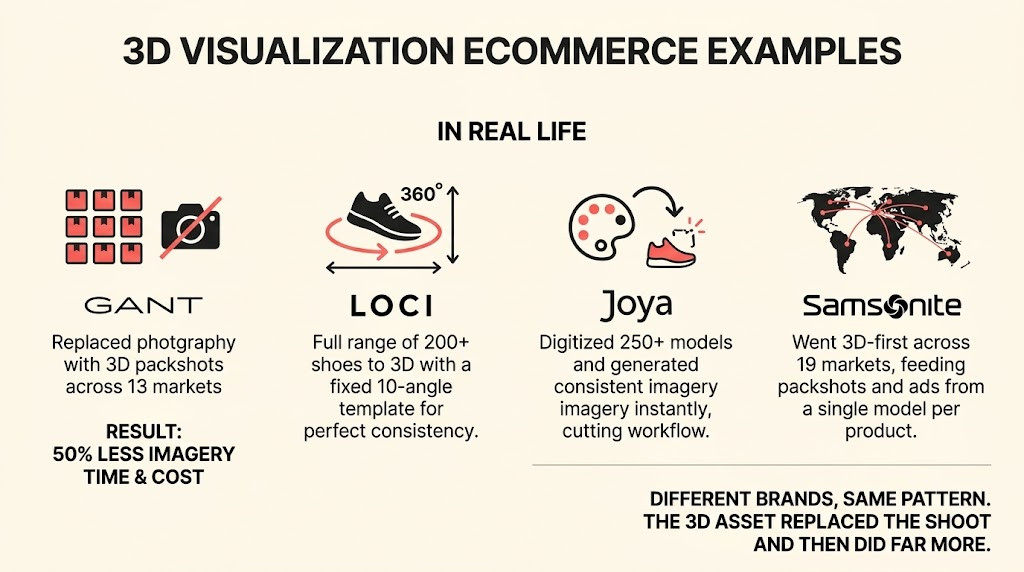
3D product visualization is not just limited to theory. Brands already run their product pages on 3D visualization:
i) GANT replaced photography with 3D packshots and 3D-first pages across 13 markets. Result: 50% less imagery time and cost, and a 6.3% conversion lift. See GANT's journey.
ii) LOCI moved its full range of 200-plus shoes to 3D, using a fixed 10-angle template for perfect consistency. See LOCI's story.
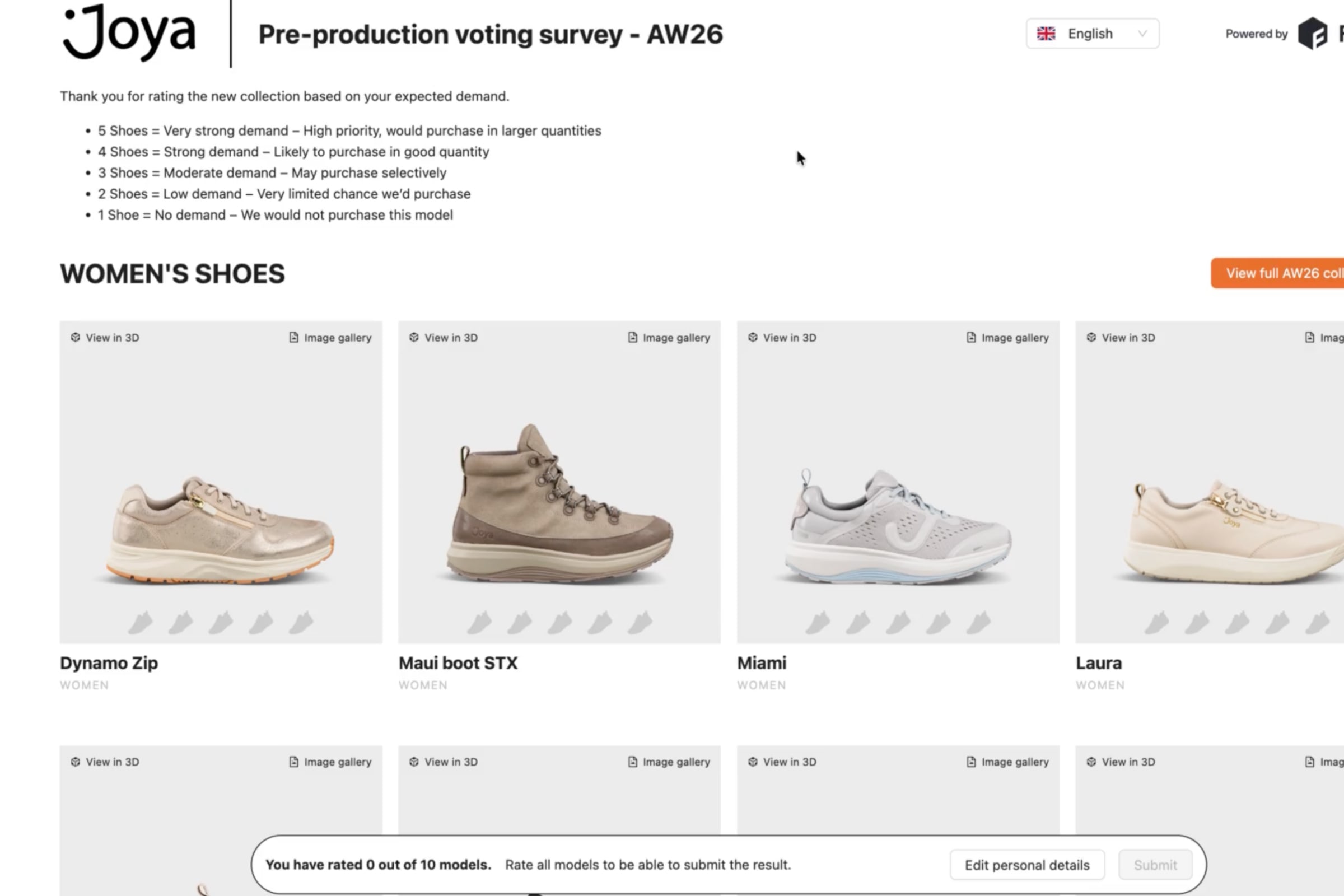
iii) Joya digitized 250-plus models and generated consistent imagery instantly, cutting its photography workflow. See Joya's journey.
iv) Samsonite went 3D-first across 19 markets, feeding packshots and ads from a single model per product. See Samsonite's experience.
Different brands, same pattern. The 3D asset replaced the shoot and then did far more.
How Fibbl Can Help You With 3D Visualization
Fibbl turns real products into accurate 3D visuals for your product pages.
We scan the product with proprietary hardware. One model then renders packshots, lifestyle images, and an interactive 3D view.
Our infra is built for catalogs, not demos. The pipeline scales from a few hero products to thousands of SKUs.
The quality comes from the scan. Real geometry and true color mean the render looks like the product, not a guess.
Footwear and bags were the start. Fibbl now covers more of what people wear and carry:
You do not have to convert everything at once. Start with a pilot and compare it against your photos.
Begin with a free product scan, or book a demo to see your own product in 3D.
Frequently Asked Questions
Can 3D visualization really replace photography for every product?
For most catalog imagery, yes. 3D matches photography on realism and beats it on consistency and scale. Still, do not switch without a proof of concept. Pilot a handful of products, compare them side by side, and decide category by category.
How fast can you convert a whole catalog to 3D?
Faster than most expect. GANT converted 549 shoes into 3D in just 18 days. Once the pipeline is set, adding products becomes a repeatable process, not a fresh project each time. The first batch is the slowest, and each one after moves quicker.
Does a 3D render look as real as a photo?
Done well, shoppers cannot tell the difference. The realism comes from the scan. Accurate geometry and true color make leather, mesh, and rubber look right. A poor scan shows, so the input quality matters most.
Will 3D visualization hurt my page speed or SEO?
No, if it is built right. Rendered images load like any other image. The optional 3D viewer is lightweight and loads on demand. You keep clean, fast product pages and gain richer visuals.
What happens to 3D assets when a product changes color or material?
You re-render; you do not reshoot. The 3D model already holds the shape. Swapping a color or material is a software change, so new variants are ready in minutes, not another studio booking.